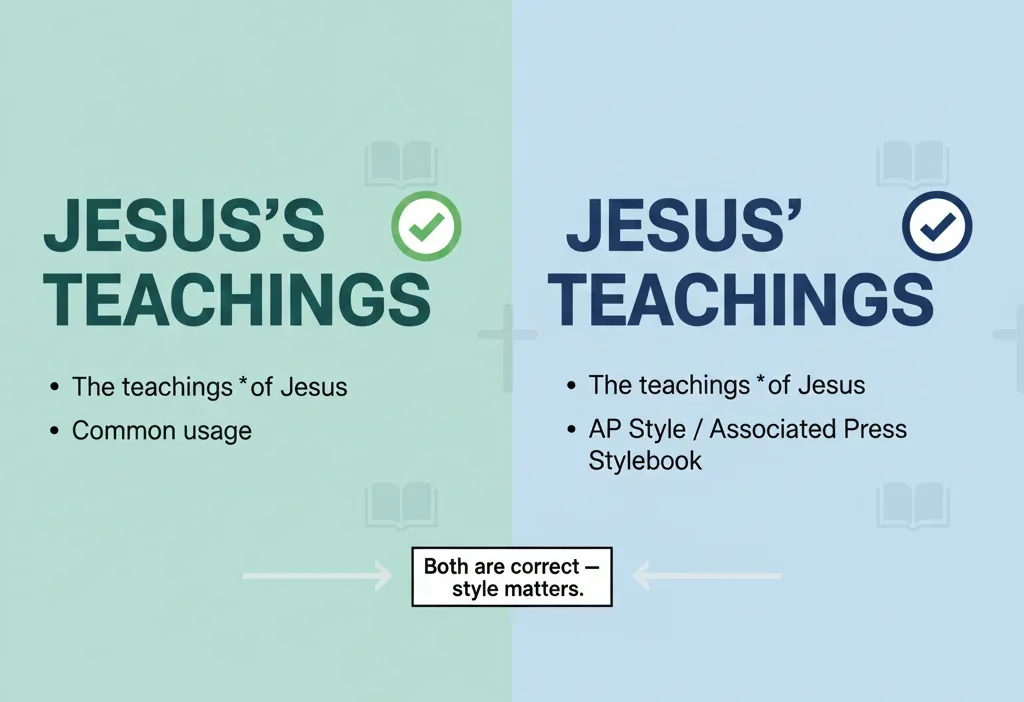
Both Jesus’ and Jesus’s can be correct — it depends on the grammar style you follow.
👉 Modern grammar guides prefer Jesus’s for clarity.
👉 Some traditional or religious writing uses Jesus’.
This guide will make it very easy to understand when and why each form is used — even if you’re a beginner.
Many people get confused when writing the possessive form of the name Jesus. Should it be Jesus’ or Jesus’s? You might see both forms in books, websites, church materials, and school writing. That’s why this topic confuses students, writers, and even teachers.
The problem happens because Jesus ends with the letter “s”, and English has different rules for showing possession with such words. Some style guides say one thing, while others say something slightly different.
In this complete and beginner-friendly guide, you will learn:
- The meaning of Jesus’ and Jesus’s
- The key difference between Jesus’ and Jesus’s
- Correct usage rules with simple examples
- Common mistakes and how to avoid them
By the end, you’ll feel confident using the correct form in writing, exams, blogs, and daily English.
What Does Each Word Mean?
What Does Jesus’s Mean?
Jesus’s shows ownership or possession.
It means something belongs to Jesus.
🔹 Part of speech: Possessive noun
Easy examples:
- Jesus’s teachings changed many lives.
- People follow Jesus’s message of love.
- Jesus’s disciples traveled far.
📖 Think of it like this:
If we say Ali’s book, we also say Jesus’s message.
What Does Jesus’ Mean?
Jesus’ also shows ownership or possession.
The meaning is the same as Jesus’s.
🔹 Part of speech: Possessive noun
Easy examples:
- Jesus’ teachings inspire millions.
- Many people read about Jesus’ life.
- Jesus’ miracles are well known.
🧠 Important note:
The meaning does not change. Only the writing style changes.
The Key Difference Between Jesus’ or Jesus’s
The real difference is grammar style, not meaning.
| Point | Jesus’s | Jesus’ |
|---|---|---|
| Meaning | Shows ownership | Shows ownership |
| Spoken English | Extra “iz” sound | Often sounds the same |
| Modern grammar | ✅ Preferred | ⚠️ Less common |
| Traditional usage | ❌ Rare | ✅ Common |
| Example | Jesus’s teachings | Jesus’ teachings |
⭐ Quick Tip to Remember
👉 If you say the extra sound when speaking, write Jesus’s.
👉 If you follow older religious style, write Jesus’.
Winter Spring Summer or Fall Trailer Hidden Meaning Revealed
Why Are People Confused?
People mix up Jesus’ or Jesus’s because:
- The name ends in -s
- Different grammar books teach different rules
- Religious writing often follows old traditions
- Teachers and websites don’t always agree
This makes Jesus’ or Jesus’s one of the most common grammar questions in English.
Common Mistakes and How to Avoid Them
❌ Mistake 1: Thinking One Form Is Always Wrong
Wrong idea: Only Jesus’ is correct.
Truth: Both can be correct.
✅ Correct:
- Jesus’s words guide us.
- Jesus’ words guide us.
❌ Mistake 2: Mixing Styles in One Article
Switching between Jesus’ and Jesus’s in the same writing looks confusing.
✅ Fix:
- Choose one style and stay consistent.
❌ Mistake 3: Forgetting It Shows Possession
Some learners write:
- ❌ Jesus teaching was kind.
✅ Correct:
- Jesus’s teaching was kind.
or - Jesus’ teaching was kind.
When to Use Jesus’s
Use Jesus’s when:
- Writing modern English
- Following school grammar rules
- Writing blogs, essays, or SEO articles
- You pronounce the extra “iz” sound
Real-Life Examples:
- Jesus’s message teaches kindness.
- Teachers explain Jesus’s parables.
- Many books explore Jesus’s life.
- Children learn about Jesus’s love.
- This lesson explains Jesus’s teachings.
🧠 Memory Hack:
👉 If you would write Chris’s, write Jesus’s.
When to Use Jesus’
Use Jesus’ when:
- Writing religious texts
- Following older grammar traditions
- Matching Bible or church style writing
- Your style guide prefers it
Simple Examples:
- Jesus’ disciples followed him.
- People study Jesus’ miracles.
- Churches teach Jesus’ words.
- Jesus’ sacrifice is remembered.
🧠 Visual Trick:
👉 Imagine the apostrophe standing quietly at the end — old style, traditional writing.
Quick Recap: Jesus’ vs Jesus’s
- ✅ Both are grammatically correct
- 🔹 Both mean something belongs to Jesus
- ✍️ Jesus’s = modern, clear, common
- 📜 Jesus’ = traditional, religious style
- 📌 Choose one style and stay consistent
Advanced Tips (Optional)
Origin & Grammar Rule
In English, most singular nouns (even ending in s) add ’s:
- James’s car
- Chris’s bag
So Jesus’s follows the same rule.
In Exams & Formal Writing
- Teachers usually prefer Jesus’s
- Modern style guides support Jesus’s
Online & SEO Writing
Using Jesus’s improves clarity for readers and search engines.
Mini Quiz: Test Your Understanding
Fill in the blanks:
- ______ teachings focus on love.
- Many follow ______ message.
- This book explains ______ parables.
- People respect ______ sacrifice.
- We discussed ______ life in class.
✅ Answers: Jesus’s or Jesus’ (both can work if consistent)
(FAQs)
1. Is Jesus’s grammatically correct?
Yes. Jesus’s is correct and preferred in modern English.
2. Is Jesus’ wrong?
No. It is correct in traditional or religious writing.
3. Which should I use in exams?
Use Jesus’s unless told otherwise.
4. Why do style guides disagree?
English evolved over time. Old and modern rules coexist.
5. Which is better for SEO writing?
Jesus’s is clearer and more reader-friendly.
Conclusion
Understanding the difference between Jesus’ or Jesus’s is easier than it seems. Both forms are correct and mean the same thing — showing possession. The main difference is writing style, not grammar meaning. Modern English prefers Jesus’s, while traditional religious writing often uses Jesus’.
The key is consistency. Choose one form and use it the same way throughout your writing. With practice, this once-confusing rule will feel simple and natural. Keep learning, keep practicing, and your English will improve every day — one small rule at a time 🌟

Jenn Ashworth offers clear, engaging explanations of language and usage, helping readers grasp meanings, nuances, and differences with accuracy and ease.