Ever wondered why Americans write “labeling” while Brits prefer “labelling”? Here’s the simple explanation! Both spellings mean the same thing—attaching a label or identifying something—but the choice depends on the region.
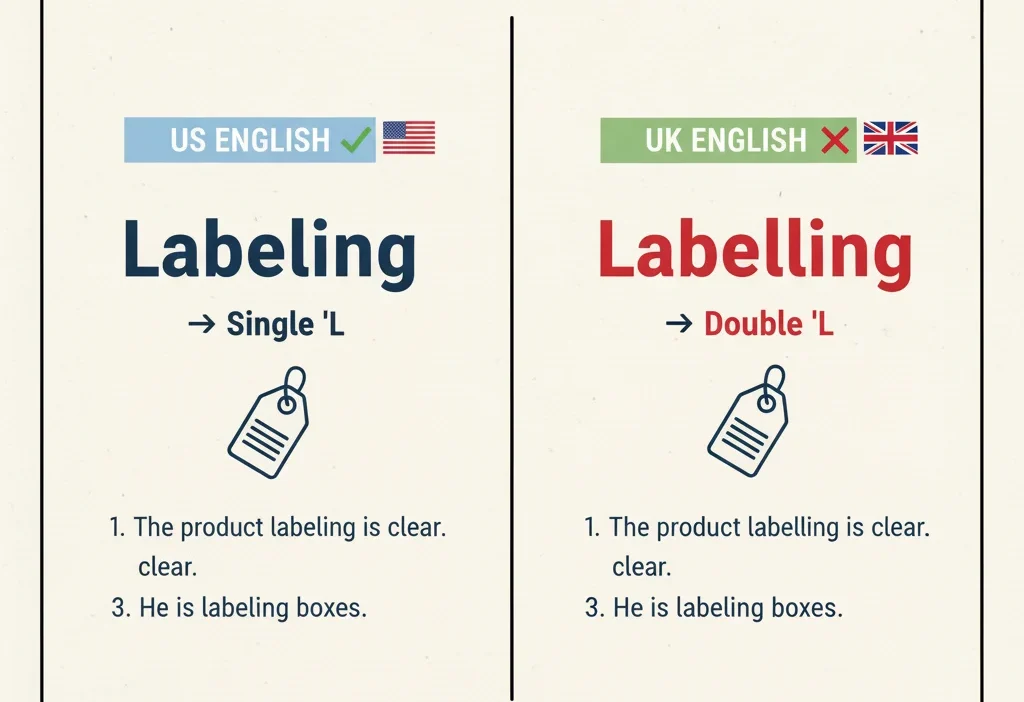
Labeling is the standard in American English, while Labelling is preferred in British English. Both are correct, and the meaning does not change; the difference is purely stylistic. For example, an American company might write, “Labeling products correctly is important”, while a British textbook might say, “Labelling the samples carefully is crucial”.
In everyday life, you might also see: “Labeling your emails helps organize your inbox” or “Labelling your folders keeps documents neat”. Understanding which version to use ensures your writing is accurate and professional. If you want to write correctly and sound natural in either British or American English, knowing labeling vs labelling is essential.
“Labeling (US) and labelling (UK) mean the same thing; use the one that fits your audience.”
🧩 What Does Each Word Mean?
Both labeling and labelling come from the root word “label”, which means to tag or identify something with a name, mark, or category.
However, the spelling difference between them depends on where you are in the world — American English vs British English.
✴️ “Labeling” — American English Spelling
Labeling (with one “l”) is the standard spelling in American English.
It’s the form you’ll find in the U.S., Canada (often), and in most international companies that follow American grammar style.
Meaning:
“Labeling” means the act of attaching a label, name, or tag to something — physically or figuratively.
Part of speech: Verb (present participle of label) or noun (the act of giving labels).
Examples:
- The teacher is labeling each student’s notebook.
- Food companies must follow strict labeling laws.
- Stop labeling people before you know them.
✴️ “Labelling” — British English Spelling
Labelling (with double “l”) is the correct form in British English, as well as in countries like the UK, Australia, New Zealand, and India.
Meaning:
It means exactly the same thing — marking or naming something with a label.
Part of speech: Verb or noun, same as “labeling.”
Examples:
- The school is labelling all its science equipment.
- British law requires proper labelling on cosmetics.
- She’s tired of people labelling her unfairly.
🧠 Fun Tip:
Think of British English as a bit “extra” — it often keeps double letters like travelling, cancelling, and labelling!
⚖️ The Key Difference Between “Labeling” and “Labelling”
The only difference is spelling, not meaning.
Both words are correct — but they follow different English language rules.
Here’s a quick visual comparison:
| Feature | Labeling | Labelling |
|---|---|---|
| Language Style | American English | British English |
| Number of L’s | One “L” | Two “L’s” |
| Meaning | The act of putting labels | The same meaning |
| Example | The product labeling is clear. | The product labelling is clear. |
| Usage Region | USA, Canada | UK, Australia, India |
✅ Quick Tip to Remember:
If you write color, favorite, or organize (American style), use labeling.
If you write colour, favourite, or organise (British style), use labelling.
🚫 Common Mistakes and How to Avoid Them
Let’s look at some common mix-ups people make when using these two spellings.
❌ Mistake 1:
The British company is labeling its products correctly.
✅ Correction:
The British company is labelling its products correctly.
Why?
British English uses double “l” after short vowels when adding “-ing” or “-ed.”
❌ Mistake 2:
The American teacher was labelling the books.
✅ Correction:
The American teacher was labeling the books.
Why?
American English simplifies the double letters — “labeling,” “traveling,” “canceled.”
220+ Humor vs Humour 😂 Meaning, Examples 2025
💡 Grammar Tip:
Always match your spelling to the form of English you’re writing in — either American or British — and stay consistent throughout your text.
🔠 Label vs. Lable: Which Spelling is Correct?
Many people misspell the word “label” as “lable”. Here’s the clear difference:
- ✅ Correct Spelling: Label (ends with -el)
- ❌ Incorrect Spelling: Lable (ends with -le)
Why the Confusion?
Words like table, cable, and stable end with “-le”, so people often mistakenly write “lable”. But “label” always ends with “-el”.
How to Remember:
Think: “Put the LABEL on the TABLE.”
Both words end differently — label (-el) and table (-le).
Examples in Sentences:
- ✅ Please label the jar before storing it.
- ❌ Please lable the jar before storing it.
- ✅ The label came off the bottle.
- ❌ The lable came off the bottle.
Note: Once you spell “label” correctly, you can then choose between labeling (US) and labelling (UK).
UK Spelling: “Lable” or “Label”?
“Label” (spelt L-A-B-E-L) is the only correct spelling for the base word in both British and American English. The misspelling “lable” (L-A-B-L-E) is always incorrect, regardless of whether you’re writing in the UK or US.
In UK English, the difference appears when adding endings:
- ✅ label (base word)
- ✅ labelling (with double ‘l’)
- ✅ labelled (with double ‘l’)
“❌ Lable or Label – Which is Correct?”
User’s Intent: The user is confused between the common misspelling “lable” and the correct spelling “label”. They want a clear, direct answer.
Best Suitable Answer:
✅ Correct: Label
❌ Incorrect: Lable
The correct spelling is always label (ending with -el), not lable (ending with *-le*). This is one of the most frequent spelling mistakes in English because many words end with “-le” (like table, cable, stable), but “label” is an exception.
Why do people misspell it as “lable”?
It’s a classic case of letter swapping. The brain expects the common “-le” ending and mistakenly writes “lable” instead of “label.”
How to remember the correct spelling:
Think: “I will put the LABEL on the TABLE.”
Both words share the “-el” and “-le” pattern correctly—you don’t write “labl” or “tabl.”
Examples in sentences:
- ✅ Please label your luggage before traveling.
- ❌ Please lable your luggage before traveling.
- ✅ The label on this jar is missing.
- ❌ The lable on this jar is missing.
🇺🇸 When to Use “Labeling”
Use labeling when:
- You are following American English writing style.
- You’re writing for U.S. readers, schools, or companies.
- You’re writing in scientific, corporate, or business documents in the U.S.
Examples:
- The labeling on these bottles meets FDA standards.
- They are labeling files before the audit.
- Improper labeling can lead to confusion.
- The labeling system helps keep the lab organized.
- Avoid labeling students based on their grades.
🧠 Memory Hack:
Think “USA” = “one L.” Both have three letters, and both are shorter!
🔠 Label vs. Lable: Which Spelling is Correct?
If you’re searching for the correct spelling of “label or lable,” the answer is clear:
- ✅ Correct: Label (ends with -el)
- ❌ Incorrect: Lable (ends with -le)
The word is always spelled L-A-B-E-L.
Why Do People Get Confused?
The confusion is understandable! Many common English words end with the letters “-le“:
- table, stable, cable, fable, able
Because of this pattern, people often mistakenly write “lable.” However, “label” comes from Old French and has always kept its “-el” ending.
How to Remember Forever:
Use this simple memory trick:
Think of the phrase: “Put the LABEL on the TABLE.”
Notice the endings: LAB-EL and TA-BLE. You wouldn’t write “tabl” or “labl.”
Examples in Sentences:
- Please label all your belongings before camp. (Correct)
- The label on this jar is torn. (Correct)
- The lable on this jar is torn. (Incorrect)
- Did you lable the folders? (Incorrect)
Quick Tip: If you remember that “label” is the correct spelling for the noun and verb, you’ll automatically know how to spell labeling/labelling and labeled/labelled correctly for your chosen dialect.
🇬🇧 When to Use “Labelling”
Use labelling when:
- You are writing in British English.
- You’re publishing for audiences in the UK, Australia, or similar regions.
- You’re using other British spellings like favourite, colour, and travelling.
Examples:
- The labelling on medicines must follow EU regulations.
- The school is labelling supplies for the new term.
- Incorrect labelling can cause health risks.
- The new teacher is labelling classroom folders.
- Labelling clothes helps children keep track of their belongings.
🎯 Memory Hack:
Double the “L” for “London.”
If your writing sounds British — double the fun, double the L!
🔁 Quick Recap: Labeling vs Labelling
Here’s a short summary to keep it simple:
- Labeling → American English ✅
- Labelling → British English ✅
- Meaning: Both mean naming, marking, or tagging something.
- Use: Match your spelling style to your audience.
- Rule: American English drops one “L” in verbs ending with a vowel + single consonant before adding “-ing.”
In short:
🇺🇸 USA → “Labeling”
🇬🇧 UK → “Labelling”
🧠 Advanced Tips (For Curious Learners)
📜 Word Origin
The word label comes from the Old French “label” or “lambel,” meaning a small strip or tag.
As English evolved, spelling differences appeared between regions — hence “labelling” vs “labeling.”
🏫 Academic Writing Tip
If you’re writing essays for British universities, use labelling.
If your paper follows APA or Chicago style (mostly American), use labeling.
💬 Modern Context
In online writing, many international websites prefer labeling because American English dominates digital communication.
However, publishers and schools in Commonwealth countries still stick to labelling.
⚠️ Be Consistent
Don’t mix both spellings in one piece.
Pick one (based on your target readers) and stay consistent throughout your writing.
✏️ Mini Quiz: Test Your Understanding
Fill in the blanks with the correct form — labeling or labelling.
- The new teacher is __________ each student’s desk.
- British shops must follow new food __________ laws.
- In the U.S., clear __________ is required for medicines.
- He spent the morning __________ all the boxes.
- The brand got in trouble for false __________ on its products.
- I don’t like people __________ others unfairly.
- The company’s __________ system helps avoid confusion.
(Answers: 1. labelling, 2. labelling, 3. labeling, 4. labeling, 5. labeling, 6. labelling, 7. labeling — depending on the English version you use.)
❓ (FAQs)
1. Is “labelling” wrong?
No! “Labelling” is 100% correct in British English. It’s just the regional spelling difference.
2. Why do Americans use only one “L” in “labeling”?
Because American English simplified double consonants after vowels — the same happens with “traveling,” “canceled,” and “modeled.”
3. Should I use “labelling” in academic writing?
If you’re writing for a British or Australian university, yes. Otherwise, use labeling for American contexts.
4. Are “labeling” and “labelling” pronounced differently?
No — both are pronounced exactly the same: /ˈleɪbəlɪŋ/.
5. Can I use both spellings in one document?
It’s best not to. Choose one based on your audience and region for a professional, consistent tone.
Q6: What’s another word for “labeling someone”?
A: When used figuratively, “labeling someone” means to categorize, stereotype, or judge them—often unfairly. Common synonyms include:
- Categorizing
- Stereotyping
- Pigeonholing
- Typecasting
- Branding
- Tagging
- Characterizing
💡 Example: Instead of labeling someone as lazy, try to understand their situation.
🏁 Conclusion
So, what did we learn?
Both labeling and labelling mean the same thing — writing or attaching a tag or name to something.
The only difference is where you’re writing from:
- Use labeling for American English 🇺🇸
- Use labelling for British English 🇬🇧
It’s a tiny spelling change, but it helps your writing look polished and regionally correct.
Keep practicing, notice patterns in other words (like traveling vs travelling), and soon, these will feel natural.
Every small detail you learn improves your English — one word at a time. 🌟

Gwendoline Riley delivers clear, compelling insights into language and usage, helping readers understand meanings, nuances, and differences with confidence.