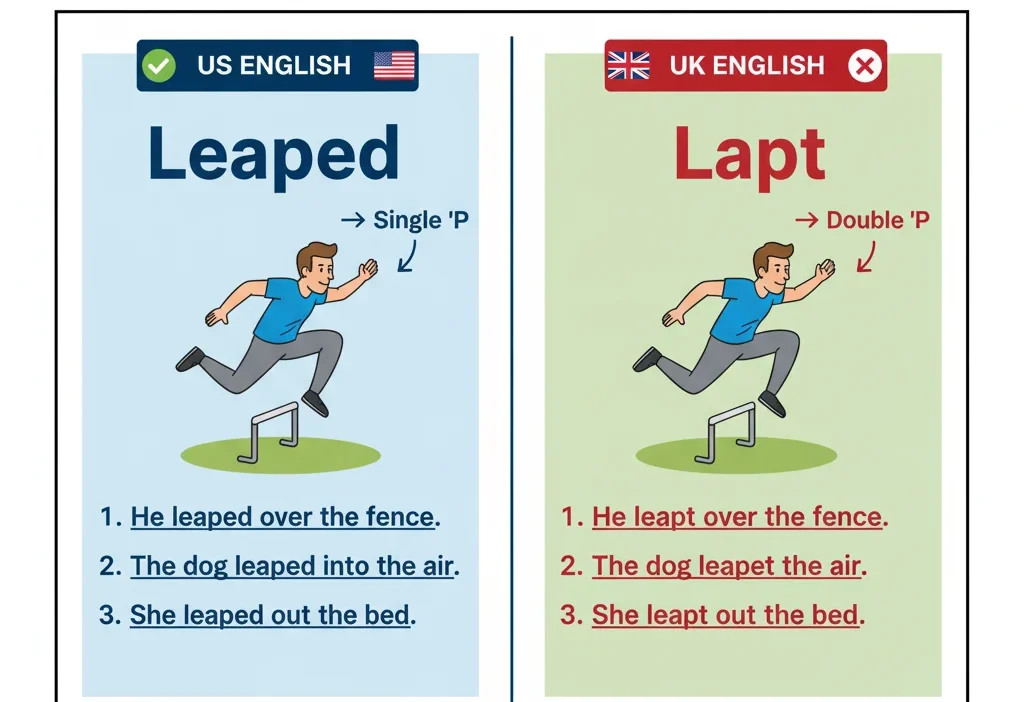
Confused between ‘leaped’ and ‘leapt’? Learn which one sounds right in American vs British English! Both words are past tense forms of the verb leap, meaning to jump or spring. The difference lies in regional usage and style.
Leaped is more common in American English, while Leapt is preferred in British English. Both are correct, and the meaning does not change. For example, an American sentence might read, “She leaped over the puddle” or “He leaped at the opportunity”, while a British sentence could say, “She leapt over the puddle” or “He leapt into action immediately”.
Using the correct form ensures your writing sounds natural and polished depending on your audience. If you want to write accurately and confidently in either American or British English, understanding leaped vs leapt is essential.
“Leaped (US) and leapt (UK) are both correct past tense forms of ‘leap’; use the one that fits your audience.”
What Does Each Word Mean?
1. Leaped – The American Favorite 🇺🇸
Leaped is the past tense and past participle of the verb “leap”, which means to jump or spring forward with force or excitement.
It’s mostly used in American English.
Part of speech: Verb (past tense, past participle)
Simple Examples:
- The cat leaped onto the table.
- He leaped with joy when he heard the good news.
- The frog leaped across the pond.
👉 Think of “leaped” as the smooth, modern version used in U.S. writing, books, and schools.
2. Leapt – The British Classic 🇬🇧
Leapt means the same thing as leaped, but it’s the British English version.
You’ll often see it in books, stories, and newspapers from the U.K., Australia, or Canada.
Part of speech: Verb (past tense, past participle)
Simple Examples:
- She leapt over the puddle.
- The knight leapt onto his horse.
- The students leapt with excitement when school ended.
👉 “Leapt” sounds a bit older or more poetic — perfect for storytelling or formal writing.
🆚 The Key Difference Between Leaped and Leapt
| Feature | Leaped | Leapt |
|---|---|---|
| Meaning | Jumped or sprang forward | Jumped or sprang forward |
| Used In | American English | British English |
| Pronunciation | “Leepd” /liːpt/ | “Lept” /lɛpt/ |
| Tone | Modern, casual | Traditional, literary |
| Example Sentence | He leaped over the chair. | He leapt over the chair. |
✅ Quick Tip to Remember:
If you use color instead of colour, go with leaped.
If you prefer colour and favourite, use leapt.
Both are correct — it just depends on your English style (American or British).
⚠️ Common Mistakes and How to Avoid Them
❌ Mistake 1: Mixing Tenses
Wrong: He leap over the wall yesterday.
Correct: He leaped (or leapt) over the wall yesterday.
👉 Remember: “Leap” is present tense; “leaped/leapt” are past tense.
❌ Mistake 2: Using Both Forms in One Sentence
Wrong: She leaped and leapt quickly away.
Correct: She leaped quickly away. (Or “leapt” — choose one form and stick with it!)
❌ Mistake 3: Thinking One is Wrong
Many learners think one form is incorrect — but both are perfectly right.
It’s all about which English you’re following.
🕒 When to Use Leaped
Use leaped if you write or speak American English — like people in the U.S. or Canada.
It fits modern writing, newspapers, blogs, and everyday conversation.
Examples:
- The dog leaped to catch the ball.
- She leaped into action when she heard the alarm.
- He leaped from his chair in excitement.
- The child leaped over the small stream.
- The dancer leaped gracefully across the stage.
📘 Memory Trick:
“Leaped” = Leaped like in “swept” → both sound snappy and modern.
🇬🇧 When to Use Leapt
Use leapt in British English, Australian English, or literary writing.
It gives your sentence an old-fashioned or elegant tone.
Examples:
- The cat leapt silently through the window.
- She leapt from joy when she saw her results.
- The horse leapt over the fence.
- The hero leapt into battle bravely.
- The boy leapt from rock to rock along the river.
💡 Memory Hack:
“Leapt” sounds like “slept” — both are old, short, and British-sounding!
🧠 Quick Recap: Leaped vs Leapt
- Both mean “jumped” or “sprang forward.”
- Leaped = American English 🇺🇸
- Leapt = British English 🇬🇧
- Both are grammatically correct.
- Choose one version and stay consistent in your writing.
📚 Advanced Tips
- Origin: Both forms come from the Old English word hlēapan, meaning to jump or run quickly.
- In Modern Writing:
- American writers prefer leaped.
- British writers prefer leapt.
- In Poetry and Literature:
- Leapt often sounds more rhythmic or dramatic:
“She leapt into the unknown.”
- Leapt often sounds more rhythmic or dramatic:
- In Exams or Essays:
- Stick with one English style throughout (don’t mix color and colour, or leaped and leapt).
📝 Mini Quiz — Test Your Understanding!
Fill in the blanks with leaped or leapt:
- The rabbit _______ into the bush.
- She _______ across the puddle to keep her shoes dry.
- He _______ from his chair when the bell rang.
- The dancer _______ into the air beautifully.
- They _______ over the stream while hiking.
(Answers: 1. leapt, 2. leapt, 3. leaped, 4. leaped, 5. leapt — both forms are correct!**)
❓ FAQs About Leaped vs Leapt
1. What is the past tense of “leap”?
The past tense (and past participle) of “leap” is leaped or leapt. Both are correct and identical in meaning.
2. Is “leaped” a real word? / Is it “leaped” or “lept”?
Yes, “leaped” is a correct and standard word in American English. “Lept” is a common misspelling and is not accepted in standard English.
3. How do you spell “leapt”? / Define “leapt”.
The correct spelling is L-E-A-P-T. It is the British English past tense of “leap,” meaning “jumped.” Remember: leap + t = leapt.
4. When should I use “leaped” vs. “leapt”?
Use “leaped” for American English and “leapt” for British English. The key is to stay consistent in your writing.
5. Can I use “leaped” in British writing?
Yes, but it may sound modern or American. “Leapt” is the traditional British form.
6. Is “leapt” older than “leaped”?
Yes, “leapt” is the older form from Old English, while “leaped” developed later.
7. What’s the pronunciation difference?
- Leaped: sounds like “leepd” (/liːpt/)
- Leapt: rhymes with “slept” (/lɛpt/)
8. Is “leapt” present tense?
No. “Leapt” is past tense. The present tense is “leap.” (Example: Today I leap, yesterday I leapt.)
9. Are “leaped” and “leapt” words spelled the same but pronounced differently?
No, they are spelled differently but mean the same. They are regional variants, not homographs.
10. What about “dived” and “dove”? Is it like “leaped/leapt”?
Similar, but not the same. Both “dived” and “dove” are correct, but “dove” is preferred in American English and “dived” in British English.
🏁 Conclusion
So now you know — “leaped” and “leapt” both mean the same thing, but their use depends on where you are and your English style. 🌍
If you’re writing for an American audience, use leaped.
If your audience is British, use leapt. The key is consistency — choose one and stick with it. Keep practicing, and soon choosing the right word will feel as easy as… a leap of joy! 💫

Jenn Ashworth offers clear, engaging explanations of language and usage, helping readers grasp meanings, nuances, and differences with accuracy and ease.