Have you ever seen the symbol ≤ and wondered what it really means? You’re not alone! Many students and even adults mix up “less than” (<) and “less than or equal to” (≤). They look similar, but there’s a small — yet important — difference between them.
In this simple guide, you’ll learn:
✅ What less than and less than or equal to mean
✅ How they’re different (with examples)
✅ How to use them correctly in math and everyday language
By the end, you’ll never confuse these two again. Let’s make this super easy — even a 4th grader can understand it! 🌟
What Does Each Term Mean?
1. “Less Than” (<) — Meaning and Examples
The symbol < means smaller than or less than.
It’s used when one number is smaller than another.
Examples:
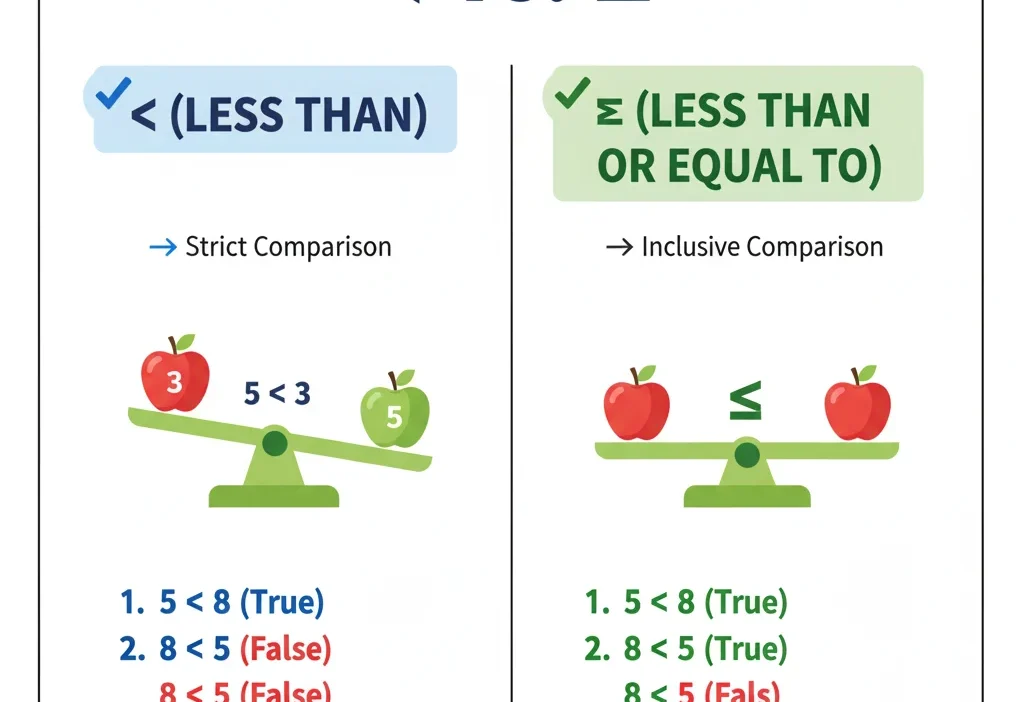
- 5 < 8 → “5 is less than 8.”
- 12 < 20 → “12 is smaller than 20.”
- The number of apples (3) is less than the number of oranges (5). 🍎🍊
So, whenever you compare two numbers and the first one is smaller, use < (less than).
2. “Less Than or Equal To” (≤) — Meaning and Examples
The symbol ≤ means less than or equal to.
It’s used when something is smaller or exactly equal to another number.
Examples:
- 5 ≤ 8 → “5 is less than or equal to 8.”
- 8 ≤ 8 → “8 is equal to 8.”
- You can take at most 10 candies, which means candies ≤ 10. 🍬
💡 Tip: Think of “less than or equal to” as having two parts:
- Less than (<)
- Equal to (=)
So, ≤ means both together!
The Key Difference Between “Less Than” and “Less Than or Equal To”
Here’s a simple comparison to help you remember ⬇️
| Term | Symbol | Meaning | Example | Sentence |
|---|---|---|---|---|
| Less Than | < | Smaller only | 6 < 10 | 6 is smaller than 10. |
| Less Than or Equal To | ≤ | Smaller or equal | 10 ≤ 10 | 10 is equal to or less than 10. |
✅ Quick Tip to Remember:
If there’s a line under the less-than sign (≤), it means “equal to” is included too!
So,
- “<” = only smaller
- “≤” = smaller or the same
Common Mistakes and How to Avoid Them
Let’s look at some common mix-ups 👇
| ❌ Wrong | ✅ Correct | 💬 Why |
|---|---|---|
| 5 < 5 | 5 ≤ 5 | Because 5 is not less than 5 — it’s equal to 5. |
| x < 10 (when x can also be 10) | x ≤ 10 | If 10 is allowed, you must use ≤. |
| “Less than or equal to 10” written as “<10” | ≤ 10 | Use the correct symbol to include equality. |
💡 Fix It Fast:
Whenever equality is possible, use ≤ instead of <.
When to Use “Less Than” (<)
Use less than (<) when something is strictly smaller — not equal.
Examples:
- Your test score must be less than 80 to retake the exam.
- There are fewer than 10 students in this group.
- The baby weighs less than 5 kilograms.
- Temperature dropped below 0°C → that’s less than zero!
- You can stay for less than an hour before the park closes.
👉 Memory Trick:
Think of less than (<) as a hungry mouth eating the bigger number.
Example: In 3 < 7, the open mouth (<) faces 7 — the bigger one! 😋
When to Use “Less Than or Equal To” (≤)
Use less than or equal to (≤) when something can be smaller or exactly the same.
Examples:
- You can bring up to 20 books → Books ≤ 20.
- The speed limit is less than or equal to 60 km/h.
- Your grade must be 70 or lower → Grade ≤ 70.
- The number of guests should be no more than 100 → Guests ≤ 100.
- A child aged 12 or younger → Age ≤ 12.
💡 Memory Hack:
Think of ≤ as “less than + equal to” — a combo!
If both are allowed, choose ≤.
Quick Recap: Less Than (<) vs Less Than or Equal To (≤)
🔹 Less Than (<)
- Used when something is smaller only.
- Example: 4 < 9 → 4 is smaller than 9.
🔹 Less Than or Equal To (≤)
- Used when something is smaller or the same.
- Example: 9 ≤ 9 → 9 is equal to 9.
🧠 Easy Rule:
If equality counts → use ≤
If not → use <
Advanced Tips: How “Less Than or Equal To” is Used in Real Life
1. In Mathematics
Used in inequalities:
- x ≤ 10 means x can be 10, 9, 8, 7, and so on.
2. In Exams
Used in marks or scores:
- “You must score ≤ 50 to qualify for the next round.”
3. In Daily Life
Used in rules or limits:
- “Children aged ≤ 5 get free tickets.” 🎟️
4. In Computer Programming
- “If x ≤ 100” means if x is less than or equal to 100, the program does something.
🧩 Mini Quiz: Test Yourself!
Fill in the blanks with < or ≤
- 4 ___ 9
- 8 ___ 8
- You can buy ___ 3 toys.
- 12 is ___ 15.
- The weight must be ___ 50 kg.
- x ___ 10 (x can also be 10)
- 5 ___ 4
✅ Answers: 1.<, 2.≤, 3.≤, 4.<, 5.≤, 6.≤, 7.>
FAQs: “Less Than or Equal To” (≤) Explained
1. What does “less than or equal to” mean?
It means a number can be smaller or exactly the same as another number.
2. What is the symbol for “less than or equal to”?
It’s ≤, which combines < and =.
3. How do I remember the difference between < and ≤?
If the line is under the symbol, it includes equality.
4. Is 5 ≤ 5 true?
Yes! Because 5 is equal to 5.
5. When should I use “less than” (<)?
Use it only when the number is strictly smaller — not equal.
Conclusion
Now you know the clear difference between less than (<) and less than or equal to (≤)! 🎯
Remember:
- Use < for smaller values only.
- Use ≤ when equality is also possible.
Keep practicing with numbers and examples around you — soon it’ll feel natural.
✨ The more you practice, the better your English and math confidence will grow!

Eley Williams writes clear, engaging guides on confusing words and phrases, helping readers understand meanings, differences, and correct usage with ease.