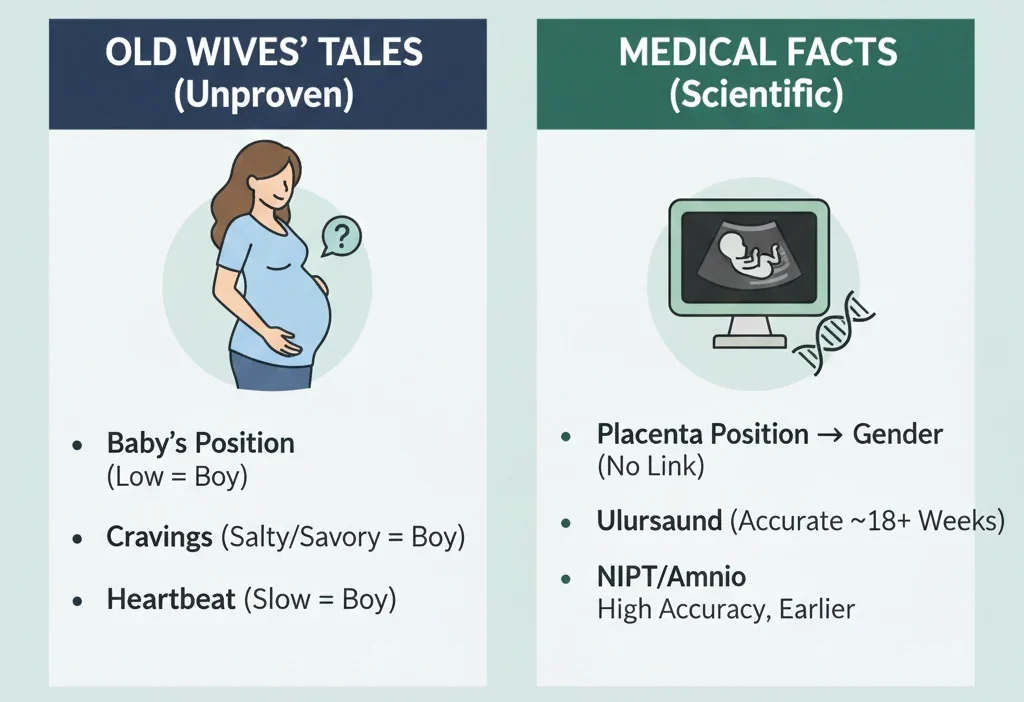
Many people believe that a low-lying placenta can predict whether you’re having a boy or a girl, but science says this is NOT true. Placenta position has no connection to baby gender — and this article explains exactly why.
Many parents wonder if certain pregnancy signs can predict their baby’s gender. One very common belief is the “low lying placenta boy or girl” myth. People often think that where the placenta sits — high, low, front, or back — gives clues about whether the baby is a boy or a girl.
But is this true? What does low-lying placenta actually mean? And why do people mix it up with gender prediction?
In this simple, friendly guide, you will learn:
- What a low-lying placenta really means
- Why some people connect it to baby gender
- The scientific difference between myth and fact
- Clear examples anyone can understand
- Common mistakes parents make
- When to use the term correctly in pregnancy conversations
By the end, even a 4th-grade student will understand the difference — in plain, easy English.
What Does “Low Lying Placenta” Mean?
A low-lying placenta means that the placenta is close to the cervix (the baby’s exit door), usually within 2 cm during mid-pregnancy. It is a medical term, not a gender clue.
Meaning in Simple Words
Think of your uterus like a balloon:
- The top part = fundus
- The bottom part = cervix
A low-lying placenta just means your placenta is sitting lower inside the uterus, like a sticker placed near the bottom of a balloon.
Examples
- “My 20-week scan shows a low-lying placenta.”
- “The doctor says my placenta is close to the cervix.”
- “I have a low placenta, but everything is fine.”
What Low-Lying Placenta Is NOT
❌ It does NOT tell if the baby is a boy or girl.
❌ It does NOT change the baby’s gender.
❌ It does NOT affect personality, looks, or growth.
What Does “Boy or Girl by Placenta Position” Mean?
This phrase comes from old pregnancy myths. People believe:
- Placenta on the right = boy
- Placenta on the left = girl
But this is not reliable, not scientific, and not medically supported.
Doctors do not use placenta location to guess baby gender.
Examples of the Myth Being Used
- “My placenta is low on the right — maybe it’s a boy?”
- “I heard left side placenta means a girl.”
- “My scan shows a low placenta; can I guess gender?”
These are fun guesses, but NOT facts.
The Key Difference Between “Low Lying Placenta” and “Baby Gender”
| Feature | Low-Lying Placenta | Boy or Girl |
|---|---|---|
| What it means | Placenta is near cervix | Baby’s biological sex |
| Medical or myth? | Medical term | Biological fact |
| Can one affect the other? | No | No |
| Used for predictions? | No | Only ultrasound, DNA test |
| Changes during pregnancy? | Often moves up later | Never changes |
Quick Tip to Remember
Placenta position = location, NOT gender.
Your baby’s gender is decided at conception, not by where the placenta sits.
Common Mistakes and How to Avoid Them
❌ Mistake 1: Thinking placenta position predicts gender
Correct: Only ultrasound or blood tests can confirm gender.
❌ Mistake 2: Believing low-lying placenta means something is wrong
Correct: Many placentas move upward as the uterus grows.
❌ Mistake 3: Mixing up “anterior/posterior” with boy/girl myths
Correct: These terms only describe front or back of uterus.
When to Use the Term “Low-Lying Placenta”
Use this term when you want to describe placenta location, not gender.
Situations
- During pregnancy scans
- When discussing pregnancy health
- When sharing medical updates
- When reading ultrasound reports
Examples
- “My doctor says my placenta is low; they will recheck at 32 weeks.”
- “The placenta is near the cervix, so I must rest more.”
- “I have a low-lying placenta but no bleeding.”
- “The placenta may move upward as pregnancy grows.”
- “My nurse explained that it’s common and nothing to fear.”
When to Use “Boy or Girl” in Pregnancy Talk
Use “boy or girl” when discussing baby gender, not placenta.
Examples
- “We can know the baby’s gender at the next scan.”
- “Is the baby a boy or girl?”
- “The ultrasound will tell us the sex.”
- “We’re waiting for the gender reveal!”
- “The baby’s chromosomes decide if it’s a boy or girl.”
Memory Hack
👉 Gender = baby. Placenta position = organ inside mom.
They are separate things.
Quick Recap: Low Lying Placenta vs Boy or Girl
- Low-lying placenta = placenta location, not gender.
- Boy or girl = baby’s sex, decided at conception.
- Placenta position cannot predict gender.
- Science does not support right-side or left-side gender myths.
- Only ultrasound or DNA tests confirm gender.
Advanced Tips
- Placenta myths come from old cultures but have no medical basis.
- In medical writing, placenta position is used only for health assessment.
- Misusing the terms in social media can spread false information.
- In exams or essays, always explain that placenta position ≠ gender prediction.
Santa’s reindeer male or female? Truth That Surprises Experts
Mini Quiz
Fill in the blanks:
- A low-lying placenta means the placenta is near the ________.
- Placenta position cannot predict a ______ or ______.
- Baby gender is decided at ________.
- Only an ________ can confirm the baby’s sex.
- Low-lying placenta is a ________ term.
FAQs
1. Can a low-lying placenta mean I’m having a boy or girl?
No. Placenta position has no connection to baby gender.
2. Does placenta location help predict gender?
No scientific study supports this idea.
3. What causes a low-lying placenta?
It is simply where the placenta attaches early in pregnancy.
4. Will my low-lying placenta move up?
In most cases, yes. It rises as the uterus expands.
5. When can I know if it’s a boy or a girl?
Usually during the 18–22 week anatomy scan or through a blood test.
Conclusion
The belief that a low-lying placenta means boy or girl is a fun myth, but it is not medically true. A low placenta simply describes location, not gender. Your baby’s gender is fixed from the moment of conception and can only be confirmed through medical tests.
Understanding the difference helps you avoid confusion and enjoy your pregnancy with confidence. Keep learning, stay informed, and remember — simple knowledge can bring great peace of mind.

Polly Clark creates clear, insightful guides on language and usage, helping readers understand meanings, differences, and nuances with clarity and confidence.