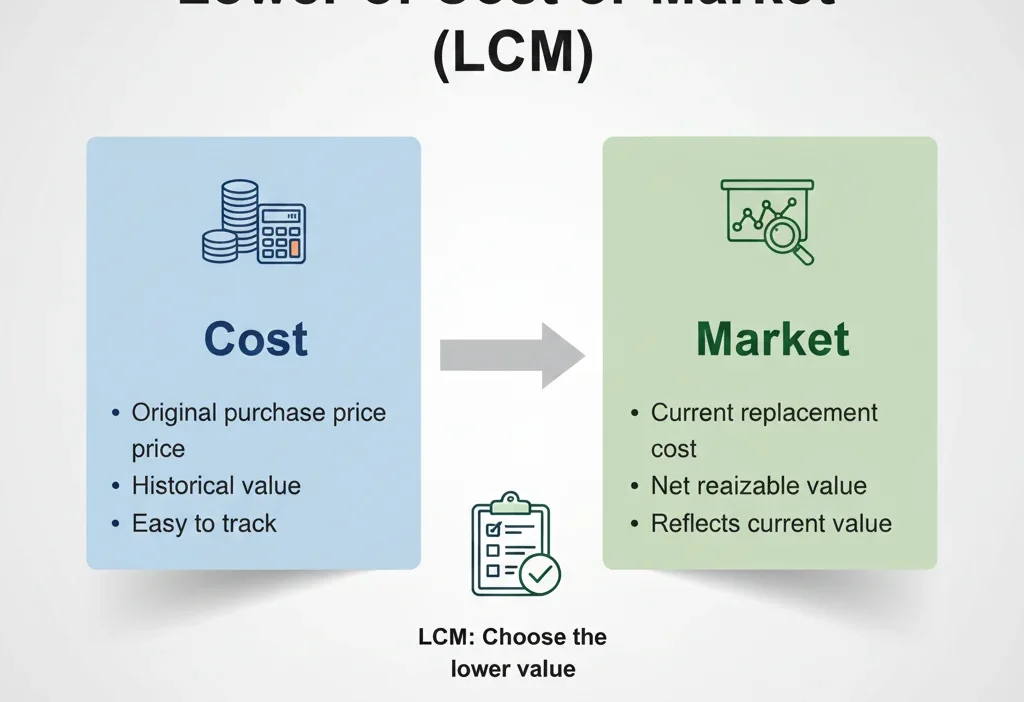
Lower of cost or market means you must record inventory at whichever is lower — its original cost or its current market value. If market value drops below cost, you report the lower amount. This rule helps prevent overstating assets and profits.
The phrase lower of cost or market often confuses students, beginners, and even business owners. People see the words cost and market and wonder: Which one should I use? Why not always use cost? Or why not always use market value?
This confusion happens because both terms deal with money and value, but they are used differently in accounting. Many learners mix them up or apply them incorrectly in exams, bookkeeping, or financial reports.
In this easy guide, you will learn the meaning of lower of cost or market, the difference between cost and market, and the correct usage with very simple examples. Everything is explained in plain English so even a class 4 student can understand it easily.
By the end, you will know exactly what lower of cost or market means, when to use it, and how to avoid common mistakes.
What Does Each Term Mean?
To understand lower of cost or market, we must first understand the two words inside it: cost and market.
What Does “Cost” Mean?
Cost is the amount of money you paid to buy something.
Part of speech: Noun
Simple meaning: Purchase price
Easy examples:
- You bought a notebook for $5. That $5 is the cost.
- A shop buys shoes for $20 each. $20 is the cost.
- A store buys toys for $10 per toy. The cost is $10.
👉 Think of cost as the original price you paid.
What Does “Market” Mean?
Market means the current selling price of something in the market today.
Part of speech: Noun
Simple meaning: Current value or price
Easy examples:
- You bought a phone for $500, but now it sells for $400. $400 is the market value.
- A shirt bought for $30 now sells for $25 in stores.
- A toy bought last year is cheaper now because demand is low.
👉 Think of market as today’s price.
What Does “Lower of Cost or Market” Mean?
Lower of cost or market is an accounting rule.
Simple definition:
You must record inventory at the lower value between cost and market.
Simple Story Example
Imagine this:
- You buy a bag for $50 (cost).
- Later, the market price drops to $35.
👉 Using lower of cost or market, you record the bag at $35, not $50.
Why?
Because accounting prefers to be safe and honest, not overly optimistic.
The Key Difference Between Cost and Market
Here is a simple comparison table to clearly show the difference.
| Point | Cost | Market |
|---|---|---|
| Meaning | Original buying price | Current selling price |
| Time | Past price | Present price |
| Changes over time | Usually stays same | Can go up or down |
| Used in accounting | Starting value | Compared with cost |
| Example | Bought for $100 | Now worth $80 |
Quick Tip to Remember
🧠 Memory Tip:
- Cost = Cash you paid
- Market = Money you can get today
Common Mistakes and How to Avoid Them
Many people make mistakes with lower of cost or market. Let’s fix them.
Mistake 1: Always Using Cost
❌ “Inventory should always be recorded at cost.”
✅ Correct: Inventory is recorded at lower of cost or market.
Why this happens:
People forget market value can drop.
Fix:
Always compare cost with current market value.
Mistake 2: Always Using Market Value
❌ “Use market value even if it is higher.”
✅ Correct: Use market value only if it is lower than cost.
Why this happens:
People want to show higher profits.
Fix:
Remember: accounting avoids overstating profits.
Mistake 3: Mixing Up Cost and Market
❌ “Market is what I paid.”
✅ Correct: Cost is what you paid. Market is current price.
Fix:
Cost = past. Market = today.
When to Use Cost
You use cost when it is lower than market value.
Simple Rule
👉 If cost < market, use cost.
Easy Examples
- You bought shoes for $40. Market value is $50 → Use $40.
- A shop buys pens for $2. Market price is $3 → Use $2.
- Toys bought for $10 now sell for $12 → Use cost.
- Books bought cheap but now popular → Use cost.
When to Use Market
You use market when it is lower than cost.
Simple Rule
👉 If market < cost, use market.
Easy Examples
- Bought a phone for $500. Market price is $400 → Use $400.
- Clothes bought for $30 now sell for $20 → Use market.
- Old stock selling slowly → Use market value.
- Products damaged or outdated → Use market.
Memory Hack 🎯
📉 Market falls? Choose market.
📈 Market rises? Ignore it.
Quick Recap: Lower of Cost or Market
- Cost = original price paid
- Market = current selling price
- Always compare cost vs market
- Record the lower value
- This rule prevents fake profits
- Used mainly for inventory accounting
Advanced Tips (Optional)
Origin and Purpose
The lower of cost or market rule comes from accounting conservatism. It means:
“Do not show profits that are not real.”
Use in Exams and Formal Writing
- Common in accounting exams
- Used in balance sheets
- Shows honest financial reporting
Online and Texting Mistakes
In casual writing, people often say:
❌ “Use market price always”
But in exams, this can cause wrong answers.
Mini Quiz: Test Your Understanding
Fill in the blanks:
- Cost means the ______ price.
- Market means the ______ price.
- If cost is $50 and market is $40, we use ______.
- If market is higher than cost, we use ______.
- Lower of cost or market avoids overstating ______.
- This rule is mostly used for ______.
- Market value can go up or ______.
(Answers: original, current, market, cost, profits, inventory, down)
FAQs
1. What is the meaning of lower of cost or market?
It means recording inventory at the lower value between its cost and current market price.
2. Why is lower of cost or market used?
To avoid showing higher profits than reality.
3. Is lower of cost or market used everywhere?
It is mainly used in accounting and finance.
4. Can market value be higher than cost?
Yes, but it is ignored if higher.
5. Is this rule important for exams?
Yes, it is very important for accounting exams.
Conclusion
Now you clearly understand lower of cost or market, the meaning of cost, the meaning of market, and the difference between cost and market. You learned that this rule helps businesses stay honest by recording inventory at the lower value.
By using simple rules, real-life examples, and memory tips, you can now apply this concept confidently in exams, homework, or real accounting work. Keep practicing small examples, and soon this topic will feel very easy.

Francis Sufford crafts thoughtful, insightful explanations on language, meaning, and usage, blending clarity with storytelling to guide readers effectively.