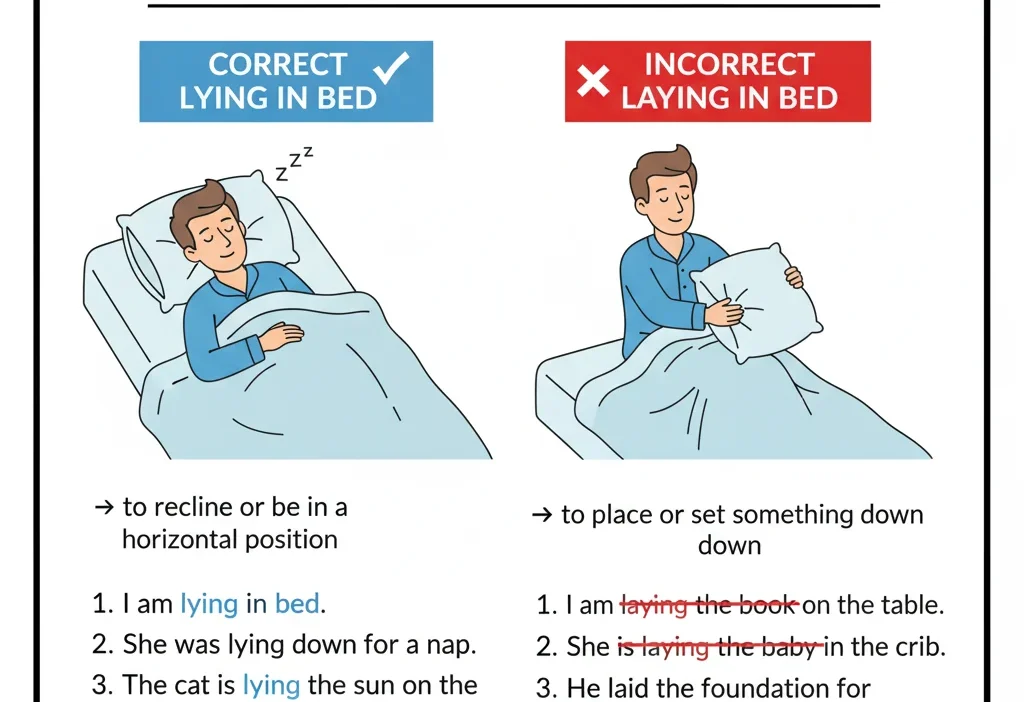
Ever wondered if you should say “lying in bed” or “laying in bed”? You’re not alone! This pair confuses even native English speakers. Both sound similar, both are used when someone is on a bed, and both come from similar-sounding verbs — but only one is usually correct in most cases.
In this friendly guide, you’ll learn the difference between “lying” and “laying”, their correct meanings, how to use each one, and easy memory tricks to never mix them up again. By the end, you’ll confidently know which to say and when — whether you’re writing an essay or just talking with friends.
🧠 What Does Each Word Mean?
Let’s start with the basics — what do lying and laying actually mean?
Lying
- Base verb: Lie
- Meaning: To rest or recline on a surface.
- Part of speech: Verb (an action word).
- Important: “Lie” does not take an object — it’s something you do yourself.
Examples of “lying”:
- I am lying in bed because I’m tired.
- The dog is lying on the couch.
- He was lying on the grass, watching the clouds.
Think of “lie” as relaxing or resting — no object needed.
Laying
- Base verb: Lay
- Meaning: To put or place something down.
- Part of speech: Verb (action).
- Important: “Lay” requires an object — something must be placed.
Examples of “laying”:
- I am laying the blanket on the bed.
- She is laying the plates on the table.
- The hen is laying eggs every morning.
Think of “lay” as putting something down.
If there’s no “thing” being placed, don’t use “laying.”
⚖️ The Key Difference Between Lying and Laying
| Feature | Lying | Laying |
|---|---|---|
| Base verb | Lie | Lay |
| Meaning | To rest or recline | To put or place something |
| Object needed? | ❌ No | ✅ Yes |
| Example | I am lying in bed. | I am laying the pillow on the bed. |
| Tense forms | lie – lay – lain – lying | lay – laid – laid – laying |
✅ Quick Tip to Remember:
If you’re doing it yourself, use lying.
If you’re doing it to something, use laying.
🚫 Common Mistakes and How to Avoid Them
Many people say “laying in bed” when they mean “lying in bed.” Let’s fix that!
❌ Wrong: I’m laying in bed all morning.
✅ Correct: I’m lying in bed all morning.
Why? Because you’re not placing something in bed — you are resting there.
❌ Wrong: The cat is laying on the sofa.
✅ Correct: The cat is lying on the sofa.
Remember: unless you’re putting the cat down, use “lying.”
Grammar Hack:
If there’s no object (like a book, pillow, or toy), it must be lying, not laying.
🛏️ When to Use “Lying”
Use lying when someone (or something) is resting, reclining, or stretched out.
No other object is needed in the sentence.
Examples:
- She was lying in bed reading her favorite book.
- I like lying on the beach on sunny days.
- The clothes are lying on the floor.
- He is lying on the sofa watching TV.
- They were lying under the stars last night.
🧩 Memory Trick:
If you could replace it with “reclining” or “resting,” use lying.
🕊️ When to Use “Laying”
Use laying only when you are putting something down.
This word always needs an object.
Examples:
- I’m laying the baby gently in the crib.
- She is laying the dishes on the table.
- He’s laying new tiles in the kitchen.
- The hen is laying eggs again.
- We are laying the books on the shelf.
🧠 Memory Hack:
If you can add something after it (“laying something”), it’s correct.
🔁 Quick Recap: Lying vs. Laying
- Lying → Resting or reclining. No object.
- “I’m lying in bed.”
- Laying → Putting something down. Needs an object.
- “I’m laying the pillow on the bed.”
Fast rule:
If the sentence answers “Who or what is being placed?”, it’s laying.
If it’s just someone resting, it’s lying.
Easy memory phrase:
“People lie down, hens lay eggs.” 🥚
🌍 Advanced Tips: History, Writing, and Common Confusion
Both verbs come from Old English and used to have clearer differences. Over time, their similar sounds caused confusion — even in books and TV shows!
In formal writing (like essays, exams, or business reports), always check if an object is present. Teachers and editors often spot “laying in bed” as a grammar mistake.
In texting or casual speech, people might say “laying in bed,” but for polished English, “lying in bed” is the correct and professional choice. Using the right form shows that you understand English deeply.
✏️ Mini Quiz: Test Your Understanding!
Fill in the blanks with lying or laying.
- I was _______ on the sofa when you called.
- She is _______ the plates on the dining table.
- The baby is _______ in the crib, sleeping peacefully.
- He is _______ the documents on the desk.
- The cat is _______ under the bed.
Answers:
- lying
- laying
- lying
- laying
- lying
💬 5 Common FAQs
1. Is it correct to say “I’m laying in bed”?
Not usually. The correct form is “I’m lying in bed,” because you’re resting, not placing something.
2. What’s the past tense of “lie”?
The past tense of “lie” is “lay.” Example: Yesterday, I lay in bed all day.
3. Why is “lay” so confusing?
Because “lay” is both the past tense of “lie” and the present tense of “lay.” Context helps you tell the difference.
4. Can I say “lay down” instead of “lie down”?
You can say “lie down” in the present. “Lay down” works only in past tense — “I lay down yesterday.”
5. What’s a simple way to remember?
If you’re resting → lying.
If you’re putting something down → laying.
🧭 Conclusion
Now you know — the next time you’re relaxing after a long day, you’re lying in bed, not laying in bed! 🎯
“Lie” means to rest, while “lay” means to place something down. Remember: no object = lying, object = laying. With practice, this rule will feel natural.
Keep learning, stay curious, and you’ll master English one word at a time — easily and confidently.

Gwendoline Riley delivers clear, compelling insights into language and usage, helping readers understand meanings, nuances, and differences with confidence.