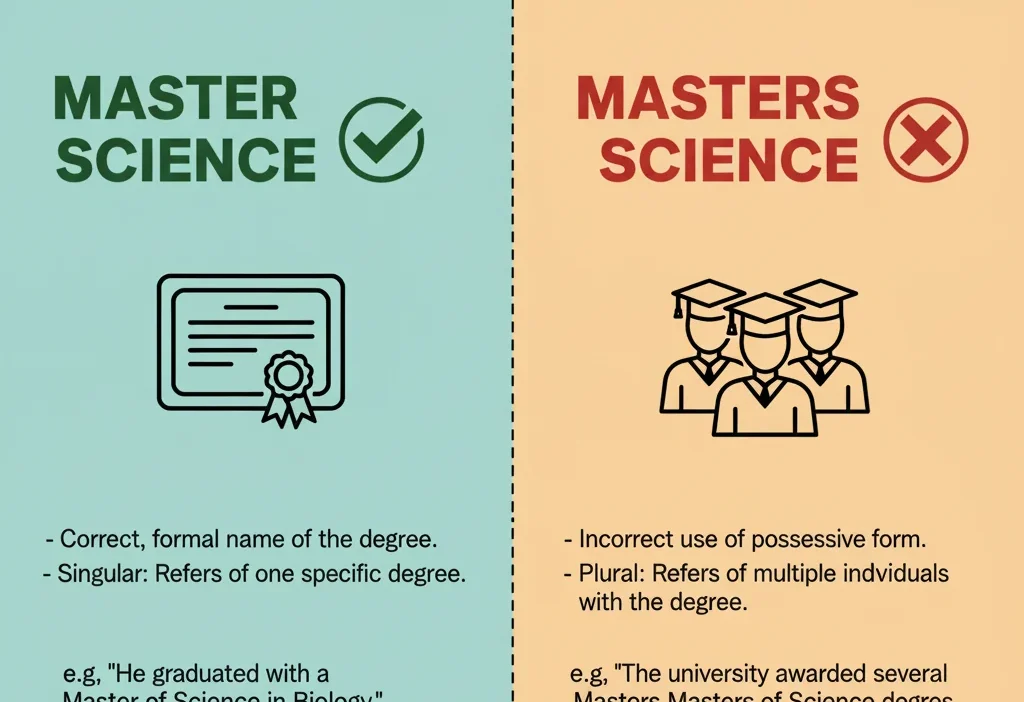
“Master of Science” is the correct singular degree name.
“Masters of Science” is usually incorrect unless used informally to describe multiple people who hold the degree
Many English learners get confused between Master of Science and Masters of Science. They look similar, sound similar, and are often mixed up in everyday writing. But their meanings are not the same. And choosing the wrong one can make your sentence look unprofessional — especially in resumes, applications, and academic writing.
In this friendly, simple guide, you’ll learn the exact difference, correct usage, easy examples, memory hacks, common mistakes, and a comparison table anyone can understand — even a Class 4 student.
By the end, you’ll never confuse these two terms again. Let’s make English simple!
What Does “Master of Science” Mean?
Master of Science (M.Sc. or MS) is the official name of a single academic degree. It is always used in the singular form.
Part of Speech
A noun phrase.
Simple Meaning
A specific postgraduate degree in science or related fields. One person gets one Master of Science degree.
Examples
- She completed her Master of Science in Biology.
- I want to study for a Master of Science after my bachelor’s degree.
- A Master of Science helps students specialize in scientific subjects.
Mini Story to Remember
Think of the Master of Science as one certificate with one title.
Just like a book has one name, the degree also has one name — Master of Science.
What Does “Masters of Science” Mean?
“Masters of Science” is not the correct degree name.
It is only used when talking about many people who each hold a Master of Science degree.
Part of Speech
A plural noun phrase.
Simple Meaning
Multiple people who have the Master of Science degree.
Examples
- Two masters of science attended the seminar.
- The university invited several masters of science as speakers.
- These masters of science work in different research fields.
Mini Story to Remember
“Masters of Science” means many people — like a group photo.
One person = Master of Science
Many people = masters of science
The Key Difference Between Master of Science and Masters of Science
Below is a simple comparison table so you can visually understand the difference:
| Feature | Master of Science | Masters of Science |
|---|---|---|
| Usage | Degree name (singular) | Refers to multiple people |
| Grammar | Singular noun phrase | Plural noun phrase |
| Correct in academic writing? | ✔ Yes | ❌ No (not as degree title) |
| Example | She earned a Master of Science. | Two masters of science attended. |
| Where used? | Resume, applications, certificates | Describing groups of graduates |
Quick Tip to Remember
If you’re naming the degree → ALWAYS use “Master of Science.”
If you’re talking about many people → you may say “masters of science.”
Common Mistakes and How to Avoid Them
❌ Incorrect:
I completed my Masters of Science in Chemistry.
✔ Correct:
I completed my Master of Science in Chemistry.
Why?
You are talking about one degree, so singular form is required.
❌ Incorrect:
She is applying for a masters of science program.
✔ Correct:
She is applying for a Master of Science program.
Why?
Programs have official names → only singular form is used.
❌ Incorrect:
He has two Master of Sciences.
✔ Correct:
He has two Master of Science degrees.
Why?
The word “Science” does not become plural.
Instead, the word “degrees” is plural.
When to Use “Master of Science”
Use Master of Science when:
✔ Talking about your degree
- I completed my Master of Science.
- She is applying for a Master of Science in Nursing.
✔ Writing a resume
- Education: Master of Science in Computer Science
✔ Filling academic forms
- Degree: Master of Science
✔ Describing your qualification
- He holds a Master of Science degree.
Real-Life Situations
- School admissions
- Professional bios
- LinkedIn profiles
- Job applications
- Scholarship forms
When to Use “Masters of Science”
Use masters of science only when talking about multiple people.
✔ Correct Examples
- The award ceremony honored five masters of science.
- Many masters of science work in research labs.
- These masters of science graduated last year.
❌ Not for degree names
Never write:
Masters of Science in Mathematics (incorrect)
Memory Hack
Imagine a group photo:
If there are many people, you can say masters of science.
Quick Recap: Master of Science vs Masters of Science
- Master of Science = official degree name
- Masters of Science = refers to many people
- Never use “Masters of Science” in resumes
- Use singular form when naming a program
- Use plural form only for groups of degree holders
Advanced Tips (Optional)
Word Origin
- “Master” comes from Latin magister, meaning teacher or chief.
- “Of Science” means the field of academic study.
Formal Writing Rule
Universities worldwide use Master of Science (M.Sc. / MS) in official documents.
Exam Tip
Many competitive exams ask:
Which is correct: Master of Science or Masters of Science?
→ Correct answer: Master of Science
Texting or Social Media
People often write “Masters of Science” casually, but it is not correct formally.
Mini Quiz
Fill in the blanks:
- I want to earn a _________ in Physics.
- Two _________ attended the conference.
- She applied for a _________ program in Psychology.
- Many _________ work in the research center.
- He completed his _________ last year.
Answers:
- Master of Science
- masters of science
- Master of Science
- masters of science
- Master of Science
FAQs
1. Which is correct: Master of Science or Masters of Science?
Master of Science is correct for the degree name.
Masters of Science is only used for referring to many people.
2. Can I write “Masters of Science” on my CV?
No. CVs and resumes must use Master of Science.
3. Is Master of Science a plural term?
No. It is always singular.
4. How do I pluralize the degree name?
Say “Master of Science degrees,” not “Master of Sciences.”
5. What is the abbreviation for Master of Science?
Common abbreviations are MS, MSc, or M.Sc.
Conclusion
By now, you clearly understand the difference between Master of Science and masters of science. One is a degree name, and the other describes a group of graduates. Using them correctly helps you sound confident, professional, and accurate — whether you’re writing a resume, filling an application, or talking about your education.
Keep practicing small examples daily. Over time, correct grammar becomes natural and easy. You’re improving your English — keep going!

Jenn Ashworth offers clear, engaging explanations of language and usage, helping readers grasp meanings, nuances, and differences with accuracy and ease.