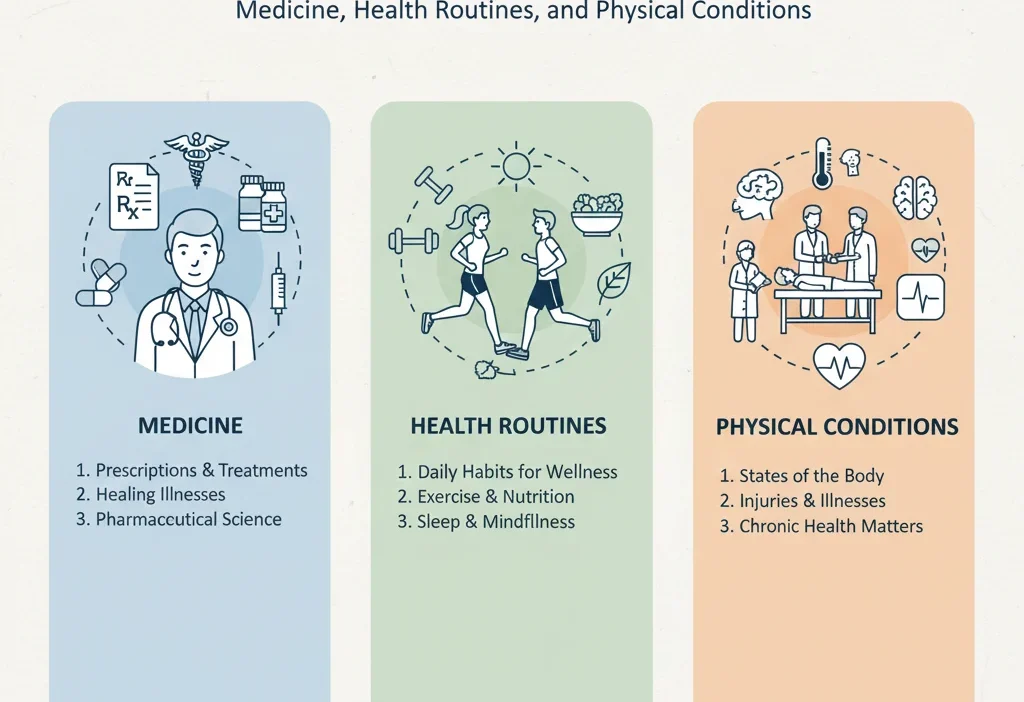
Medicine treats illnesses.
Health routines prevent illnesses.
Physical conditions describe the state of your body — healthy, weak, sick, strong, tired, injured, etc.
These three terms are connected, but they do NOT mean the same thing. Medicine helps you recover, health routines help you stay healthy, and physical conditions describe how your body feels or functions.
People often mix up medicine, health routines, and physical conditions because all three are related to the human body and wellness. But each term has a different meaning, different usage, and a different role in daily life. Students, writers, and even adults sometimes use these words incorrectly while talking about health, exercise, sickness, or everyday habits.
In this simple, friendly guide, you will learn the clear meaning, difference, and correct usage of all three terms — explained in a way that even a 4th-grade student can easily understand. You’ll see examples, stories, memory tips, a comparison table, and a mini quiz to help you remember everything. By the end of this guide, you’ll know exactly when to use medicine, when to talk about health routines, and how to describe physical conditions correctly.
Let’s begin the easiest explanation ever!
What Does Each Term Mean?
1. What Does “Medicine” Mean?
- Part of Speech: Noun
- Simple Meaning: Medicine is something you take when you are sick, such as pills, syrups, tablets, or injections.
- It helps your body fight germs, reduce pain, or cure illness.
Easy Examples
- The doctor gave me medicine for my fever.
- She takes her medicine after breakfast.
- This medicine will help you breathe better.
Think of medicine like a superhero that comes only when there is trouble.
2. What Does “Health Routines” Mean?
- Part of Speech: Noun phrase
- Simple Meaning: Health routines are the good habits you follow every day to stay healthy, strong, and active.
- Examples include exercise, sleeping early, drinking water, eating healthy food, and washing your hands.
EasY Examples
- My health routine includes walking every morning.
- Drinking more water is part of a good health routine.
- A healthy routine helps prevent sickness.
Think of health routines like daily body homework — small tasks that keep you strong.
3. What Does “Physical Conditions” Mean?
- Part of Speech: Noun phrase
- Simple Meaning: Physical conditions are the state of your body, like being tired, sick, hungry, strong, energetic, injured, or weak.
- It describes “how your body feels or works.”
Easy Examples
- His physical condition improved after rest.
- She could not run because of her weak physical condition.
- Good physical conditions make exercise easier.
Think of physical conditions as “body status updates.”
The Key Difference Between Medicine, Health Routines, and Physical Conditions
Below is a simple table to help you understand the differences clearly:
| Feature | Medicine | Health Routines | Physical Conditions |
|---|---|---|---|
| Meaning | Treatment for sickness | Daily habits for staying healthy | The state of the body |
| When Used | When sick | When preventing sickness | When describing body condition |
| Form | Pills, syrups, injections | Exercise, diet, sleep, hygiene | Weak, strong, tired, injured |
| Example | “I took medicine.” | “I follow a health routine.” | “My physical condition is good.” |
Quick Tip to Remember
- Medicine = Cure
- Health routines = Prevention
- Physical conditions = Body status
If you remember these three words, you will ALWAYS choose the right one.
Common Mistakes and How to Avoid Them
❌ Mistake 1: Mixing Routine with Medicine
Wrong: “I follow medicine every day.”
Correct: “I follow a health routine every day.”
Why? Medicine is taken when you are sick, not followed daily.
❌ Mistake 2: Using Health Routines as Treatment
Wrong: “I need a health routine for my flu.”
Correct: “I need medicine for my flu.”
Why? Routines help you stay healthy, but they don’t cure sickness.
❌ Mistake 3: Confusing Physical Condition with Medicine
Wrong: “My medicine is weak today.”
Correct: “My physical condition is weak today.”
Why? “Weak” describes your body, not the medicine.
❌ Mistake 4: Using Physical Conditions Instead of Routines
Wrong: “My physical conditions include drinking water daily.”
Correct: “My health routine includes drinking water daily.”
Why? Drinking water is a habit, not a condition.
When to Use “Medicine”
Use medicine when:
- You are sick
- You need treatment
- A doctor prescribes something
- You want to reduce pain or symptoms
Examples
- I took medicine for my headache.
- The doctor said to take this medicine twice a day.
- This medicine helps with cough.
- She forgot to take her medicine this morning.
- The baby refuses to drink the medicine.
When to Use “Health Routines”
Use health routines when:
- You talk about daily habits
- You want to prevent sickness
- You want to stay strong and fit
- You discuss wellness
Examples
- My health routine includes jogging.
- Drinking warm water is a healthy routine.
- I added stretching to my daily routine.
- A strong health routine helps the body stay active.
- Sleeping early is part of a good health routine.
Memory Hack
Health routines = “Body habits.”
Medicine = “Body help.”
When to Use “Physical Conditions”
Use physical conditions when:
- You describe how the body feels
- You talk about strength or weakness
- You discuss fitness levels
- You talk about sickness or injury
Examples
- His physical condition improved after therapy.
- A weak physical condition makes exercise difficult.
- Her physical condition is perfect for sports.
- Bad physical conditions can cause sickness.
- Good physical conditions show healthy living.
Memory Trick
Physical conditions = “Body status.”
Quick Recap: Medicine vs Health Routines vs Physical Conditions
Medicine
- Used for treatment
- Taken when sick
- Comes as pills, syrups, injections
Health Routines
- Daily habits
- Prevent sickness
- Includes exercise, diet, hygiene
Physical Conditions
- Describe the body state
- Can be good or bad
- Shows how fit or sick you are
Advanced Tips
Word Origins
- Medicine → Latin medicina (healing)
- Routine → French route (path)
- Condition → Latin condicio (state)
Formal Writing Tips
Use medicine for medical essays.
Use health routines for wellness or fitness essays.
Use physical conditions for scientific or health reports.
Common Online Confusion
People mix these terms on social media. Using the wrong one can change meaning completely, especially in health-related posts.
Mini Quiz
Fill in the blanks with medicine, health routines, or physical conditions:
- His ________ improved after he started exercising.
- I need ________ for my headache.
- Good ________ help prevent many illnesses.
- Her ________ was too weak for sports.
- The doctor gave me ________ for cough.
- A strong ________ includes drinking enough water.
- The athlete has excellent ________.
Conclusion
Now you clearly understand the difference between medicine, health routines, and physical conditions. Each term plays a special role in your health: medicine helps you recover, health routines keep you strong, and physical conditions describe your body’s state. With the examples, memory tricks, and comparison table, choosing the right term will now be simple and stress-free. Keep practicing, keep learning, and keep improving your English every day. You’re doing great!
FAQs
1. What is the difference between health routines and physical conditions?
Health routines are habits. Physical conditions describe body status.
2. Is medicine part of a health routine?
No. Medicine is taken only when you are sick.
3. Can good health routines improve physical conditions?
Yes! Healthy routines make the body stronger.
4. Do physical conditions require medicine?
Only if the condition is caused by sickness or pain.
5. Can physical conditions be temporary?
Yes — like tiredness, injury, fever, or weakness.

Polly Clark creates clear, insightful guides on language and usage, helping readers understand meanings, differences, and nuances with clarity and confidence.