Have you ever wondered whether to write “molding” or “moulding”? 🤔
You’re not alone! These two words look almost identical, mean the same thing, and are often used in the same contexts — yet one tiny letter can change which is correct depending on where you live.
This guide will make it super simple to understand.
By the end, you’ll know:
- What each word means
- When to use molding or moulding
- How to avoid common mistakes
- Simple examples and memory tricks
Let’s make English easy — one confusing pair at a time! 🌍
🧠 What Does Each Word Mean?
Both molding and moulding refer to the same thing — a shaped strip of material (like wood, plaster, or plastic) used to decorate walls, ceilings, or furniture.
The only difference is spelling, not meaning.
Let’s look at each in detail 👇
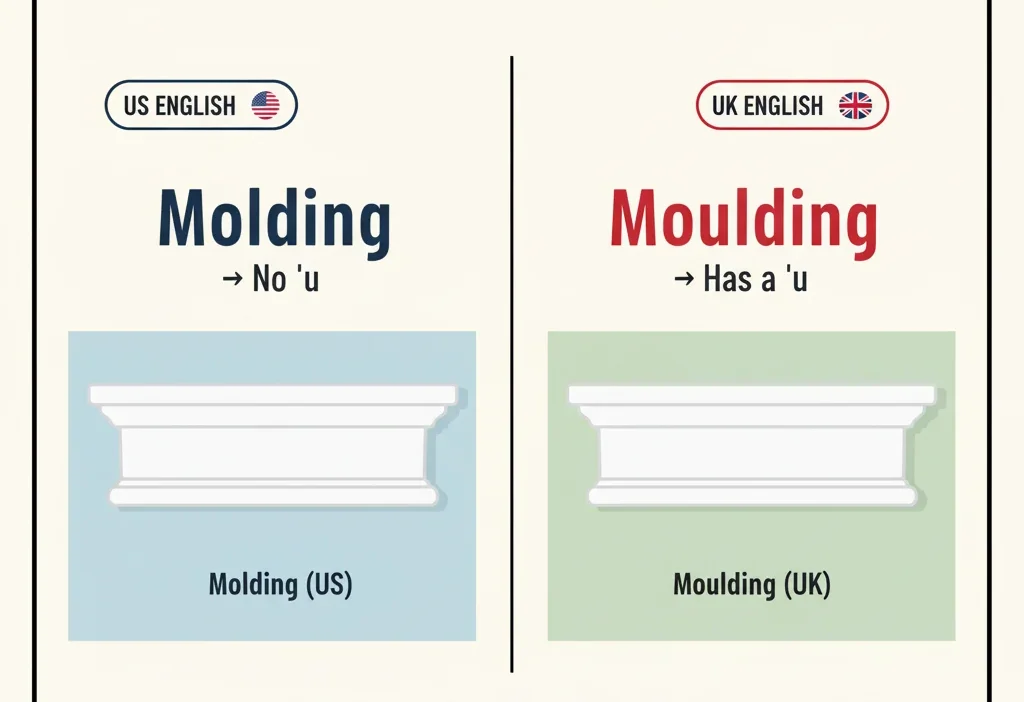
✅ Molding (American English)
Part of Speech: Noun / Verb
Meaning: A decorative or shaped strip used in building or furniture design.
Examples:
- The carpenter added molding around the ceiling.
- I love the smooth finish of the wooden molding.
- She’s molding the clay into a beautiful bowl.
🪶 In short: “Molding” is the American spelling. If you’re writing for a U.S. audience or following American English rules — use molding.
✅ Moulding (British English)
Part of Speech: Noun / Verb
Meaning: Exactly the same as “molding,” but used in British English.
Examples:
- The old Victorian house had fine moulding on the walls.
- The artist is moulding figures from wet clay.
- Please paint the door and the moulding white.
🪶 In short: “Moulding” is the British spelling. It’s commonly used in the UK, Canada, Australia, and other Commonwealth countries.
⚖️ The Key Difference Between Molding and Moulding
| Feature | Molding 🇺🇸 | Moulding 🇬🇧 |
|---|---|---|
| Language Style | American English | British English |
| Meaning | Decorative trim or shape | Decorative trim or shape |
| Pronunciation | Same (MOHLD-ing) | Same (MOHLD-ing) |
| Example Sentence | The molding around the doors looks new. | The moulding around the doors looks new. |
| Common Regions | USA, Philippines | UK, Canada, Australia, India |
💡 Quick Tip to Remember:
If your spell-check suggests words with “ou” (like colour, honour, favourite), use moulding.
If it prefers shorter forms (color, honor, favorite), use molding.
🚫 Common Mistakes and How to Avoid Them
Let’s see how people often mix these up — and how to fix them!
| ❌ Incorrect | ✅ Correct | 💡 Why |
|---|---|---|
| The wall moulding looks great. (in U.S. text) | The wall molding looks great. | U.S. English uses “molding.” |
| We installed molding around the ceiling. (in UK text) | We installed moulding around the ceiling. | British English uses “moulding.” |
| The artist is molding the clay (in a British exam) | The artist is moulding the clay | Keep your spelling consistent with the exam’s format (UK or US). |
✅ Rule of Thumb:
Match your spelling to your audience or setting.
If you’re writing for an American company or school, use molding.
If you’re in the UK or Commonwealth, stick to moulding.
🧠 240+ Honor vs Honour Grammar, Examples 2025
🇺🇸 When to Use “Molding”
Use molding when you’re writing or speaking American English.
You’ll see this version in:
- U.S. schools
- American building stores
- Magazines, essays, and blogs from the U.S.
Examples:
- The living room molding adds elegance to the space.
- She’s molding the dough into little circles.
- My dad replaced the old molding with a modern design.
- The artist enjoys molding clay into shapes.
- The factory uses machines for plastic molding.
🧠 Memory Trick:
Think “molding = model.” Both are short and simple — just like American spelling! 🇺🇸
🇬🇧 When to Use “Moulding”
Use moulding when you’re following British English conventions.
You’ll see it in:
- UK-based architecture and design
- School exams (like Cambridge or IELTS)
- Australian, Canadian, or Indian writing
Examples:
- The craftsman is moulding the clay into a vase.
- We installed crown moulding along the ceiling edges.
- The ornate moulding on the fireplace looks vintage.
- The artist specializes in plaster moulding.
- She loves moulding ideas into reality.
🧠 Memory Trick:
Remember: Moulding = Colourful English.
British words often have “ou” — colour, favourite, honour, moulding!
🧾 Quick Recap: Molding vs Moulding
Here’s a super quick summary:
- ✅ Molding → American English 🇺🇸
- ✅ Moulding → British English 🇬🇧
- 📚 Meaning: Both refer to decorative trims or shaping materials.
- 🧩 Pronunciation: Same in both versions.
- ✍️ Usage Tip: Be consistent — don’t mix both spellings in one document.
Easy Way to Remember:
“If you spell colour with a ‘u’, use moulding too!”
📜 Advanced Tips: History and Extra Usage
The difference between molding and moulding comes from how English evolved in different regions.
- The British “moulding” kept the older Middle English spelling (influenced by French).
- The American “molding” dropped the extra “u” for simplicity during the spelling reforms led by Noah Webster in the 1800s.
Both are correct — just regional preferences.
🏛️ In Formal Writing:
- Academic papers or British exams → moulding
- U.S. school essays or business reports → molding
💬 In Everyday Texting:
People often just use whichever their phone autocorrect prefers!
Still, it’s a good habit to learn which one matches your country’s standard.
🧩 Mini Quiz: Test Your Understanding!
Choose the correct word — molding or moulding.
- The artist is _______ the clay into animal shapes.
- We added crown _______ in the living room.
- In American English, it’s spelled _______.
- In British English, it’s spelled _______.
- The carpenter installed beautiful wooden _______ around the ceiling.
Answers:
- molding/moulding (both correct – depends on English type)
- molding/moulding
- molding
- moulding
- molding/moulding
🙋♀️ FAQs about Molding vs Moulding
1. Are “molding” and “moulding” the same word?
Yes! They have the same meaning — the difference is only in spelling (U.S. vs U.K.).
2. Which is correct in Canada or Australia?
Canada and Australia usually follow British English, so moulding is preferred.
3. Can I use both in the same document?
No. Pick one spelling and use it consistently throughout your writing.
4. Is “moulding” ever wrong?
Not at all. It’s perfectly correct in British English — just not used in the U.S.
5. What’s the easiest way to remember?
If you write “colour,” use “moulding.”
If you write “color,” use “molding.”
🏁 Conclusion
“Molding” and “moulding” might look confusing, but now you know the simple rule —
they mean the same thing, and the only difference is American vs. British spelling.
Use molding for American English 🇺🇸
Use moulding for British English 🇬🇧
Keep your writing consistent, clear, and confident.
Every small step — even learning one tiny spelling difference — makes your Englis

Francis Sufford crafts thoughtful, insightful explanations on language, meaning, and usage, blending clarity with storytelling to guide readers effectively.