Have you ever seen the “≥” symbol and wondered what it really means? You’re not alone!
Many students and even adults mix up the “more than” sign (>) and the “more than or equal to” sign (≥). They look similar — but they don’t mean the same thing.
In this guide, you’ll learn:
- What “more than” and “more than or equal to” mean
- The key difference between them
- When and how to use each sign correctly
- Common mistakes and easy examples to remember them
By the end, you’ll understand these symbols so clearly that even a 4th grader could explain them confidently! Let’s dive in.
📘 What Does Each Sign Mean?
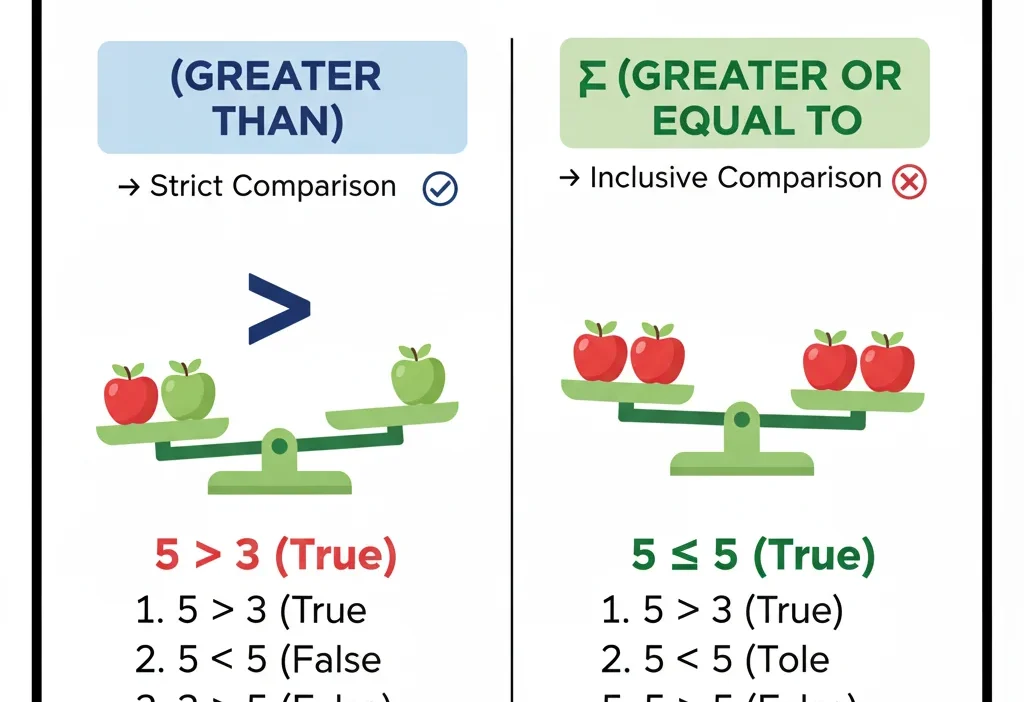
1. More Than Sign (>)
The “more than” sign shows that one number is larger than another number.
It does not include equality — it only means greater than.
✅ Meaning:
A number on the left side is bigger than the number on the right.
✅ Examples:
- 7 > 5 → 7 is more than 5.
- 12 > 8 → 12 is more than 8.
- 100 > 50 → 100 is more than 50.
🧠 Quick Tip:
The “mouth” of the > sign always opens toward the bigger number — like a hungry alligator eating the larger one!
2. More Than or Equal To Sign (≥)
The “more than or equal to” sign means a number is either greater than or exactly equal to another number.
✅ Meaning:
It covers two conditions:
1️⃣ Greater than
2️⃣ Equal to
✅ Examples:
- 6 ≥ 5 → 6 is greater than 5.
- 5 ≥ 5 → 5 is equal to 5 (still correct!)
- 9 ≥ 3 → 9 is greater than 3.
🧠 Quick Tip:
Think of ≥ as a “gentle” version of > — it includes equality too!
⚖️ The Key Difference Between “More Than” (>) and “More Than or Equal To” (≥)
Here’s a simple comparison table to help you remember:
| Feature | More Than (>) | More Than or Equal To (≥) |
|---|---|---|
| Meaning | One number is strictly greater than another | One number is greater or equal |
| Includes Equality? | ❌ No | ✅ Yes |
| Example 1 | 8 > 6 → true | 8 ≥ 6 → true |
| Example 2 | 5 > 5 → false | 5 ≥ 5 → true |
| Math Use | Comparing numbers without equality | Comparing numbers including equality |
| Real-Life Example | “You must score more than 60 to pass.” | “You must score 60 or more to pass.” |
💡 Quick Trick to Remember:
If the question says “or more,” use ≥.
If it says only “more than,” use >.
❌ Common Mistakes and How to Avoid Them
Mistake 1:
❌ 5 > 5 (when equality is allowed)
✅ Correct: 5 ≥ 5
📝 Why? The “more than” sign doesn’t include equal values.
Mistake 2:
❌ Use of ≥ in wrong context:
“You must be ≥ 18 years old.”
✅ Correct: “You must be 18 years old or older.”
📝 Why? The ≥ sign is for math or data, not for normal English sentences.
Mistake 3:
❌ Mixing up direction:
5 < 3 (wrong direction)
✅ Correct: 5 > 3
📝 Tip: The sign always opens toward the bigger number.
✏️ When to Use “More Than” (>)
You use the “more than” sign when one value is strictly greater than another — no equality allowed.
✅ Examples:
- A student who scored 80 > 60 did better.
- The temperature today is > yesterday’s.
- You need to run more than 3 miles to win.
- 9 > 2 (mathematical example)
- You must save more than $100 to buy that toy.
🧠 Memory Hack:
Think of “>” as “only greater, no twins allowed!”
📈 When to Use “More Than or Equal To” (≥)
Use the “more than or equal to” sign when a value can be either greater or equal to another.
✅ Examples:
- To pass, your marks must be ≥ 50.
- A child ≥ 12 years can ride alone.
- The temperature must stay ≥ 0°C to avoid freezing.
- 8 ≥ 8 → true (equal!)
- 10 ≥ 7 → true (greater!)
🧠 Memory Hack:
Think of ≥ as a “kind and fair” sign — it accepts both bigger and equal values.
🧾 Quick Recap: “>” vs “≥”
Here’s a short summary you can remember easily:
- > means “only greater.”
- ≥ means “greater or equal.”
- If it says “or more,” use ≥.
- If it says “strictly more than,” use >.
- The mouth of the sign always faces the larger number.
✅ Example to Remember:
“You must be 13 or older to use social media.”
Mathematically: Age ≥ 13
💡 Advanced Tips
- The ≥ sign is used in algebra, data analysis, and inequalities.
Example: x ≥ 10 means x can be 10, 11, 12… - In computer programming, it’s written as >=.
Example: if (score >= 60) → pass - The concept of “more than or equal to” comes from ancient Greek mathematics — showing that equality matters in logical comparisons.
- In writing or speech, never use ≥ or >. Always write it out as “more than” or “at least.”
🧩 Mini Quiz: Test Yourself!
Fill in the blanks with the correct sign (> or ≥):
- 9 ___ 7
- 6 ___ 6
- 4 ___ 10
- A student must score ___ 60 to pass.
- 15 ___ 8
✅ Answers:
- 2. ≥ 3. < 4. ≥ 5. >
❓ FAQs (For Featured Snippet Optimization)
Q1. What does the “more than or equal to” sign mean?
It means a number is either greater than or exactly equal to another number (≥).
Q2. What’s the difference between “>” and “≥”?
“>” means strictly greater, while “≥” means greater or equal.
Q3. How can I remember the direction of the sign?
The open side always faces the bigger number — like a hungry alligator!
Q4. Can I use ≥ in writing?
Use ≥ in math and data, but in normal English, write “at least” or “no less than.”
Q5. What is the keyboard shortcut for ≥?
On Windows: Alt + 242 | On Mac: Option + >
🎯 Conclusion
The “more than or equal to” (≥) sign is simple once you understand it.
Remember — “>” means strictly greater, while “≥” includes equal too.
By practicing with examples, you’ll never confuse them again.
Keep using what you learned today in schoolwork, math problems, or even computer coding. The more you use it, the easier it gets!
Written by an English grammar enthusiast passionate about making language simple for everyone.

Francis Sufford crafts thoughtful, insightful explanations on language, meaning, and usage, blending clarity with storytelling to guide readers effectively.