Have you ever written “more then” instead of “more than” and wondered why it looks wrong? You’re not alone! Many English learners — and even native speakers — mix up these two phrases because they sound so similar. But the truth is, “more than” and “more then” mean completely different things.
In this simple, step-by-step guide, you’ll learn the difference between “more than” and “more then,” how to use each correctly, and the most common mistakes to avoid. By the end, you’ll be able to confidently choose the right one in any sentence — even in formal writing or exams.
Primary Keywords
- more than or more then
- more than vs more then
- difference between more than and more then
- correct usage of more than or more then
Secondary Keywords
- grammar tips
- English examples
- correct word usage
- grammar difference
- common mistakes
- meaning in English
- how to use more than and more then
- writing correctly
Semantic Keywords
- what’s the difference
- simple explanation
- easy grammar rule
- when to use each word
- examples of correct sentences
What Does Each Phrase Mean?
Let’s start by understanding what each phrase means and how it’s used in sentences.
Meaning of “More Than”
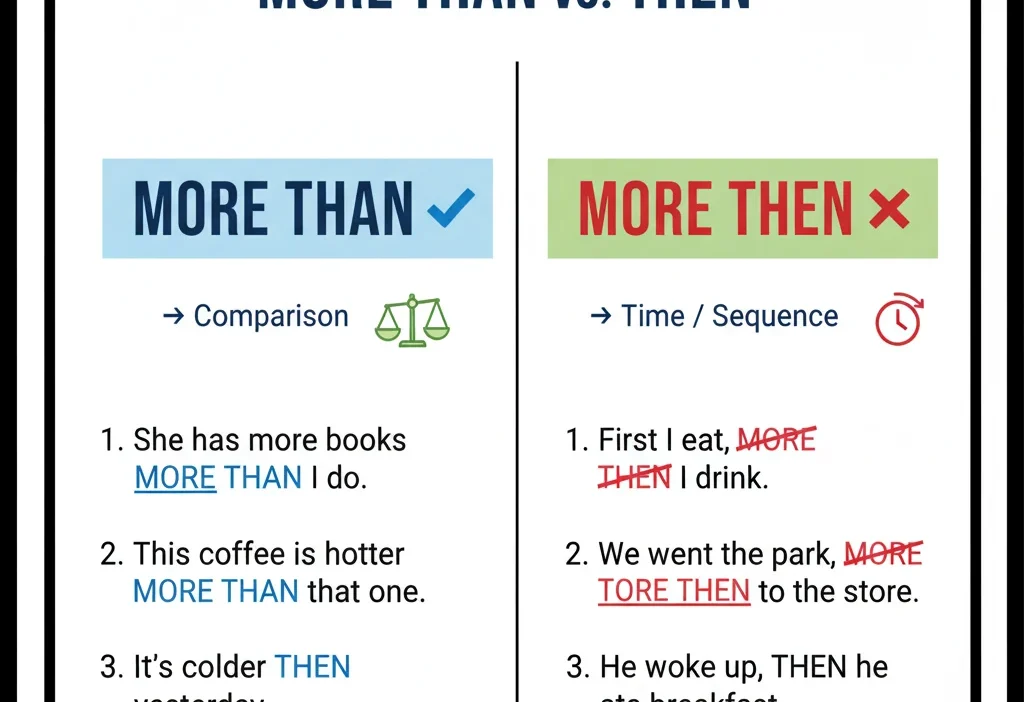
“More than” is used to compare quantities, numbers, or amounts. It means greater than or in excess of something.
🧩 Part of speech: It’s a phrase made up of an adverb (“more”) and a conjunction/preposition (“than”).
✅ Examples:
- She has more than five books.
- I love you more than words can say.
- This movie is more than just entertainment; it teaches a lesson.
🧠 Memory tip: Think of “more than” as “greater than.” If you’re comparing two things, this is the one you need.
Meaning of “More Then”
“More then” is not a correct comparison phrase. It’s only correct if “then” means “at that time” or “next.”
🧩 Part of speech: “More” (adverb) + “then” (adverb of time).
✅ Examples:
- I studied hard, and then I rested.
- He worked all day and earned more. Then, he took a vacation.
- We’ll eat lunch, then go shopping for more supplies.
So, “more then” can appear together by accident in a sentence — but they are not a single phrase. They just happen to be next to each other.
🚫 Incorrect: She has more then ten pens.
✅ Correct: She has more than ten pens.
The Key Difference Between “More Than” and “More Then”
Here’s a clear comparison to help you understand quickly:
| Phrase | Meaning | When to Use | Example |
|---|---|---|---|
| More Than | Shows comparison or greater quantity | When comparing amounts, numbers, or qualities | She is more than happy to help. |
| More Then | Refers to time sequence (rarely correct together) | When “then” means “next” or “after that” | He studied hard, then he did more exercises. |
💡 Quick Tip to Remember:
If you can replace it with “greater than,” use “more than.”
If you’re talking about time or sequence, use “then.”
Common Mistakes and How to Avoid Them
Mistake #1:
❌ He has more then enough money.
✅ He has more than enough money.
👉 “More than” compares the amount — not time.
Mistake #2:
❌ I like reading more then watching TV.
✅ I like reading more than watching TV.
👉 When comparing two activities, always use “more than.”
Mistake #3:
❌ You should eat more then rest.
✅ You should eat, then rest.
👉 “Then” shows order or time, not comparison.
🧠 How to fix these:
Read your sentence out loud. If you’re comparing, say “more than.” If you’re describing what happens next, use “then.”
When to Use “More Than”
Use “more than” when you’re comparing numbers, amounts, or qualities.
✅ Examples:
- I spent more than $50 on groceries.
- She’s more than just a teacher; she’s a mentor.
- It takes more than talent to succeed — you need effort too.
- The exam was more than difficult; it was exhausting.
- Our team has more than 10 members.
💡 Tip: If you can replace “more than” with “greater than” or “better than,” your sentence is correct.
When to Use “More Then”
“More then” is used only when “more” and “then” happen to appear together, but they’re not working as one phrase.
✅ Examples:
- He did a little, and then did more.
- She studied for two hours, then studied more for her exam.
- First, wash the dishes. Then, do more cleaning.
- We’ll buy some items now and then buy more later.
- He worked, rested, then worked more.
🧠 Memory Hack:
If “then” can be replaced by “after that,” it’s probably correct.
👉 He worked, after that, he worked more. ✅
Quick Recap: More Than vs More Then
Here’s a quick summary to lock it in:
- “More than” → Used for comparisons (amounts, numbers, qualities).
- “More then” → Rare, only correct when “then” means next or after that.
- Always check if you’re comparing something. If yes, use “more than.”
Shortcut Reminder:
Comparison = more than
Sequence in time = then
Advanced Tips for English Learners
- Origin: “Than” comes from Old English thanne, used for comparisons, while “then” came from thænne, meaning at that time.
- Formal writing: Always use “more than” in essays, business emails, and academic writing when comparing.
- In texting: People often type “then” instead of “than” because of autocorrect or habit — but it changes the meaning!
Example: “I love you more then ever” ❌ should be “I love you more than ever” ✅
Pro Tip: Read your sentence backwards. If it still makes sense with “greater than,” it’s “than,” not “then.”
Mini Quiz — Test Yourself!
Fill in the blanks with “more than” or “then.”
- She is __________ my best friend; she’s family.
- We’ll go shopping, __________ have dinner.
- He saved __________ $100 last week.
- You should rest first, __________ study more.
- This phone costs __________ the other one.
- I like swimming __________ running.
- First clean your room, __________ you can play games.
✅ Answers:
- more than
- then
- more than
- then
- more than
- more than
- then
FAQs
1. What is the difference between “more than” and “more then”?
“More than” shows comparison; “more then” refers to time but is rarely correct as one phrase.
2. Is “more then” ever correct?
Only when “then” means next or after that. Example: We’ll buy more, then go home.
3. How can I remember when to use “than”?
If you’re comparing two things — use “than.” Example: Bigger than, faster than.
4. Why do people confuse “then” and “than”?
They sound similar, but have different meanings. “Than” = comparison; “Then” = time or sequence.
5. Is “more than” used in formal English?
Yes, it’s correct and common in essays, reports, and academic writing.
Conclusion
Now you know the clear difference between “more than” and “more then.”
Use “more than” when comparing amounts or ideas, and “then” when talking about time or order. Simple practice and awareness will help you avoid this common grammar mistake forever.

Gwendoline Riley delivers clear, compelling insights into language and usage, helping readers understand meanings, nuances, and differences with confidence.