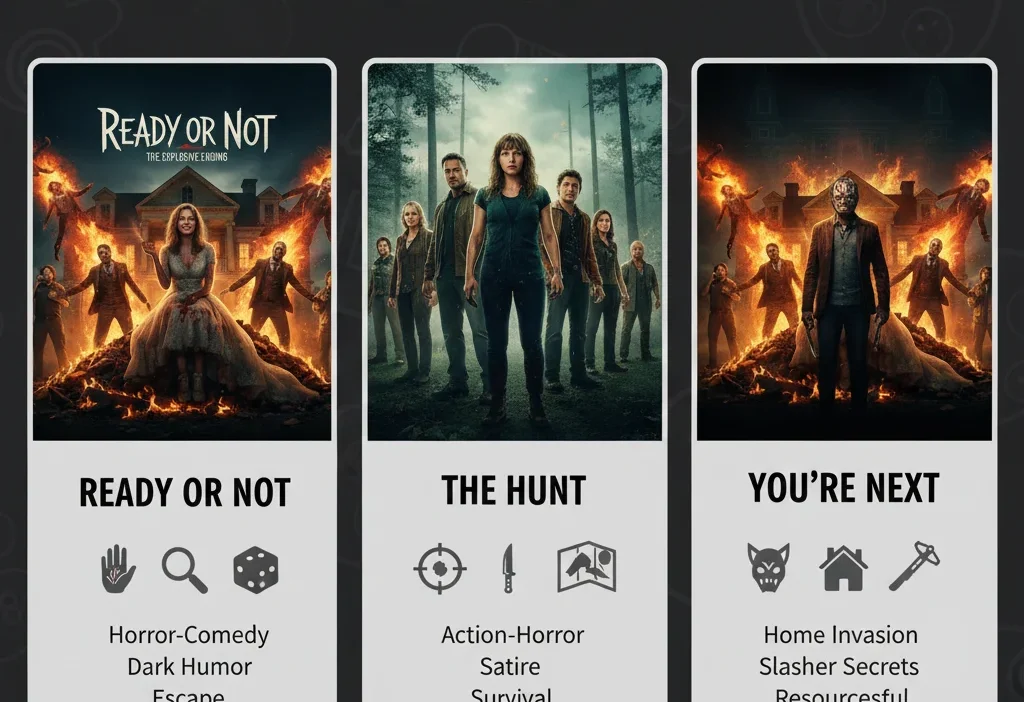
If you’re searching for movies like Ready or Not, you might get confused because the phrase looks like two separate words — “movies” and the expression “ready or not.” In English, “Ready or Not” is a fixed phrase used in games or dramatic situations, while “movies like Ready or Not” is a comparison phrase used when people want similar films, similar stories, or similar styles.
This guide clearly explains the meaning, usage, difference, and correct way to use “movies like Ready or Not.”
People often search for movies like Ready or Not, but many don’t fully understand how this phrase works in English. It looks simple, yet it combines a fixed expression (“Ready or Not”) with a comparison phrase (“movies like…”) — and that’s why it becomes confusing.
In this complete grammar-friendly guide, you will learn:
- What “Ready or Not” really means
- How “movies like Ready or Not” works in English
- The difference between the two ideas
- Correct usage with simple examples
- Memory tricks, common mistakes, and a recap
- A mini quiz + FAQs for practice
Everything is explained in simple, beginner-friendly English, so even a Grade-4 student can understand it easily.
⭐ What Does “Ready or Not” Mean?
“Ready or Not” is a popular English phrase used when:
- A game is about to start
- A surprise action is coming
- Someone must act even if others are not prepared
Part of Speech:
➡️ Idiomatic phrase (expression)
Simple Meaning:
“Whether you are prepared or not, something is going to happen.”
Easy Examples:
- Ready or not, here I come!
- The test is tomorrow, ready or not.
- Ready or not, the rain started suddenly.
🎬 What Does “Movies Like Ready or Not” Mean?
“Movies like Ready or Not” is a comparison phrase used when someone wants recommendations for films that are:
- Similar in style
- Similar in story
- Similar in theme
- Similar in mood or genre
Part of Speech:
➡️ Phrase used for comparison
Simple Meaning:
“Films that are similar to the movie Ready or Not.”
Easy Examples:
- Can you recommend movies like Ready or Not?
- I love that suspenseful style. I want movies like Ready or Not.
- She searched online for movies like Ready or Not to watch at night.
🔍 The Key Difference Between “Ready or Not” and “Movies Like Ready or Not”
| Feature | Ready or Not | Movies Like Ready or Not |
|---|---|---|
| Type | Idiom / expression | Comparison phrase |
| Meaning | Something happens even if you are not prepared | Asking for similar films |
| Usage | Games, warnings, surprises | Movie recommendations |
| Example | Ready or not, here we go! | Can you suggest movies like Ready or Not? |
Quick Tip to Remember
- “Ready or Not” = action is starting
- “Movies like Ready or Not” = you want similar movies
Just remember:
One is an expression. The other is a comparison.
❗ Common Mistakes & How to Avoid Them
❌ Mistake 1:
“I watched ready or not movies like yesterday.”
✔️ Correct:
“I watched Ready or Not and now I want movies like it.”
❌ Mistake 2:
“Ready or not movies like means being prepared.”
✔️ Correct:
“Ready or Not means the action starts, but ‘movies like Ready or Not’ means similar films.”
❌ Mistake 3:
“I like ready or not meaning similar movies.”
✔️ Correct:
“I like Ready or Not and want movies that are similar.”
🎯 When to Use “Ready or Not”
Use “Ready or Not” when:
- You start a game
- You warn someone
- Something begins suddenly
- You describe something fast or unexpected
Simple Examples:
- Ready or not, the teacher started the quiz.
- Ready or not, the bus left.
- The clock kept ticking, ready or not.
- Ready or not, the show is starting.
- Ready or not, life keeps moving.
🎬 When to Use “Movies Like Ready or Not”
Use “movies like Ready or Not” when:
- You want movie suggestions
- You want similar genres
- You want similar suspense, thrill, or comedy
Simple Examples:
- Can you list movies like Ready or Not?
- I enjoy dark humor, so I want movies like Ready or Not.
- We searched YouTube for movies like Ready or Not trailers.
- She made a list of movies like Ready or Not to watch later.
- What are the best movies like Ready or Not for weekend fun?
Memory Hack
Think of it like this:
➡️ Ready or Not = One movie
➡️ Movies like Ready or Not = Many similar movies
🔄 Quick Recap: “Ready or Not” vs “Movies Like Ready or Not”
- “Ready or Not” is an expression used in games or surprises.
- “Movies like Ready or Not” is a comparison phrase.
- One describes an action.
- The other asks for similar films.
- Both are easy to use once you know the difference.
📘 Advanced Tips (Optional)
- Origin: The phrase “Ready or Not” comes from old children’s games like hide-and-seek.
- In Movies: It became popular after the 2019 film Ready or Not.
- In Writing: Use “Ready or Not” in creative or dramatic lines.
- Online Confusion: People mix both phrases because they appear together in movie searches.
📝 Mini Quiz
Fill in the blanks:
- _________, here I come!
- Can you suggest ___________ Ready or Not?
- The show starts now, _________ you’re prepared or not.
- I need thriller ___________ Ready or Not.
- The rain came, ready or ______.
- I want more __________ like Ready or Not.
- ________ or not, life goes on.
❓ FAQs
1. Is “Ready or Not” a movie title or an expression?
Both — it is an English expression and also a popular film title.
2. What does “movies like Ready or Not” mean?
It means movies that are similar in style, genre, or story.
3. Can I use “Ready or Not” in formal writing?
Yes, in creative or dramatic sentences. Avoid it in academic essays.
4. Why do people confuse these phrases?
Because the movie title uses a common English expression.
5. How do I remember the difference?
“Ready or Not” = action starts.
“Movies like Ready or Not” = list of similar movies.
🏁 Conclusion
Now you know the meaning, difference, and correct usage of both phrases — “Ready or Not” and “movies like Ready or Not.”
You learned how they work, when to use each one, and how to avoid mistakes. Keep practicing these phrases in real life, in your writing, and while talking with friends. With simple steps like this, your English will improve every day.

Jenn Ashworth offers clear, engaging explanations of language and usage, helping readers grasp meanings, nuances, and differences with accuracy and ease.