It depends on the type of mum and how they are grown. Garden mums can come back every year (perennial), while florist mums usually last for one season only (annual).
Are mums annuals or perennials? This is one of the most common plant questions people search online—because the answer is a little confusing. Many gardeners buy mums every fall, only to wonder why some return the next year while others don’t.
In this simple and friendly guide, you’ll learn exactly what mums are, why people mix up the terms, and how to tell whether your mums will grow every year or last only one season. Every explanation is written in clear, easy English so even a 4th-grade student can understand. By the end, you’ll know the meaning, difference, examples, and correct usage of mums as annuals or perennials—with zero confusion!
What Does “Annual” Mean?
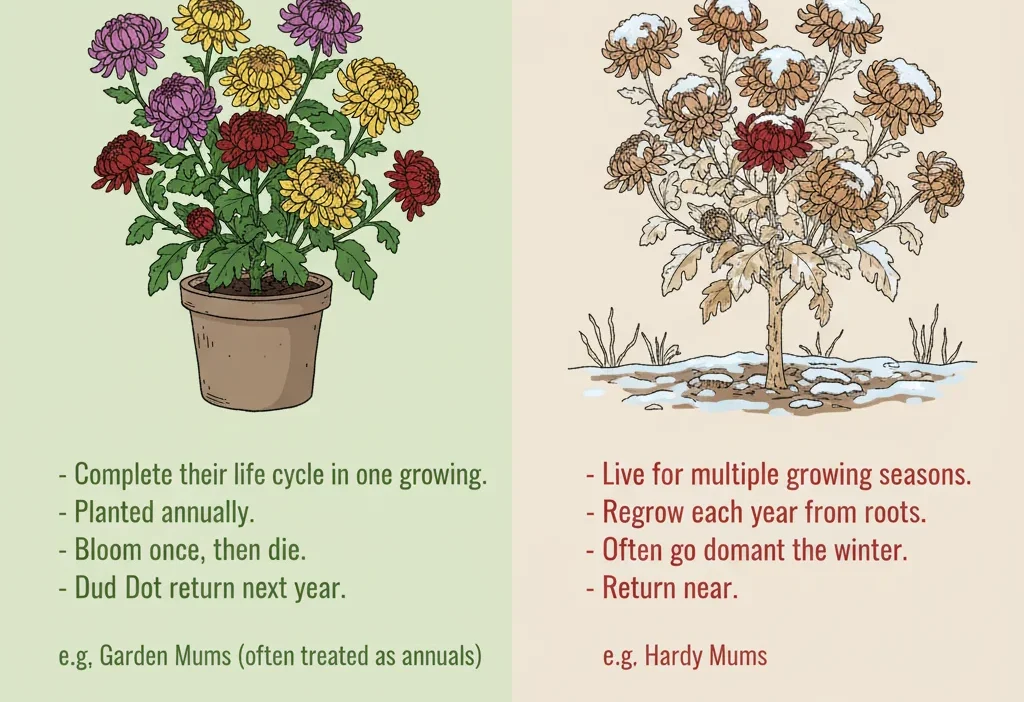
A plant is annual if it completes its life cycle in one season.
This means it grows, blooms, and dies in the same year.
Examples of Annual Plants
- Sunflowers
- Marigolds
- Zinnias
Annual mums last for only one season and do not return the next year.
3 Easy Examples Using “Annual”
- “This mum is annual, so it won’t grow again next year.”
- “I buy annual mums every fall for decoration.”
- “Annual plants bloom fast but don’t last long.”
What Does “Perennial” Mean?
A perennial plant lives for many years. It goes dormant in winter and returns every spring.
Examples of Perennial Plants
- Lavender
- Daylilies
- Hostas
Perennial mums can return year after year with proper care.
3 Easy Examples Using “Perennial”
- “These mums are perennial, so they’ll grow again.”
- “Perennial plants come back every year.”
- “Garden mums are often perennial.”
The Key Difference Between Mums as Annuals or Perennials
Comparison Table
| Feature | Annual Mums | Perennial Mums |
|---|---|---|
| Life Span | One season | Many years |
| Type of Mum | Florist mums | Garden mums (Hardy mums) |
| Return Next Year? | ❌ No | ✔️ Yes |
| Root Strength | Weak roots | Strong roots |
| Best Use | Fall decoration | Long-term garden growing |
| Example | Gift mums in pots | Hardy mums in garden beds |
Quick Tip to Remember
Florist mums = annual.
Garden mums = perennial.
If you buy mums in a gift pot, they are usually annual. If you buy hardy mums from a garden center, they are often perennial.
Common Mistakes and How to Avoid Them
Mistake 1: Thinking all mums are perennials
❌ Incorrect: “All mums come back every year.”
✔️ Correct: “Only hardy mums are perennial.”
Why it happens: People assume all mums are the same, but they are not.
Mistake 2: Planting mums too late
❌ If you plant mums right before winter, they won’t survive.
✔️ Plant hardy mums early in the fall so the roots can grow strong.
Mistake 3: Confusing pot mums with garden mums
❌ Florist mums are bred for looks, not survival.
✔️ Garden mums are bred to survive winter.
When to Use “Annual Mums”
You should call mums annuals when:
- They last for only one season
- They are florist mums
- They are used only for decoration
- You don’t expect them to return next year
Examples
- “These yellow mums are annuals for fall decoration.”
- “Annual mums bloom beautifully but die after winter.”
- “I buy annual mums every October.”
- “Pot mums are often annuals.”
- “These mums won’t come back because they’re annual.”
When to Use “Perennial Mums”
You should call mums perennials when:
- They survive winter
- They come back every year
- They are hardy garden mums
- They have strong roots
Examples
- “These perennial mums grow back each fall.”
- “Hardy mums are true perennials.”
- “Perennial mums return stronger every year.”
- “These garden mums are perennial.”
- “Plant perennial mums early for best results.”
Memory Hack
If the mum looks “too perfect” and is in a gift pot, it’s probably annual.
If it looks bushy and strong, it’s likely perennial.
Quick Recap: Mums Annuals or Perennials
- Annual mums = one season
- Perennial mums = many years
- Florist mums = annual
- Garden mums = perennial
- Plant early for best survival
- Root strength decides whether mums return
Advanced Tips
- The term “chrysanthemum” is the scientific name for mums.
- Perennial mums need cold-resistant stems and roots.
- In formal gardening, always label mums correctly to avoid confusion.
- In online writing, mislabeling mums as annual when they’re perennial can confuse readers, shoppers, and new gardeners.
Mini Quiz
Fill in the blanks:
- Florist mums are usually ________.
- Perennial mums come back ________.
- Garden mums have ________ roots.
- Annual mums last for ________ season.
- Hardy mums are usually ________.
- You must plant perennial mums ________ to survive winter.
- Gift mums are mostly ________ mums.
Conclusion
Now you clearly understand whether mums are annuals or perennials. You learned their meanings, key differences, examples, and how to use each term correctly. Mums can be both, depending on the type and how they’re grown. Keep practicing these concepts while gardening or helping others choose the right mums for their yard. With simple knowledge like this, improving your gardening skills becomes easy and fun!
FAQs
1. Are mums annuals or perennials?
They can be either—florist mums are annuals, and garden mums are perennials.
2. Do mums come back every year?
Only perennial (hardy) mums return yearly.
3. How can I tell if my mums are perennial?
Look for hardy labels, strong stems, and bushy shape.
4. Can I make annual mums act like perennials?
Not usually—annual mums have weak roots and won’t survive winter.
5. When should I plant perennial mums?
Early fall is best so the roots can grow before winter.

Gwendoline Riley delivers clear, compelling insights into language and usage, helping readers understand meanings, nuances, and differences with confidence.