Have you ever wondered whether to say negative or positive first when describing numbers, emotions, or test results? You’re not alone! Many English learners and even native speakers pause for a second before deciding which word should come first.
In this friendly guide, you’ll learn what negative and positive mean, the difference between them, and when to use each. We’ll explore grammar tips, real-life examples, and an easy trick to remember which to say first. By the end, you’ll confidently know whether to use negative or positive first — in writing, conversation, or even science class! 🌈
💡 What Does Each Word Mean?
Let’s start with simple meanings.
Meaning of “Negative”
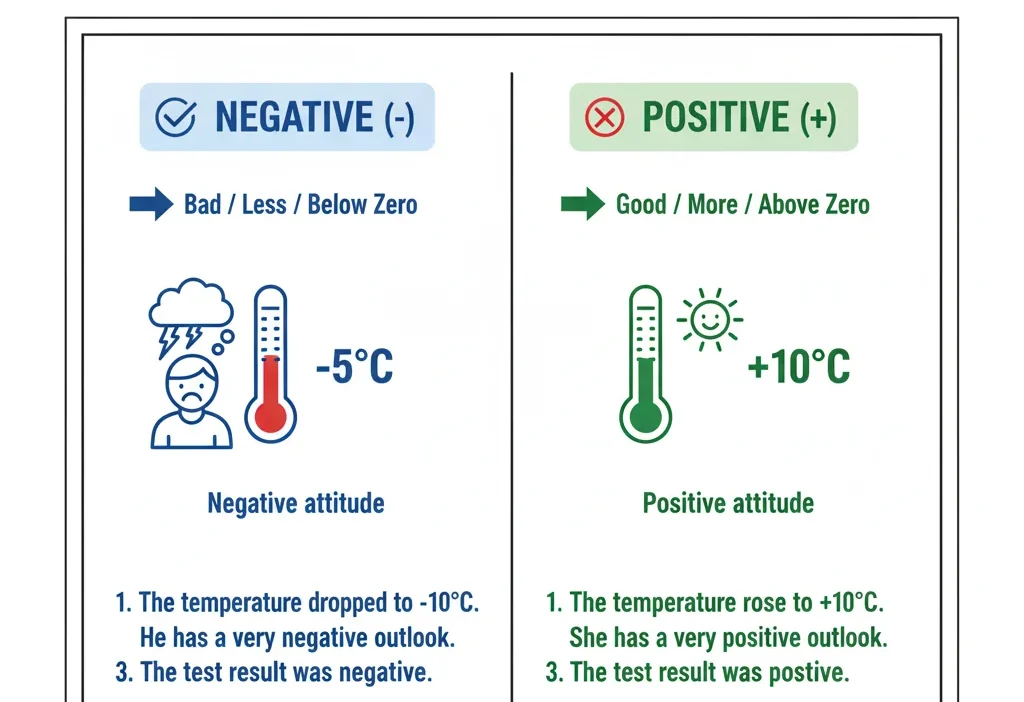
Negative means something below zero, bad, or unfavorable. It can describe numbers, feelings, or results.
Part of speech: adjective or noun
Easy examples:
- The temperature was negative five degrees.
- She had a negative attitude about the test.
- His COVID test result was negative (which is actually good!).
Mini story:
Imagine your math teacher says, “You owe me 3 pencils.” That’s like having negative pencils — less than zero!
Meaning of “Positive”
Positive means something above zero, good, or favorable. It shows presence, approval, or growth.
Part of speech: adjective or noun
Easy examples:
- The temperature is positive ten degrees today.
- He gave me positive feedback on my essay.
- Her test result came back positive.
Mini story:
If your friend gives you a gift, that’s a positive experience — something added or gained!
⚖️ The Key Difference Between Negative and Positive
Here’s a simple way to see the difference:
| Aspect | Negative | Positive |
|---|---|---|
| Meaning | Below zero, bad, or absence | Above zero, good, or presence |
| Example (Math) | -5 is a negative number | +5 is a positive number |
| Example (Feelings) | Negative thoughts make you sad | Positive thoughts make you happy |
| Example (Tests) | Negative = not found | Positive = found or detected |
| Common Words | minus, no, none, bad | plus, yes, good, happy |
Quick Tip 🧠:
➡️ When talking about numbers or science results, say “negative first.”
➡️ When talking about feelings or attitudes, say “positive first.”
🚫 Common Mistakes and How to Avoid Them
Let’s look at a few mix-ups people make:
❌ Incorrect: My report was positive negative.
✅ Correct: My report was negative or positive.
❌ Incorrect: The test is positive, meaning nothing was found.
✅ Correct: The test is negative if nothing is found.
❌ Incorrect: Negative feedback means you did well.
✅ Correct: Positive feedback means you did well.
Why it happens:
These mistakes happen because negative and positive can switch meanings depending on the situation — in health, math, or emotions.
📘 When to Use “Negative”
You should use negative when describing something unfavorable, below zero, or absent.
Use “negative” in these situations:
- Math or Science: The temperature dropped to negative 2°C.
- Health Tests: Your flu test result was negative.
- Behavior: She often gives negative comments.
- Mood: He was in a negative mindset after losing the game.
- Electricity: The battery has a negative terminal.
Memory Hack:
Think of negative as something taken away — like losing points or having zero cookies 🍪.
🌞 When to Use “Positive”
Use positive when describing something good, present, or above zero.
Use “positive” in these situations:
- Math or Science: Water freezes at a positive temperature.
- Health Tests: Her test came back positive for antibodies.
- Behavior: He always stays positive, even on bad days.
- Electricity: Connect the wire to the positive terminal.
- Results: The company saw positive growth this year.
Memory Trick:
Think of positive as a plus sign (+) — adding something good to your life! 🌼
🔁 Quick Recap: Negative vs Positive
Here’s an easy summary you can screenshot 📸
- Negative = less than zero, bad, or not present
- Positive = more than zero, good, or present
- In math or science, say negative or positive first
- In daily talk, it’s common to say positive attitude first
- Negative = – sign, Positive = + sign
✅ Quick Rule:
If it’s about measurement or testing, say negative first.
If it’s about mood or motivation, say positive first.
📚 Advanced Tips: Going Beyond Basics
- Origin:
Both words come from Latin roots — “negativus” (to deny) and “positivus” (to affirm). - Formal Writing:
In essays or reports, use “negative impact” or “positive outcome” for clear tone. - In Science:
Always state negative first when giving results, like “negative or positive charge.” - In Emotions:
Motivational writing usually places positive first, like “positive or negative thinking.” - In Everyday Use:
Both words appear in social media, like “Stay positive!” or “Avoid negative energy!”
🧠 Mini Quiz: Test Your Understanding
Fill in the blanks with negative or positive 👇
- The COVID test result was _______.
- She always tries to stay _______ during tough times.
- The number -10 is a _______ number.
- The feedback I got was very _______.
- The scientist tested both _______ and _______ samples.
- The weather changed from _______ five to _______ two degrees.
- A _______ attitude can help you reach your goals.
(Answers: 1-negative, 2-positive, 3-negative, 4-positive, 5-negative and positive, 6-negative five to positive two, 7-positive)
❓ FAQs
Q1. What does “negative or positive first” mean?
It means deciding which word to say or write first when comparing both. For test results or numbers, we usually say “negative or positive first.”
Q2. Is it correct to say “positive or negative first”?
Yes, if you’re talking about emotions, attitudes, or life outlooks — “positive or negative” sounds more natural.
Q3. Which is better to say — negative or positive?
It depends! For science, say negative first. For life or mindset, say positive first.
Q4. Why do we list negative before positive in science?
Because in measurement and testing, scientists check for absence (negative) before presence (positive).
Q5. How can I remember the difference easily?
Think of negative = minus (-) and positive = plus (+) — one removes, one adds!
🎯 Conclusion
Now you know exactly when to use negative or positive first — whether it’s about math, science, or feelings. You’ve learned their meanings, key differences, and real-life examples.
Remember: Negative = absence or below zero. Positive = presence or above zero.
Keep practicing, and soon this will come naturally every time you write or speak. Stay positive — and keep growing your English skills every day! 🌻

Jenn Ashworth offers clear, engaging explanations of language and usage, helping readers grasp meanings, nuances, and differences with accuracy and ease.