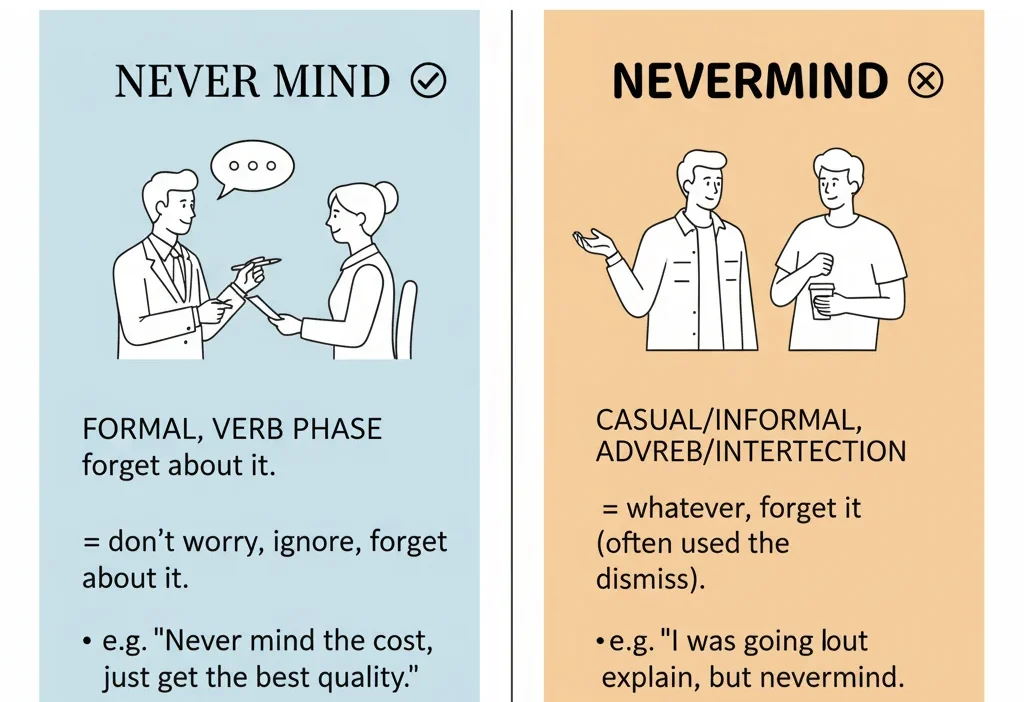
Have you ever wondered whether it’s correct to write nevermind as one word or never mind as two words? Many English learners and even native speakers get confused about this. Both forms appear in casual conversations, texts, and online writing, but only one is widely accepted in formal English.
In this guide, you’ll learn the meaning of each form, how they differ, and when to use them correctly. We’ll provide simple explanations, easy-to-understand examples, and even memory tricks to help you remember the right usage. By the end, you’ll confidently know whether to write nevermind or never mind, whether you’re texting a friend, writing an email, or practicing English grammar.
Even beginners will find this guide simple, practical, and fun to follow.
What Does Each Word Mean?
1. Never Mind
Never mind is a phrase used to tell someone not to worry about something or to ignore it. It’s usually polite and informal.
- Part of Speech: Phrase (verb + noun)
- Meaning: Forget it, don’t worry, or it’s okay
Examples:
- Never mind, I can do it myself.
- Oh, never mind! I already found the answer.
- Never mind what I said earlier, it’s not important.
Think of never mind as gently telling someone to “forget about it” or “don’t worry.”
2. Nevermind
Nevermind is often seen in casual writing, especially online. However, it is not standard English. You might see it in song titles or social media posts, but most grammar guides recommend avoiding it.
- Part of Speech: Single word (informal, sometimes used as a noun or title)
- Meaning: Same as never mind in casual usage, but often treated as incorrect in formal writing
Examples:
- Nevermind, I’ll figure it out.
- She said “Nevermind” and walked away.
- The song “Nevermind” by Nirvana is famous worldwide.
Think of nevermind as a shortcut you see online or in pop culture—it’s casual, but not for essays or professional writing.
The Key Difference Between Nevermind and Never Mind
| Feature | Never Mind | Nevermind |
|---|---|---|
| Correctness | Standard English, recommended in formal and informal writing | Informal, often considered incorrect in standard English |
| Usage | Telling someone to forget or not worry | Casual, slang, pop culture titles, online texting |
| Example | “Never mind, I can do it later.” | “Nevermind, I’ll handle it myself.” (acceptable online) |
| Memory Tip | Think “two words = polite, correct” | Think “one word = casual, sometimes wrong” |
Quick Tip: When in doubt, always use never mind as two words—it’s safe and correct.
Common Mistakes and How to Avoid Them
Mistake 1: Writing nevermind in formal emails or essays.
- ❌ Incorrect: Nevermind the instructions, I’ll do it my way.
- ✅ Correct: Never mind the instructions, I’ll do it my way.
Mistake 2: Confusing the phrase with mind never, which is grammatically wrong.
- ❌ Incorrect: Mind never what I said.
- ✅ Correct: Never mind what I said.
Mistake 3: Using nevermind in professional writing.
- ❌ Incorrect: Nevermind your report, I read it.
- ✅ Correct: Never mind your report, I read it.
Why these mistakes happen: People see nevermind online and think it’s correct. Always remember: formal writing = never mind (two words).
When to Use Never Mind
Use never mind when you want to politely ask someone to ignore something or not worry.
Situations:
- In conversations: Never mind, it’s not important.
- In emails or letters: Never mind my previous message.
- In school: Never mind the mistake, try again.
- Daily life: Never mind the mess, we can clean it later.
Examples:
- Never mind that I’m late; let’s start the meeting.
- If you can’t come, never mind—I understand.
- Never mind asking her, she’s busy right now.
- Never mind the traffic, I’ll be patient.
Memory Hack: Two words = polite reminder to forget or ignore something.
When to Use Nevermind
Use nevermind only in casual writing, texting, or as a proper noun in songs and pop culture.
Situations:
- Texting a friend: Nevermind, I’ll handle it.
- Social media posts: Nevermind, let’s do it later.
- Song or book titles: “Nevermind” by Nirvana.
Examples:
- Nevermind, I didn’t need your help anyway.
- She just said “Nevermind” and walked away.
- I listened to “Nevermind” last night.
Memory Trick: One word = informal, casual, or pop culture. Two words = polite and standard English.
Quick Recap: Nevermind vs Never Mind
- Never mind (two words): Correct, standard English; tells someone not to worry.
- Nevermind (one word): Informal, casual, often incorrect in professional writing.
- Use two words in emails, essays, or schoolwork.
- Use one word in texts, social media, or as a title.
- Tip: When unsure, always write never mind.
Advanced Tips (Optional)
- Origin: The phrase never mind has been used in English since the 16th century.
- Formal writing: Always use never mind in essays, exams, and professional communication.
- Online usage: Nevermind has become popular in memes, texting, and song titles, but avoid it in academic work.
Mini Quiz: Test Yourself
Fill in the blanks with never mind or nevermind:
- _____, I found the answer myself.
- She said _____ and walked away.
- _____ the previous message; it was a mistake.
- He shouted, “_____! I’ll do it later.”
- I listened to Nirvana’s album “_____.”
Answers:
- Never mind
- Nevermind
- Never mind
- Never mind
- Nevermind
FAQs
1. Is “nevermind” correct?
- Nevermind is informal and not recommended in standard English. Use never mind instead.
2. Can I use “nevermind” in emails?
- No, always use never mind in professional or academic writing.
3. What’s the meaning of “never mind”?
- It means “forget it” or “don’t worry about it.”
4. Is “never mind” polite?
- Yes, it is a polite way to tell someone to ignore or forget something.
5. How do I remember the difference?
- Two words = standard and polite. One word = casual or pop culture.
Conclusion
Understanding the difference between nevermind and never mind is simple once you know the rules. Always remember: two words = polite and correct, while one word = casual and informal. By practicing these examples and tips, you can confidently use the right form in conversations, texts, emails, and schoolwork.
English becomes easier when you pay attention to small details like this. Start using never mind in your daily writing, and soon it will feel natural. Every step you take toward mastering these little grammar tricks helps you speak and write better. Keep practicing, and enjoy learning English!

Francis Sufford crafts thoughtful, insightful explanations on language, meaning, and usage, blending clarity with storytelling to guide readers effectively.