“The ‘or’ symbol (|) represents choices, alternatives, or logical operations in writing, programming, and mathematics.”
Confused about the “or” symbol and its correct usage? The or symbol, often written as “|” (vertical bar), is a versatile symbol used in writing, logic, mathematics, and programming to indicate alternatives, options, or logical operations. Using it correctly ensures your statements are clear, professional, and error-free.
Key Uses of the Or Symbol
- In Programming (Logical OR):
The or symbol checks multiple conditions.
Example:if (x > 10 || y < 5)→ Executes if x > 10 or y < 5. - In Writing (Alternatives):
Shows choices or options in text.
Example: “Choose your favorite drink: tea | coffee | juice.” - In Mathematics & Logic:
Represents logical OR operations in formulas or expressions.
Example:A ∨ Bmeans A or B is true.
Tips for Using the Or Symbol Correctly
- Use || in programming for logical OR.
- Use | in writing to separate options clearly.
- Avoid mixing programming and writing styles in the same context.
- Ensure spacing is consistent to improve readability.
Understanding the or symbol is essential for students, coders, writers, and professionals, as it ensures clarity and correctness in your work. This article provides full explanation, practical examples, and tips to use the or symbol confidently in any context.
🔤 What Does the “Or” Symbol Mean?
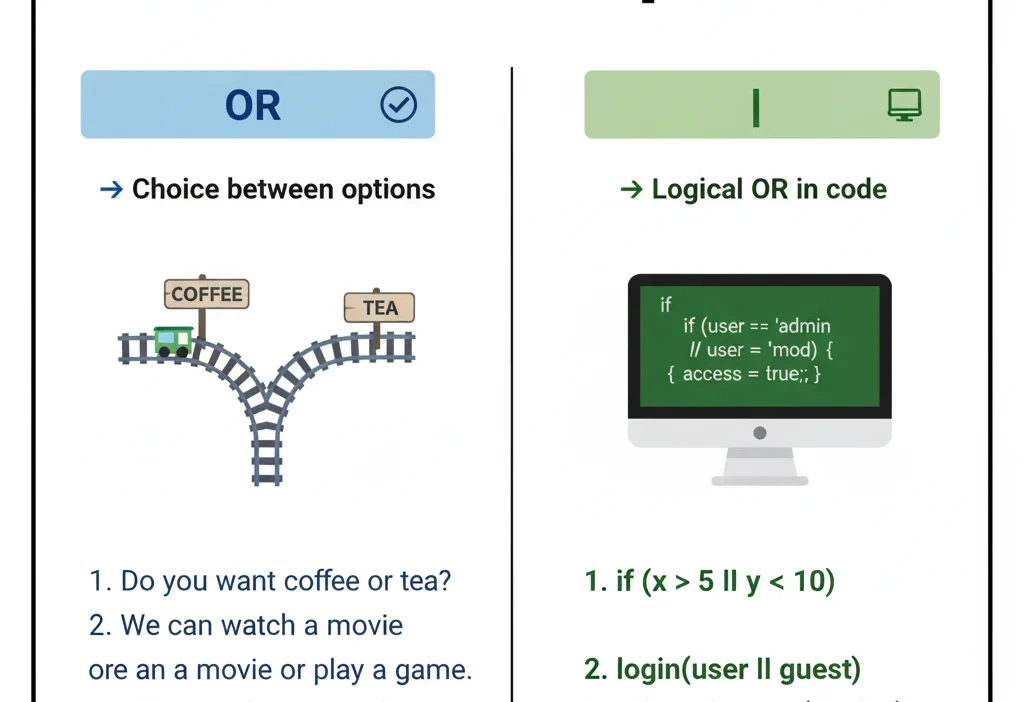
The “or” symbol or word shows a choice, option, or alternative between two or more things. It connects ideas that cannot happen at the same time or gives different possibilities.
✅ Grammar Meaning:
In everyday English, “or” connects words or phrases to show a choice.
Part of Speech: Conjunction
Examples:
- Do you want tea or coffee?
- You can come today or tomorrow.
- Should I call you, or will you text me?
💡 Tip: “Or” = choice between two or more options. Think of it as a fork in the road (↔️) — you can go one way or the other.
💻 The “Or” Symbol (|) in Logic and Programming
In computing and mathematics, the vertical bar (|) stands for logical OR — a condition that is true if any one of the options is true.
✅ Programming Example:
if a == 10 | b == 20:
    print("At least one condition is true")
Here, the | operator checks if either condition is true. It’s different from the word “or” in sentences but carries the same choice meaning logically.
✅ Math Example:
- A∣BA | BA∣B means “A or B” is true.
- 1 | 0 = 1 (because one of them is true).
💡 Tip: In logic and coding, “|” means at least one condition must be true.
🧠 The Key Difference Between “Or” and the “|” Symbol
Here’s a simple chart explaining their difference:
| Feature | Word “or” | Symbol “|” |
|———-|—————-|—————-|
| Used In | English grammar | Math, logic, programming |
| Meaning | Choice between two options | Logical OR (any one is true) |
| Part of Speech / Type | Conjunction | Operator |
| Example | Tea or coffee? | A | B = True |
| Quick Tip | For sentences | For formulas and code |
✅ Memory Hack:
If you’re writing words, use “or.”
If you’re writing logic or code, use “|.”
🚫 Common Mistakes and How to Avoid Them
Let’s look at some everyday mix-ups with “or” and the “|” symbol.
❌ Incorrect: You | me should go first.
✅ Correct: You or me should go first.
👉 Reason: In grammar, we use the word “or,” not the symbol.
❌ Incorrect (in code):
if a == 5 or| b == 10:
✅ Correct:
if a == 5 or b == 10:
👉 Reason: The symbol “|” and word “or” are different in programming syntax.
❌ Incorrect: 2 and 3 both true | false
✅ Correct: Use | in logic, not in normal English writing.
💡 Simple Rule:
- In English sentences → use or
- In math or code → use |
📚 When to Use the Word “Or”
Use “or” in writing and speech when you want to show choices, options, or alternatives.
✅ Examples:
- Would you like cake or ice cream?
- We can go to the park or the mall.
- You must finish today or lose points.
- Is it yes or no?
- I’ll call you or message you later.
💡 Memory Trick:
If you can replace it with “either this or that,” it’s the word “or.”
💻 When to Use the “|” Symbol
Use the “|” symbol in math, logic, or programming to represent OR operation or absolute value (in some contexts).
✅ Programming (Logical OR):
if x == 1 | y == 2:
    print("True")
✅ Mathematics:
- |x| means the absolute value of x (distance from zero).
- A | B means A or B is true.
✅ Data / Excel Example:
In formulas, “|” may be used in logical operations or filters.
💡 Memory Trick:
“|” looks like a gate — it opens to any one true option.
🧩 Quick Recap: “Or” vs “|”
| Feature | Or (word) | | (symbol) |
|———-|—————-|—————-|
| Used In | Grammar / Writing | Math, Logic, Coding |
| Meaning | Choice between options | Logical operation (true if any condition is true) |
| Type | Conjunction | Operator |
| Example | Tea or coffee? | A | B = True |
| Memory Tip | Words = “or” | Formulas = “|” |
🧠 Advanced Tips (For Grammar and Coding Learners)
- Origin: The word “or” comes from Old English oþer meaning other, second, or choice.
- In Logic: “OR” is often written as ∨ (mathematical symbol) or | in programming.
- In English: Use commas with “or” when listing multiple options.
Example: You can eat apples, bananas, or grapes. - In Programming: Don’t confuse | (bitwise OR) with || (logical OR) in languages like C++ or JavaScript.
✏️ Mini Quiz — Test Yourself!
Choose the correct word or symbol (or / |):
- Would you like coffee ___ tea?
- In Python, we can write a == 1 ___ b == 2.
- A ___ B = True (if any is true).
- Should I stay ___ go?
- |x| = 5 means x = 5 ___ x = -5.
✅ Answers:
- or | 2. | | 3. | | 4. or | 5. or
❓ FAQs
Q1: What does the “or” symbol mean?
It represents a choice or alternative — in grammar it’s a conjunction; in coding, it’s a logical operator.
Q2: Is “|” the same as “or”?
Not exactly. The symbol “|” is used in math and code, while “or” is used in normal writing.
Q3: What’s the grammar difference between “or” and “|”?
“Or” connects words or phrases; “|” connects logical statements or numbers.
Q4: Can I use “|” in English sentences?
No. Use “or” in grammar and writing. “|” is for programming or logic.
Q5: How do I remember the difference?
If it’s text, write “or.”
If it’s math or code, use “|.”
✅ Conclusion
The “or” symbol (|) and the word “or” both express choices, but they belong to different worlds.
In grammar, “or” is a conjunction connecting options.
In coding or logic, “|” represents a logical OR — true if any condition is true.
By understanding their meanings and contexts, you’ll use each one correctly every time. Whether writing essays, solving math problems, or programming, this small difference makes a big impact.

Jenn Ashworth offers clear, engaging explanations of language and usage, helping readers grasp meanings, nuances, and differences with accuracy and ease.