Have you ever called a stubborn friend “ornery” or read the word in a classic novel and stumbled over its spelling? You’re not alone. Every month, thousands of people search for “ornery,” seeking clarity on its meaning, its correct spelling, and its surprisingly rich character.
The confusion often peaks around the incorrect spelling “onery,” a common typo that reflects how the word is casually pronounced. This search represents more than a spelling check—it’s a quest to understand a uniquely expressive term that captures a specific blend of stubbornness, irritability, and mischievous charm.
This article is your definitive guide. We’ll resolve the ornery / onery spelling debate once and for all, tracing the word’s fascinating journey from a simple dialectical alteration to a staple of descriptive English.
Whether you’re a writer aiming for authenticity, a student analyzing text, or simply a curious wordsmith, understanding “ornery” unlocks a deeper appreciation for language that paints vivid personality portraits. Let’s dive into the history, usage, and enduring appeal of this wonderfully cantankerous word.
Ornery
The correct spelling is ornery. “Onery” is a common misspelling and informal pronunciation, but it is not considered standard in written English. The word is an adjective used to describe someone who is stubborn, bad-tempered, and often inclined to cause minor trouble or annoyance. It suggests a kind of grumpy, combative attitude that is sometimes more mischievous than truly malicious.
Examples in a sentence:
- “The ornery old mule refused to budge from the middle of the road.”
- “Despite his ornery exterior, he had a heart of gold.”
- “She gets a bit ornery if she hasn’t had her morning coffee.”

The Origin of Ornery
The word “ornery” is a beautiful example of how language evolves through everyday speech. Its story begins with the word “ordinary.” In the early 1800s, in American regional dialects, particularly in the South and Midland US, “ordinary” took on a derogatory twist. To call something “ordinary” meant it was common, plain, or of low quality.
Through a process called phonetic alteration or “slurring,” the pronunciation began to shift. “Ornery” emerged as a dialectal variant, shedding the middle syllable and hardening the “d” sound. This new word, “ornery,” carried forward the negative connotation of “ordinary” but specialized it to describe a person with a common, mean, or disagreeable disposition. It was the language of the frontier and rural America, capturing a very specific type of difficult personality that was both frustrating and familiar. The persistence of the misspelling “onery” is a direct echo of this casual, spoken pronunciation where the first “r” sound is often dropped.
British English vs. American English Spelling
The ornery / onery dilemma is less about transatlantic spelling differences (like colour vs. color) and more about standard spelling versus phonetic misspelling. However, understanding broader spelling rules helps clarify why “ornery” is correct.
American English often favors simplified and phonetic spellings, but it maintains consistency with a word’s etymological root where possible. Since “ornery” derives from “ordinary,” retaining the “r” after the “o” is standard.
British English, while having different rules for words like theatre/theater or realise/realize, would also accept only “ornery” as the correct form. The misspelling “onery” is considered incorrect in all standard forms of written English, regardless of dialect.
Comparison Table: Ornery in English Variants
| Variant | Correct Spelling | Common Misspelling | Notes |
|---|---|---|---|
| American English | ornery | onery | The standard spelling. “Onery” reflects informal speech. |
| British English | ornery | onery | Same spelling as US; the word is less common in UK usage. |
| General Standard | ornery | onery | “Onery” is universally considered a spelling error. |
Which Spelling Should You Use?
The answer is simple and universal: always use “ornery” in any form of writing where standard English is expected.
- For a US Audience: Use “ornery”. While some might pronounce it as “onery” in casual conversation, the written standard is clear. Using the correct spelling shows attention to detail.
- For a UK/Commonwealth Audience: Use “ornery”. The word is understood, though potentially seen as an Americanism. The spelling rule remains the same.
- For Global/Formal Writing (Academic, Business, Publishing): You must use “ornery”. “Onery” will be marked as a spelling mistake by editors, teachers, and proofreading software.
- For Creative Writing/Dialogue: Here you have artistic license. If you are writing dialogue for a character who speaks in a specific dialect where “onery” is the natural pronunciation (e.g., a rural Southern character in a novel), you might spell it phonetically as “onery” to capture their voice authentically. However, in the narration itself, stick to “ornery”.
Common Mistakes with Ornery
- The Primary Misspelling: Onery
- Mistake: “He was being so onery about the rules.”
- Correction: “He was being so ornery about the rules.”
- Why: This is a phonetic error. Always remember the first “r.”
- Confusion with Meaning: Ornery vs. Mean
- Mistake: Using “ornery” to describe someone who is cruelly or violently mean.
- Correction: “Ornery” is better for describing stubborn, grumpy, or mischievous irritation, not malice. A person can be ornery without being evil.
- Pronunciation Errors: Or-nery vs. On-ery
- While pronouncing it as “on-ery” is common in some dialects, the more standard pronunciation includes the first “r” sound: /ˈɔːr.nɚ.i/ (OR-ner-ee).
Ornery in Everyday Examples
- Email (Workplace): “I apologize if I seemed ornery in the meeting earlier; I was grappling with a technical issue that had me frustrated.”
- News Headline: “Local Mayor’s Ornery Stance on Development Divides Council.”
- Social Media Post: “My cat is in an especially ornery mood today. He’s knocked over two plants and is now glaring at me from the bookshelf. #CatLife”
- Formal Writing/Literary Analysis: “The author uses the ornery nature of the protagonist not as a flaw, but as a shield for a deep-seated vulnerability, challenging the reader’s initial judgment.”
Ornery – Google Trends & Usage Data
Analysis of search data reveals consistent, moderate interest in the term “ornery,” with predictable spikes around the common misspelling “onery.” Geographically, search interest is strongest within the United States, particularly in regions with deeper historical ties to the word’s dialectical roots, such as the Midwest and the South. This aligns perfectly with the word’s American origin story.
Searches often cluster around intent to define (“ornery meaning”), to spell (“ornery or onery”), and to find synonyms (“ornery synonym”). The data shows people encounter the word in literature, film, and regional conversation and turn to search engines for clarification, confirming its status as a recognizable yet slightly elusive piece of vocabulary.

(FAQs)
1. What does being ornery mean?
Being ornery means being habitually bad-tempered, combative, and stubborn in a sometimes mischievous or irritating way. It’s more about a difficult attitude than serious malice.
2. Is “ornery” a negative word?
It is generally negative, but often with a softened or slightly humorous connotation. Calling someone “ornery” can imply their behavior is frustrating but not necessarily hateful.
3. How did “ornery” become a word?
“Ornery” is a phonetic alteration of the word “ordinary.” In 19th-century American dialect, “ordinary” meant common or vulgar. Over time, the pronunciation slurred into “ornery,” which came to mean having a common, mean, or disagreeable disposition.
4. What is a synonym for ornery?
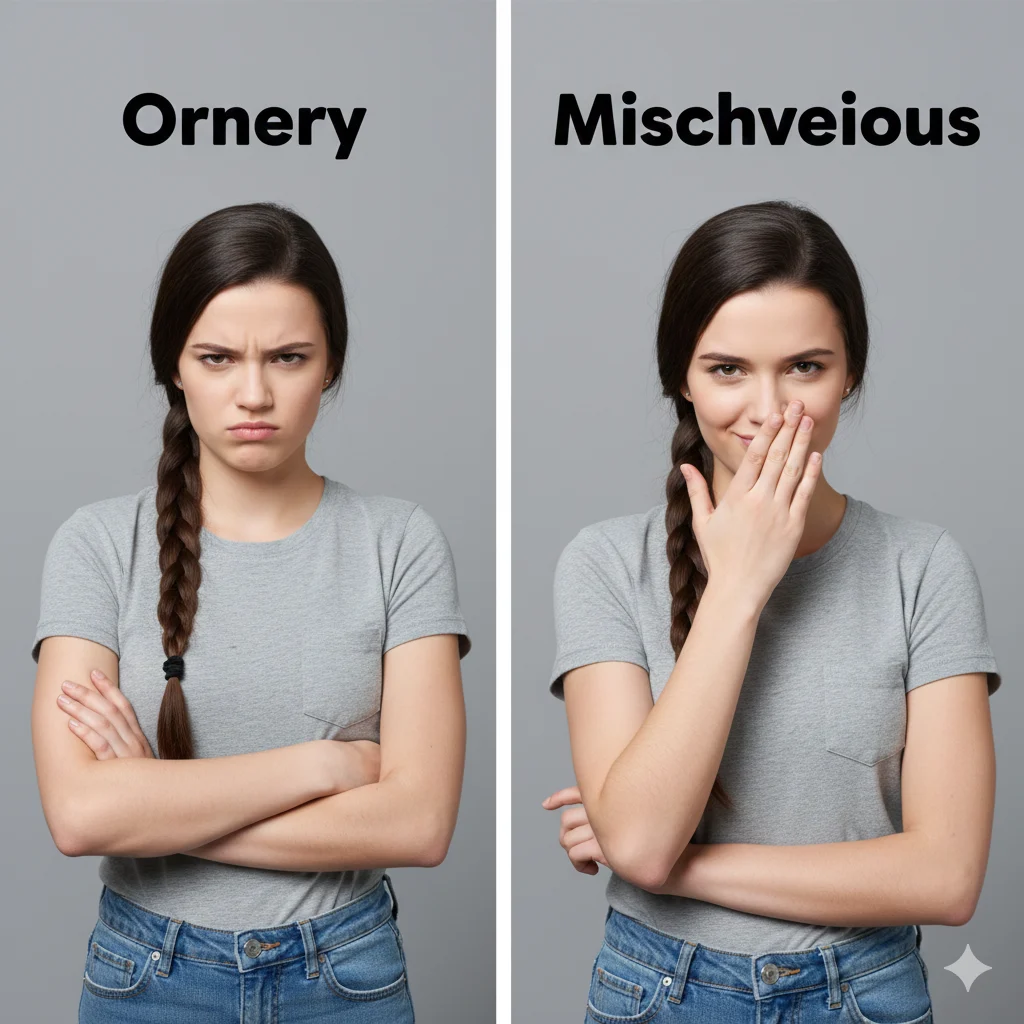
Common synonyms include cantankerous, crotchety, grumpy, irascible, curmudgeonly, and contrary. “Mischievous” can be a related trait but doesn’t capture the grumpiness.
5. How do you pronounce “ornery”?
The standard pronunciation is OR-ner-ee (/ˈɔːr.nɚ.i/), with a clear “r” after the “o.” The pronunciation “ON-ery” is a common dialectal variant but is non-standard.
6. Can “ornery” be used for things, not just people?
Yes, informally. You might describe an ornery computer that freezes at inconvenient times or an ornery zipper that won’t close smoothly, attributing a stubborn, troublesome personality to the object.
7. What’s the difference between ornery and stubborn?
“Stubborn” simply means unreasonably refusing to change. “Ornery” includes stubbornness but adds layers of irritability, bad temper, and a tendency to be difficult or contrary.
Conclusion
Navigating the ornery / onery confusion ultimately leads us to a richer understanding of a uniquely expressive word. The correct spelling, “ornery,” is a small but important key to using the term effectively in writing. Its journey from a slurred form of “ordinary” to a descriptor for a particular kind of grumpy, stubborn character is a testament to the living, evolving nature of English.
Remember, “ornery” does more than just describe stubbornness; it paints a mini-portrait of personality—think of the old cowboy set in his ways, the neighbor who complains about everything but secretly feeds stray cats, or even yourself before that first cup of coffee. It’s a word with character, used to describe character. So, whether you’re writing a story, crafting an email, or simply satisfying a linguistic curiosity, you can now confidently use—and spell—this wonderfully cantankerous term.

Eley Williams writes clear, engaging guides on confusing words and phrases, helping readers understand meanings, differences, and correct usage with ease.