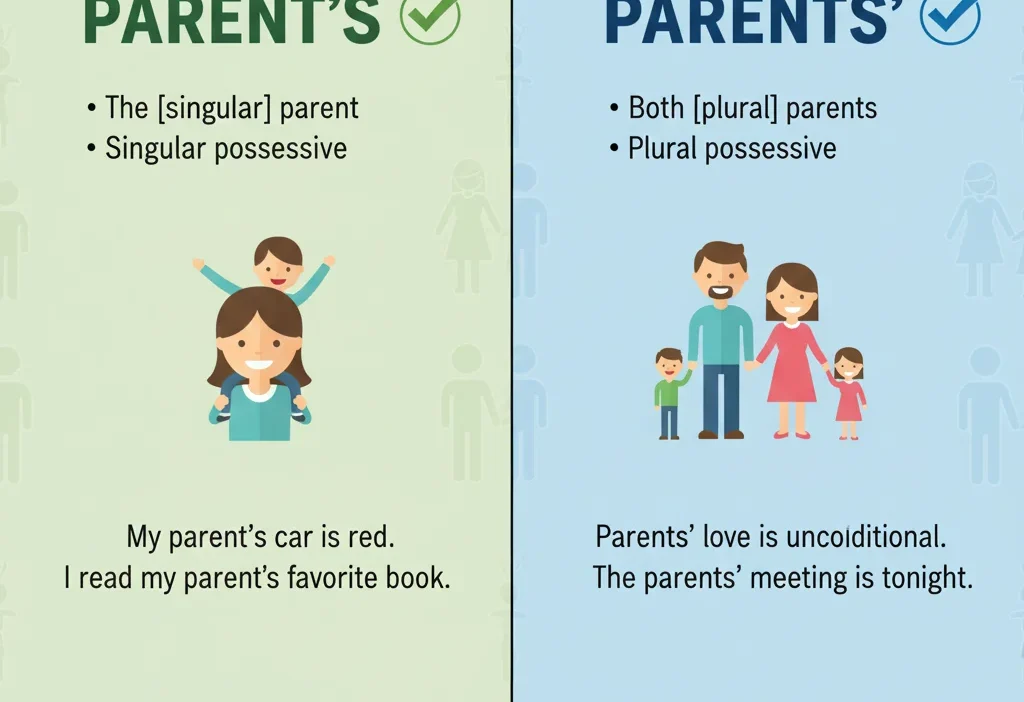
👉 Use parent’s when you are talking about one parent and something that belongs to them.
👉 Use parents’ when you mean both parents and something that belongs to them.
The apostrophe position is the secret. Small mark, big meaning.
Many English learners — and even native speakers — get confused between parent’s or parents’. They look almost the same, sound the same, and appear in similar sentences. A tiny apostrophe causes a big problem. 😄
This confusion often happens in school homework, essays, emails to teachers, and even text messages. One small mistake can change the whole meaning of your sentence.
In this easy-to-follow guide, you will learn:
- The meaning of parent’s and parents’
- The key difference between them
- Simple rules to remember correct usage
- Real-life examples anyone can understand
- Common mistakes and how to avoid them
Don’t worry — this explanation is so simple that even a 4th-grade student can understand it. By the end, you’ll confidently know when to use parent’s or parents’ correctly every time.
What Does Each Word Mean?
Let’s start with the basic meanings.
What Does Parent’s Mean?
Parent’s shows that one parent owns something.
- Parent = one mother or one father
- ’s = shows ownership (something belongs to them)
📌 Parent’s = belonging to one parent
Easy Examples:
- This is my parent’s phone.
(One parent owns the phone.) - I forgot my parent’s signature on the form.
- My parent’s advice helped me a lot.
🧠 Story Trick:
Imagine only one parent standing in front of you. Anything they hold belongs to parent’s.
What Does Parents’ Mean?
Parents’ shows that both parents own something together.
- Parents = mother and father (more than one parent)
- ’ after s = ownership by more than one person
📌 Parents’ = belonging to both parents
Easy Examples:
- This is my parents’ house.
(Mom and dad own it together.) - My parents’ decision was final.
- We visited my parents’ hometown.
🧠 Story Trick:
If both parents are standing together, you must use parents’.
The Key Difference Between Parent’s and Parents’
The difference depends on how many parents you are talking about.
Comparison Table
| Feature | Parent’s | Parents’ |
|---|---|---|
| Number of parents | One parent | Both parents |
| Apostrophe position | Before s | After s |
| Meaning | Belonging to one parent | Belonging to two parents |
| Example | Parent’s car | Parents’ car |
⭐ Quick Tip to Remember
- Apostrophe before S → one parent
- Apostrophe after S → more than one parent
👉 Count the parents first. Then place the apostrophe.
Common Mistakes and How to Avoid Them
Let’s look at mistakes people often make.
❌ Mistake 1
Wrong: My parent’s are coming today.
Correct: My parents are coming today.
📌 Why?
You don’t need an apostrophe when it’s just plural (more than one). No ownership here.
❌ Mistake 2
Wrong: This is my parents house.
Correct: This is my parents’ house.
📌 Why?
The house belongs to both parents, so add an apostrophe after s.
❌ Mistake 3
Wrong: My parents advice was helpful.
Correct: My parents’ advice was helpful.
📌 Fix:
Always ask: Who owns it?
If both parents own it → parents’
When to Use Parent’s
Use parent’s when one parent owns something or does something.
Common Situations
- Talking about mother or father (not both)
- School forms
- Personal advice
- Single-parent situations
Easy Examples:
- My parent’s car is blue.
- I need my parent’s permission.
- The parent’s job keeps them busy.
- My parent’s cooking is amazing.
- The teacher called my parent’s number.
🧠 Memory Hack:
Only ONE parent? Apostrophe goes before S.
When to Use Parents’
Use parents’ when both parents own something or do something together.
Common Situations
- Family rules
- Shared house or car
- Joint decisions
- Family trips
Easy Examples:
- My parents’ house is big.
- I follow my parents’ rules.
- My parents’ anniversary is today.
- We visited my parents’ office.
- My parents’ decision surprised me.
🎨 Visual Trick:
Imagine two parents holding an item together → apostrophe goes after S.
Quick Recap: Parent’s vs Parents’
- Parent’s → one parent owns something
- Parents’ → both parents own something
- Apostrophe position shows how many parents
- No apostrophe for simple plural (parents)
✔ Count first
✔ Place apostrophe correctly
✔ Check meaning
Advanced Tips (For Exams & Writing)
- In formal writing, apostrophe mistakes lower marks.
- In essays, teachers quickly notice this error.
- In texting, wrong usage can confuse meaning.
- The possessive apostrophe comes from old English grammar rules showing ownership.
📘 Exam Tip:
If unsure, rewrite the sentence:
- “The house of my parents” → parents’ house
- “The phone of one parent” → parent’s phone
Jesus’ or Jesus’s: The Tiny Grammar Detail Everyone Gets Wrong
Mini Quiz: Test Yourself ✅
Fill in the blanks:
- My ________ car is parked outside. (one parent)
- I follow my ________ rules. (both parents)
- This is my ________ signature.
- We like our ________ cooking.
- The teacher called my ________ number.
Answers:
- parent’s
- parents’
- parent’s
- parents’
- parent’s
FAQs: Parent’s or Parents’
1. What is the difference between parent’s and parents’?
Parent’s is for one parent. Parents’ is for both parents owning something.
2. Is parents’ grammatically correct?
Yes. It shows ownership by more than one parent.
3. When do I use parent’s?
When something belongs to only one parent.
4. Can parents be plural without apostrophe?
Yes. Example: My parents are kind.
5. Why is this mistake so common?
Because both sound the same when spoken, but differ in writing.
Conclusion
Now you clearly understand the difference between parent’s or parents’. The rule is simple:
👉 One parent = parent’s
👉 Both parents = parents’
That tiny apostrophe tells a big story. With a little practice, this grammar mistake will disappear forever. Keep reading, practicing, and correcting small errors — they lead to big improvements in saying and writing English confidently.

Eley Williams writes clear, engaging guides on confusing words and phrases, helping readers understand meanings, differences, and correct usage with ease.