Have you ever written parents’ or parent’s and wondered if you used the right one? You’re not alone! These two little words confuse many English learners — and even native speakers — because just one tiny apostrophe changes the meaning completely. In this simple guide, we’ll explain what parents’ and parent’s mean, the difference between them, and when to use each one correctly. By the end, you’ll never mix them up again. Let’s make it easy — even for beginners and young learners — with simple meanings, examples, and quick tips!
🧩 What Does Each Word Mean?
Before we talk about the difference between parents’ and parent’s, let’s first understand what each one means. Both come from the same base word — parent — but the apostrophe (’) changes how we use them.
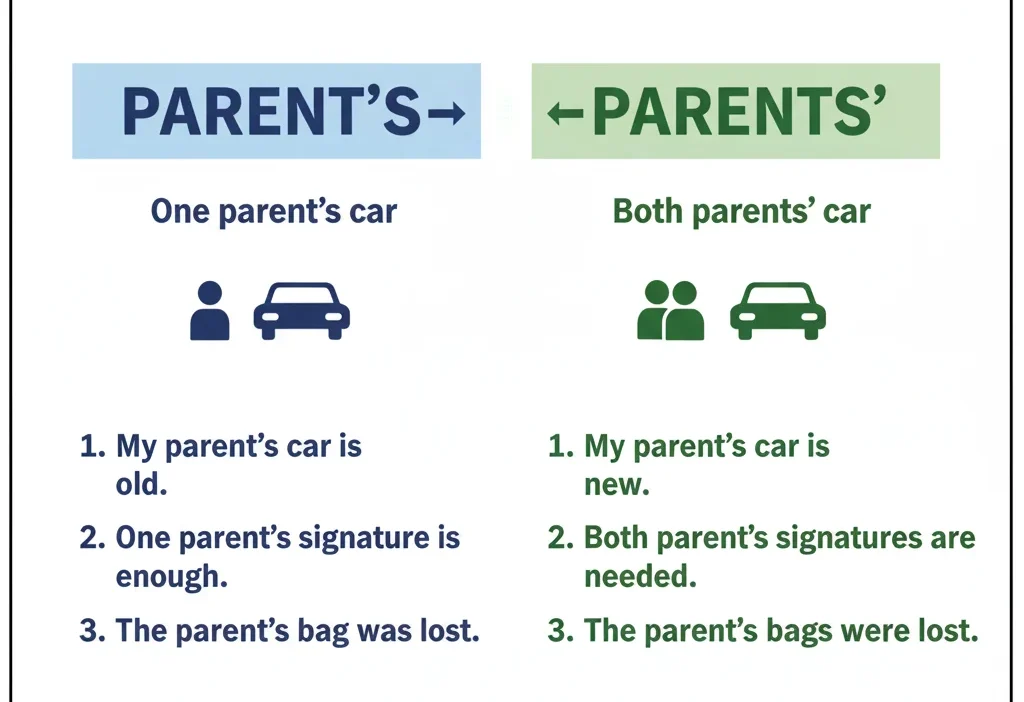
1. Parent’s (Singular Possessive Form)
👉 Meaning: Something belongs to one parent (either mother or father).
- The apostrophe comes before the “s” to show that one parent owns or possesses something.
Examples:
- My parent’s car is parked outside. (One parent owns the car.)
- I have to sign my parent’s permission slip. (One parent needs to sign it.)
- My parent’s advice helped me make the right choice. (Advice from one parent.)
📘 Simple Tip: “Parent’s” = belongs to one parent.
2. Parents’ (Plural Possessive Form)
👉 Meaning: Something belongs to both parents (mother and father).
- The apostrophe comes after the “s” to show that more than one parent owns something.
Examples:
- My parents’ house is very cozy. (Belongs to both parents.)
- I always listen to my parents’ opinions. (Opinions from both.)
- We went to my parents’ anniversary party. (Celebrating both together.)
📘 Simple Tip: “Parents’” = belongs to both parents.
⚖️ The Key Difference Between Parent’s and Parents’
Here’s the easiest way to see how parent’s and parents’ are different:
| Word | Meaning | Who It Refers To | Example Sentence |
|---|---|---|---|
| Parent’s | Belonging to one parent | Singular (Mother or Father) | My parent’s car is new. |
| Parents’ | Belonging to both parents | Plural (Mother and Father) | My parents’ car is new. |
💡 Quick Tip to Remember:
If you’re talking about one, the apostrophe goes before the S → Parent’s.
If you’re talking about two or more, the apostrophe goes after the S → Parents’.
❌ Common Mistakes and How to Avoid Them
Even advanced writers sometimes mix these up! Let’s see the common errors and how to fix them.
| ❌ Wrong | ✅ Correct | 💬 Why? |
|---|---|---|
| My parents’s room is upstairs. | My parents’ room is upstairs. | Never add an extra “s” after parents’. |
| My parent’s are coming to visit. | My parents are coming to visit. | There’s no apostrophe — you’re not showing ownership, just talking about them. |
| I borrowed my parents’ coat. | I borrowed my parent’s coat. | If you mean one parent, use parent’s. |
✅ Grammar Tip: Only use an apostrophe when you’re showing ownership or possession — not just talking about people.
🧠 When to Use “Parent’s” (Singular Possessive)
Use parent’s when something belongs to one parent — your mom or dad, not both.
Example situations:
- My parent’s phone is ringing. (One parent’s phone.)
- I followed my parent’s advice and studied hard.
- My parent’s signature is required on the form.
- My parent’s cooking is my favorite!
- The teacher met my parent’s friend.
📍 Memory Hack: Imagine one parent holding something. That’s parent’s — one person owns it.
💞 When to Use “Parents’” (Plural Possessive)
Use parents’ when something belongs to both parents.
Example situations:
- We live in my parents’ old house.
- My parents’ support means everything to me.
- I’m saving for my parents’ anniversary gift.
- The children played in their parents’ garden.
- My parents’ rules are strict but fair.
📍 Memory Hack: Imagine both parents sharing something — that’s parents’ (the apostrophe after s means “more than one”).
🔄 Quick Recap: Parent’s vs Parents’
Let’s keep it super simple:
- Parent’s = One parent’s thing 🧍♀️
- Parents’ = Both parents’ thing 👩👩👦
- No apostrophe = just talking about parents, not showing ownership.
Remember:
One = Parent’s
Two = Parents’
Mini Examples:
- My parent’s car = car of my mom or dad.
- My parents’ car = car of both mom and dad.
- My parents are kind = no apostrophe, just talking about them.
🌍 Advanced Grammar Tips & Fun Facts
Even though this is simple, here are some fun ways to understand it deeper:
1. Origin of the Words
The word parent comes from Latin parens, meaning “one who gives birth or cares for.” When you add ’s, it shows ownership, just like teacher’s, student’s, or dog’s.
2. Use in Formal Writing
In essays, letters, or emails, using the correct apostrophe shows good grammar skills. For example:
- ✅ “I value my parents’ guidance.” looks polished.
- ❌ “My parents’s guidance” looks incorrect.
3. In Texts or Social Media
People often skip apostrophes online — like my parents house. That’s fine for casual texting but incorrect in proper English writing.
4. Other Similar Examples:
- Boy’s (one boy) → Boys’ (many boys)
- Teacher’s (one teacher) → Teachers’ (many teachers)
- Child’s (one child) → Children’s (many children — irregular plural)
Seeing the pattern? Just one apostrophe can totally change the meaning!
210+ People’s vs Peoples’ Difference in English Grammar 📚 2025
📝 Mini Quiz: Test Your Understanding!
Fill in the blanks with parent’s, parents’, or parents.
- My _______ car is red. (Both mom and dad)
- My _______ cooking is amazing. (Only mom)
- I met my _______ friends at school. (Both)
- The teacher asked for my _______ signature. (One parent)
- My _______ are coming to visit next week. (Just talking about them)
- My _______ house is very clean. (Both)
- I lost my _______ keys. (One parent)
Answers:
- parents’
- parent’s
- parents’
- parent’s
- parents
- parents’
- parent’s
💬 FAQs
Q1. What’s the main difference between parent’s and parents’?
A1. Parent’s means one parent owns something. Parents’ means both parents own something.
Q2. When do I use just “parents” without an apostrophe?
A2. Use it when you’re simply talking about them, not showing possession. Example: “My parents are kind.”
Q3. Why is there an apostrophe in parents’?
A3. The apostrophe shows ownership — it’s after the “s” because there’s more than one parent.
Q4. Can I ever write “parents’s”?
A4. No! That’s incorrect. The correct plural possessive form is parents’, not parents’s.
Q5. How can I easily remember the difference?
A5. Think:
- One = Parent’s 👤
- Two = Parents’ 👥
✨ Conclusion
Now you know exactly when to use parent’s and parents’ — and how that tiny apostrophe changes everything! Remember: if it belongs to one parent, use parent’s; if it belongs to both, use parents’; and if you’re just talking about them, no apostrophe at all. Practice a few sentences every day, and soon it’ll feel natural. Small grammar wins like this make a big difference in your English confidence.

Jenn Ashworth offers clear, engaging explanations of language and usage, helping readers grasp meanings, nuances, and differences with accuracy and ease.