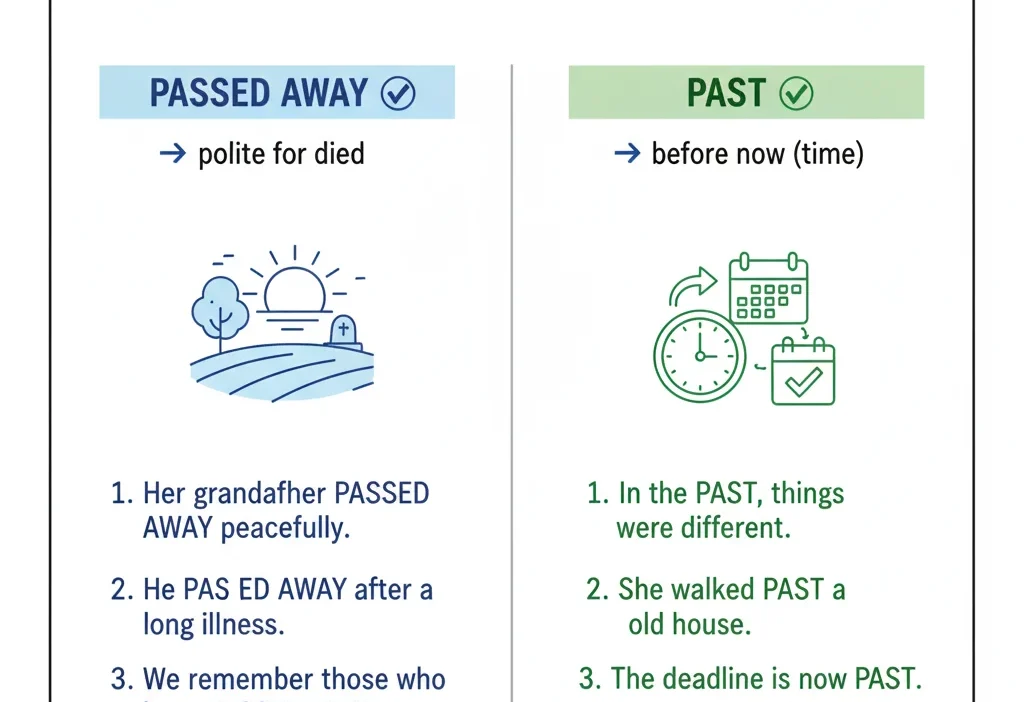
‘Passed away’ is the correct and respectful way to refer to someone’s death, while ‘past away’ is incorrect.”
Confused about “passed away” and “past away”? You’re not alone. These phrases sound similar, but only one is correct. Using the wrong form can make writing look unprofessional, disrespectful, or incorrect.
- “Passed away” is the polite and standard expression used when someone has died:
“Her grandfather passed away peacefully last year.” - “Past away” is incorrect and should never be used in formal or informal contexts.
Using “passed away” correctly ensures your writing is sensitive, respectful, and professional, whether in obituaries, letters, essays, messages, or social media posts.
In this article, you’ll also find:
- Common mistakes people make with this phrase
- Tips and tricks to remember the correct usage
- Alternative polite expressions you can use
By the end, you’ll be able to use passed away confidently in any sentence, making your writing clear, professional, and mistake-free.
What Does Each Phrase Mean?
Meaning of “Passed Away”
“Passed away” is a phrasal verb that means to die in a polite or gentle way.
It’s a more respectful way to talk about someone’s death, often used in conversations, news, and writing.
Examples:
- My grandfather passed away last night.
- We were sad to hear that our teacher passed away.
- Her cat passed away after living for 15 years.
💡 Remember: “Passed away” = died politely.
Meaning of “Past Away”
“Past away” is not a correct phrase in standard English.
The word “past” is a noun, adjective, or preposition, not a verb.
It means “before now” or “gone by,” but it cannot replace “passed.”
Incorrect Examples:
❌ My uncle past away last year.
❌ Her grandmother past away peacefully.
The correct form in both cases is “passed away.”
However, the word “past” can be used correctly in other sentences like:
✅ He walked past the school.
✅ That’s all in the past now.
✅ It’s half past six.
💡 Tip: If you’re talking about someone dying, use “passed away.”
If you’re talking about time, direction, or history, use “past.”
The Key Difference Between “Passed Away” and “Past Away”
| Feature | Passed Away | Past Away |
|---|---|---|
| Part of Speech | Verb phrase | Incorrect phrase |
| Meaning | A polite way to say “died” | Not a valid English expression |
| Used For | Talking about death gently | ❌ Should not be used |
| Example | My neighbor passed away last night. | ❌ My neighbor past away last night. |
| Memory Tip | “Passed” has -ed, just like other verbs. | “Past” has no -ed, so it can’t be a verb. |
🧠 Quick Trick:
If you can replace it with “died,” use passed away.
If not, “past” might be correct — but not with “away.”
Common Mistakes and How to Avoid Them
Many learners confuse these words because “passed” and “past” sound almost the same.
Here are a few common errors and how to fix them:
| Incorrect | Correct | Why? |
|---|---|---|
| Her dog past away yesterday. | Her dog passed away yesterday. | “Passed” is the verb, not “past.” |
| My uncle past away in 2020. | My uncle passed away in 2020. | Use “passed” when talking about death. |
| The years have passed quickly. | ✅ Correct | Here, “passed” is the correct verb form. |
💡 Grammar Tip:
If you’re writing about time, movement, or someone’s death, check whether it’s an action.
If yes → use passed (verb).
If it describes time or direction → use past (noun/preposition).
When to Use “Passed Away”
Use “passed away” when you want to talk politely or softly about someone’s death.
It’s often used in conversations, obituaries, news reports, and condolence messages.
Examples:
- My grandmother passed away peacefully in her sleep.
- We were shocked when we heard our neighbor passed away.
- His father passed away from illness last year.
- Many people attended the funeral after their teacher passed away.
- I still miss the pet that passed away when I was little.
💡 Memory Hack:
Think of “passed away” like someone passing from this life to another world — gently moving away.
When to Use “Past” (Not “Past Away”)
While “past away” is incorrect, the word “past” is used correctly in many other situations.
Let’s look at how to use “past” the right way.
Examples of “Past” in Sentences:
- We walked past the park on our way home. (preposition – showing direction)
- It’s already half past seven. (adjective – showing time)
- Let’s forget about the past and move on. (noun – referring to time gone by)
- He looked past her and smiled. (preposition – showing position)
- Don’t worry about past mistakes. (adjective – describing something gone)
💡 Trick to Remember:
If it’s about time or place, use past.
If it’s about someone dying, use passed away.
Quick Recap: Passed Away vs Past Away
✅ Passed away → Correct phrase meaning died politely.
❌ Past away → Incorrect phrase; never use it.
✅ Past → Means before now, gone by, or beyond.
✅ Passed → Action verb (moved, went by, or died).
Easy Summary:
- “Passed” = action (He passed his exam. / She passed away.)
- “Past” = time or direction (It’s past 5 o’clock. / He walked past the door.)
Advanced Tips: Understanding “Passed” and “Past” Like a Pro
- Origin: “Passed” comes from the verb pass, while “past” comes from Old English paest, meaning “gone by.”
- In formal writing: Always use “passed away” in obituaries or condolence letters. “Died” may sound too direct or harsh.
- In casual writing: You can use “passed away” when talking kindly about a person or pet.
- Online tip: Avoid writing “past away” in social media posts — it’s one of the most common grammar mistakes and can sound careless.
Mini Quiz: Test Your Understanding
Fill in the blanks with passed or past:
- My uncle ________ away last year.
- The train just ________ the station.
- It’s already half ________ ten.
- Let’s not talk about the ________.
- She ________ her driving test easily.
- Our old dog ________ away peacefully.
- We walked ________ the riverbank.
(Answers: 1. passed, 2. passed, 3. past, 4. past, 5. passed, 6. passed, 7. past)
5 Frequently Asked Questions
1. Is “past away” correct grammar?
No, “past away” is incorrect. The right phrase is “passed away.”
2. What’s the difference between “passed” and “past”?
“Passed” is a verb (action), while “past” is a noun, adjective, or preposition meaning “before now” or “beyond.”
3. Can I use “passed away” in formal writing?
Yes. It’s polite and respectful — perfect for letters, news, or essays.
4. Why do people confuse “past away” and “passed away”?
Because they sound the same when spoken (homophones), but their meanings and spellings differ.
5. What’s another polite way to say “passed away”?
You can say “departed,” “gone to a better place,” or “no longer with us.”
Conclusion
Now you know the clear difference between passed away and past away.
Remember: only “passed away” is correct when talking about death, while “past” is used for time or direction.
Keep practicing these examples, and soon you’ll never mix them up again.
Every small grammar improvement brings you closer to mastering English — one word at a time!

Jenn Ashworth offers clear, engaging explanations of language and usage, helping readers grasp meanings, nuances, and differences with accuracy and ease.