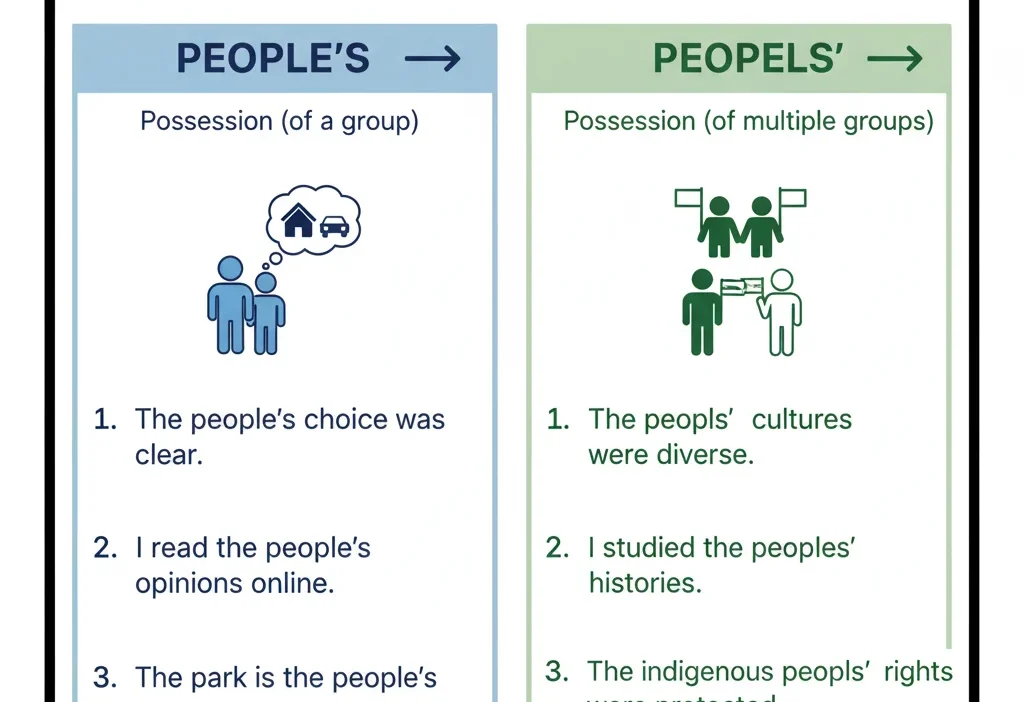
“‘People’s’ is singular possessive, referring to something belonging to a single group, while ‘Peoples’’ is plural possessive, referring to multiple groups.”
Confused about “people’s” vs “peoples’”? You’re not alone. These two possessive forms are often mixed up, but they have different meanings and grammatical rules. “People’s” is the singular possessive, used when referring to something belonging to one group of people (e.g., “The people’s vote decided the outcome”).
“Peoples’” is the plural possessive, used when referring to something belonging to multiple groups, communities, or nations (e.g., “The peoples’ cultures around the world are diverse”). Using the wrong form can confuse readers and reduce clarity, especially in essays, reports, or professional writing.
Whether you’re writing academic papers, articles, or social media posts, this guide explains how to correctly use people’s vs peoples’, with clear examples, tips, and tricks to ensure your writing is precise and professional every time.
What Does Each Word Mean?
Let’s start with what each word means. Both words come from people, but how the apostrophe is placed changes the meaning.
✅ People’s
- Part of speech: Possessive noun (shows ownership or belonging).
- Meaning: Something belongs to a group of people.
- How to remember: One group, showing possession → people’s.
Examples:
- The people’s voices were heard during the election.
- We must protect the people’s rights.
- This park is the people’s favorite place to relax.
Here, “people’s” means the rights, voices, or places belong to one group of people.
210+ Understand Colon vs Semicolon Easily 2025 Grammar Guide
✅ Peoples’
- Part of speech: Possessive noun (also shows ownership).
- Meaning: Belonging to many groups of people or nations.
- How to remember: More than one group → peoples’.
Examples:
- The peoples’ traditions of Africa are rich and diverse.
- The United Nations protects the peoples’ interests around the world.
- The peoples’ cultures in Asia are fascinating.
Here, “peoples’” means the traditions or cultures belonging to multiple groups or nations, not just one.
The Key Difference Between People’s and Peoples’
Here’s a quick comparison to make it easy to remember the grammar difference between people’s and peoples’:
| Feature | People’s | Peoples’ |
|---|---|---|
| Meaning | Belonging to one group of people | Belonging to many groups or nations |
| Apostrophe Position | Before the “s” → people’s | After the “s” → peoples’ |
| Plural? | No, refers to one group collectively | Yes, refers to multiple groups |
| Example | The people’s opinions matter. | The peoples’ rights must be respected. |
| Quick Tip | Think: one community → people’s | Think: many communities → peoples’ |
📝 Memory Tip:
👉 If you’re talking about one society or group, use people’s.
👉 If you mean several nations or ethnic groups, use peoples’.
Common Mistakes and How to Avoid Them
Even native English speakers mix these up! Let’s fix that with a few examples.
| ❌ Wrong Sentence | ✅ Correct Sentence | 💡 Why It’s Wrong |
|---|---|---|
| The peoples’ vote decided the winner. | The people’s vote decided the winner. | Only one group voted. |
| The people’s of Asia have diverse cultures. | The peoples’ of Asia have diverse cultures. | Refers to many groups. |
| These are the peoples’ opinions in our city. | These are the people’s opinions in our city. | Only one local group. |
Tip:
If you can replace “people” with “citizens” or “residents,” use people’s.
If you can replace “peoples” with “nations,” use peoples’.
When to Use People’s
Use people’s when you’re talking about one community, group, or population.
It shows what belongs to that group as a whole.
Examples:
- The people’s choice for mayor was clear.
- Clean water is a people’s right.
- The people’s happiness matters to the government.
- The president promised to serve the people’s needs.
- Music reflects the people’s culture.
💡 Quick Hack:
Think of “people’s” as the same as “the group’s.” It means the same thing, just in a more general way.
When to Use Peoples’
Use peoples’ when talking about many different ethnic groups or nations. It shows what belongs to all those groups collectively.
Examples:
- The peoples’ languages of the Pacific are diverse.
- The peoples’ festivals show their shared values.
- History records the peoples’ struggles for independence.
- The museum displays the peoples’ art from around the world.
- The treaty protected the peoples’ freedom in the region.
💡 Memory Trick:
If you’re describing something global, cultural, or historical involving more than one society, use peoples’.
Quick Recap: People’s vs Peoples’
Here’s a super simple way to remember:
- ✅ People’s → One group’s belongings or opinions.
- ✅ Peoples’ → Belongings of many groups or nations.
Summary Table:
| Use This | When You Mean | Example |
|---|---|---|
| People’s | One community | The people’s voice matters. |
| Peoples’ | Many communities | The peoples’ traditions are ancient. |
Easy Rule:
“People’s” = One group.
“Peoples’” = More than one group.
Advanced Tips: A Little Grammar and History
- The word “people” originally meant “a group of humans.” Over time, it became plural for “person.”
- When you say “peoples”, you’re referring to different groups of people, often by nation or culture.
- In formal writing (like essays or reports), use peoples’ when discussing multiple cultures or ethnicities.
- In everyday English, people’s is far more common. You’ll see it in newspapers, speeches, and conversations.
- Be careful online—some writers forget the second apostrophe, changing the meaning completely!
Mini Quiz: Test Your Understanding!
Fill in the blanks with people’s or peoples’.
- The ________ opinions helped shape the new law.
- The United Nations protects the ________ rights around the world.
- That song reflects the ________ emotions during the war.
- The museum exhibits the ancient ________ jewelry of South America.
- The ________ festival in the town is held every year.
Answers:
- people’s
- peoples’
- people’s
- peoples’
- people’s
FAQs About People’s vs Peoples’
1. What is the main difference between people’s and peoples’?
- People’s refers to one group, while peoples’ refers to several different groups or nations.
2. Is “peoples’” a real word?
- Yes! It’s the plural of “people,” used when talking about multiple communities or cultures.
3. Can I use “peoples” without an apostrophe?
- Yes. “Peoples” (no apostrophe) simply means “different groups of people.” Example: The indigenous peoples of America.
4. Which is used more often, people’s or peoples’?
- “People’s” is used more often in everyday English. “Peoples’” appears mainly in academic or cultural contexts.
5. How can I quickly remember which to use?
- Think: one group = people’s, many groups = peoples’.
Conclusion
Now you know the clear difference between people’s and peoples’! Remember—people’s shows something belongs to one group, while peoples’ refers to many groups or nations. Using the correct word helps your writing sound smart, clear, and accurate. Keep practicing with simple sentences every day, and soon you’ll use these words naturally and confidently.

Polly Clark creates clear, insightful guides on language and usage, helping readers understand meanings, differences, and nuances with clarity and confidence.