“‘Affect’ is a verb meaning to influence, while ‘Effect’ is a noun meaning the result; knowing the difference ensures clear writing.”
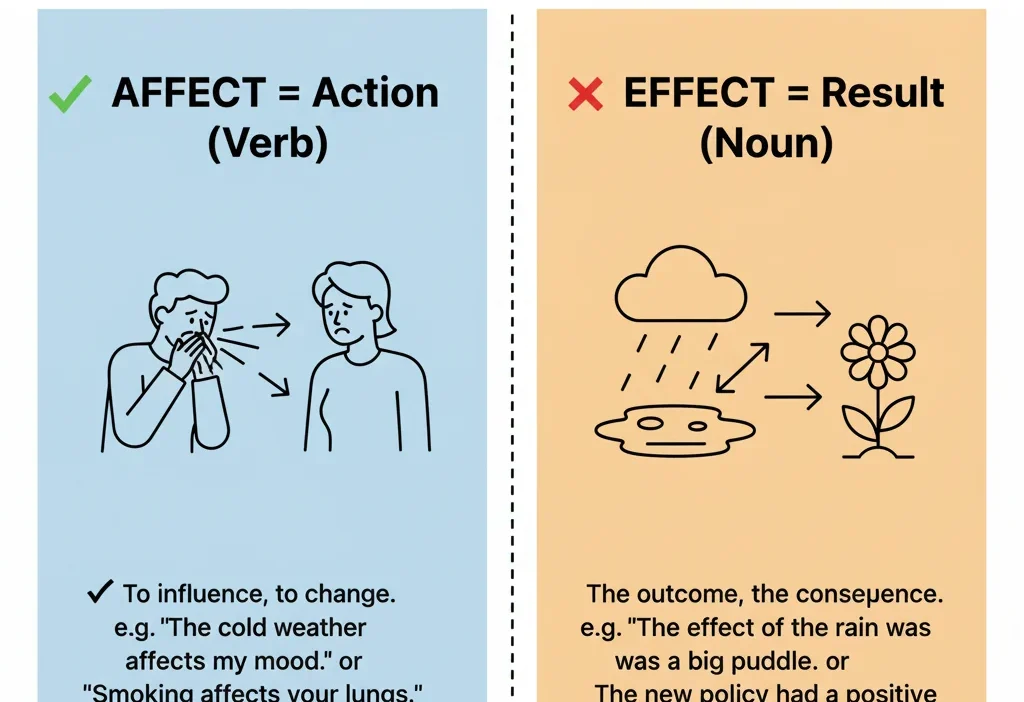
Confused about “affects” vs “effects”? You’re not alone. Though these words sound similar, they have different grammatical roles and meanings. “Affect” is usually a verb, used when something influences or changes something else (e.g., “The weather affects my mood”).
“Effect” is usually a noun, referring to the result or outcome of a change (e.g., “The new law had a positive effect”). Using the wrong word can confuse readers and reduce clarity in writing.
Whether you’re writing essays, reports, social media posts, or professional emails, this guide explains how to use affects vs effects correctly, with easy examples and memory tips, so you never mix them up again. By the end, you’ll be able to write confidently and clearly in any context.
What Does Each Word Mean?
Let’s start by understanding both words: affect and effect.
🟢 “Affect” — The Action (Verb)
Meaning: “Affect” means to influence or change something.
It’s usually a verb — an action word.
Examples:
- The weather can affect your mood.
- Loud noise affects my concentration.
- Missing breakfast affected his energy at school.
Think of affect = action. It’s something that does or changes something.
🔵 “Effect” — The Result (Noun)
Meaning: “Effect” means the result or outcome of something.
It’s usually a noun — a thing, not an action.
Examples:
- The new rule had a good effect on students.
- Her speech had a strong effect on everyone.
- The medicine had no side effects.
Think of effect = end result. It’s what happens after the action.
Quick Memory Trick 💡
👉 Affect = Action (Verb)
👉 Effect = End Result (Noun)
The Key Difference Between “Personal Affects” and “Personal Effects”
Here’s the biggest secret:
✅ “Personal effects” is the correct and common phrase.
❌ “Personal affects” is almost always wrong in everyday English.
Let’s look at the difference clearly:
| Feature | Personal Affects ❌ | Personal Effects ✅ |
|---|---|---|
| Part of Speech | “Affects” = Verb | “Effects” = Noun |
| Meaning | Sounds like you’re saying “someone’s influences” | Means personal belongings or items |
| Common Usage | Very rare or incorrect | Very common and correct |
| Example | ✗ His personal affects were packed. | ✓ His personal effects were packed. |
| Correct Context | Only in psychology (rare) | In daily English and legal writing |
🧠 Quick Tip to Remember
If you’re talking about belongings or possessions, always use personal effects — never “personal affects.”
✅ Correct: The police collected the man’s personal effects.
❌ Wrong: The police collected the man’s personal affects.
Common Mistakes and How to Avoid Them
Let’s see how people often make mistakes with these two:
Mistake 1
❌ She took all her personal affects when she moved out.
✅ She took all her personal effects when she moved out.
Why: “Affects” is a verb, not a noun. Here, you need a noun to describe things she took.
Mistake 2
❌ The news had a bad effected on him.
✅ The news had a bad effect on him.
Why: “Effected” is a verb form of “effect,” but in this case, you need the noun “effect.”
Mistake 3
❌ Rain always effects my mood.
✅ Rain always affects my mood.
Why: “Affects” is the action (verb), while “effects” would be incorrect here.
When to Use “Affect”
Use affect when you mean to influence or cause a change.
Examples:
- The cold weather affects my health.
- Your kindness affects everyone around you.
- Not studying can affect your grades.
- Pollution affects the quality of air.
- Her words affected me deeply.
🧩 Memory Hack: “Affect starts with A — for Action.” It’s something happening!
When to Use “Effect”
Use effect when you mean the result or outcome.
Examples:
- The new teacher had a positive effect on the class.
- The medicine had a calming effect.
- Exercise has great effects on mental health.
- His apology had no effect on her decision.
- We studied the effects of the new law.
📘 Memory Tip: “Effect” starts with E — for “End result.”
What Does “Personal Effects” Mean?
In English, personal effects is a fixed phrase that means someone’s personal belongings — the things they own or carry with them.
Examples:
- The traveler lost all his personal effects at the airport.
- The hospital returned the patient’s personal effects.
- Soldiers keep their personal effects in secure lockers.
This phrase is often used in legal, police, or formal documents.
Quick Recap: “Personal Affects” vs “Personal Effects”
Let’s summarize everything in simple bullet points:
- ✅ Affect = Verb = to influence
- ✅ Effect = Noun = the result
- ✅ Personal effects = belongings or items
- ❌ Personal affects = incorrect in most cases
- 💡 Trick: “Affect = Action,” “Effect = End result.”
Advanced Tips 🌟
- In psychology, “affect” can be a noun meaning emotion or feeling.
Example: The patient displayed a flat affect.
But this is very rare in normal writing. - In formal writing, always check the context:
- Talking about belongings? → “Personal effects”
- Talking about influence or change? → “Affect” (verb)
- In emails, essays, or reports, misuse of “affect” or “effect” can make your writing look unprofessional.
Always double-check which one fits!
🧩 Mini Quiz: Test Yourself!
Fill in the blanks with the correct word: affect(s) or effect(s).
- The new rule will _______ how students behave.
- Lack of sleep has a bad _______ on the body.
- The news deeply _______ her emotions.
- Exercise has many positive _______ on health.
- Stress can _______ your ability to focus.
- His words had a calming _______ on me.
- The cold weather _______ my mood every winter.
(Answers: 1. affect, 2. effect, 3. affected, 4. effects, 5. affect, 6. effect, 7. affects)
🧠 FAQs About “Personal Affects” vs “Personal Effects”
1. Is “personal affects” ever correct?
Rarely. Only in psychology, where “affect” means emotion. In normal English, it’s incorrect.
2. What does “personal effects” mean?
It means someone’s personal belongings or possessions, like clothes, wallet, or jewelry.
3. How can I remember the difference easily?
Think: “Affect = Action,” “Effect = End Result.”
4. Which word is a noun — affect or effect?
“Effect” is a noun. “Affect” is usually a verb.
5. Can “affect” be used as a noun?
Yes, but only in psychology (e.g., “a flat affect”), not in everyday language.
🏁 Conclusion
Now you know that “personal effects” means belongings, while “personal affects” is usually incorrect.
Always remember:
- Affect = Action (verb)
- Effect = End result (noun)
Next time you write, you’ll instantly know which one fits — confidently and correctly. Keep practicing and soon your grammar will affect (change) your writing in the best way possible! 🌟

Polly Clark creates clear, insightful guides on language and usage, helping readers understand meanings, differences, and nuances with clarity and confidence.