Have you ever paused while typing, unsure if you are “pouring over a book” or “poring over it”? You’re not alone. This common spelling confusion trips up countless writers, from students to professionals. People search for “pouring / poring” primarily to solve a specific grammar puzzle:
they know the sound but not the correct spelling or meaning. This keyword intent is clear—users want a quick, authoritative answer to avoid embarrassing mistakes in their emails, reports, or social posts.
This article directly addresses that confusion, providing a clear, definitive guide that not only explains the difference but also dives into word origins, regional spelling rules, and practical usage. Understanding this distinction is a small but powerful step toward sharper, more confident writing.
Pouring or Poring
The quick answer is: they are two different words with different meanings.
- Pouring relates to a liquid flowing rapidly in a steady stream.
- Example: It is pouring rain outside.
- Example: She is pouring a cup of tea.
- Poring (almost always followed by “over”) means to examine or study something with great attention.
- Example: He spent the night poring over the financial reports.
- Example: The lawyer was poring over the contract details.

The Origin of Pouring and Poring
The confusion between pouring and poring is a classic example of a homophone mix-up—words that sound alike but have different origins and meanings.
Pouring comes from the Middle English word pouren, whose origin is uncertain but has long been associated with the movement of liquids. Its meaning has stayed consistent: to cause a fluid to flow.
Poring comes from the Middle English word poren, meaning “to gaze intently” or “to peer deeply.” This historical sense of looking closely evolved into its modern meaning of studying something meticulously.
The spelling difference exists because, despite their identical pronunciation in modern English, they developed from separate linguistic roots. Over time, as pronunciation shifted, the sounds merged, but the distinct spellings remained to preserve their unique meanings.
British English vs American English Spelling
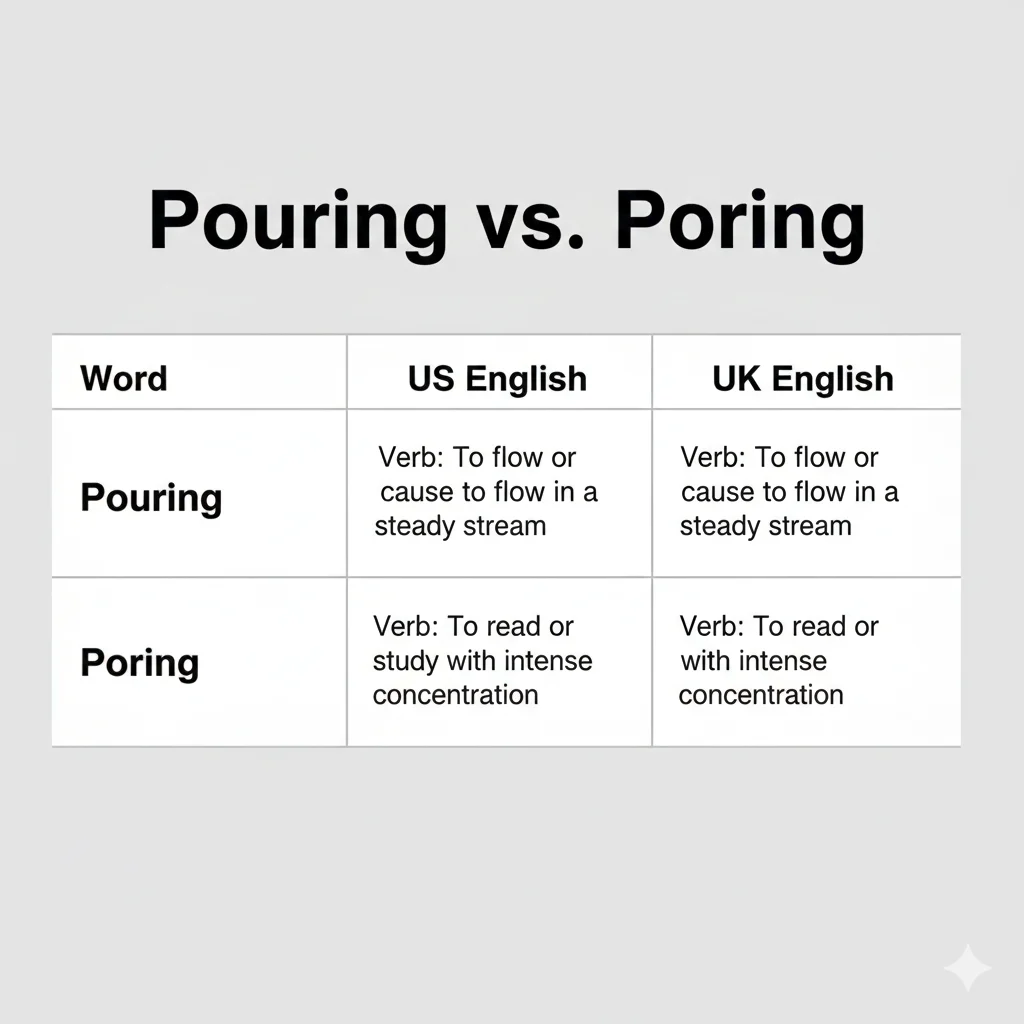
Fortunately, the pouring poring grammar dilemma is one area where British and American English agree! There is no spelling variation between the regions for these specific words.
Both varieties use:
- Pouring for the flow of liquids.
- Poring (with “over”) for studying closely.
The consistency ends here. For other common words, spelling rules differ. Here’s a quick comparison table highlighting standard variations:
| Word Type | American English Spelling | British English Spelling |
|---|---|---|
| Color/Honor | Color, Honor | Colour, Honour |
| Center/Theater | Center, Theater | Centre, Theatre |
| Analyze/Apologize | Analyze, Apologize | Analyse, Apologise |
Which Spelling Should You Use?
Your choice depends entirely on your intended meaning, not your location.
- For a US, UK, or Global Audience: The rule is universal. Use pouring when talking about liquids or rain falling heavily (poring or pouring rain? It’s pouring rain). Use poring when describing someone examining something in detail.
- For Formal & Professional Writing: Precision is key. Using the correct spelling (“poring over the data”) demonstrates attention to detail and strengthens your professional credibility .
- For Everyday Communication: Getting it right avoids confusion and ensures your message is clear, whether in a text, email, or social media update.
Common Mistakes with Pouring and Poring
The most frequent error is using “pouring over” when the context is about reading or studying.
- Incorrect: I was pouring over the old photographs.
- Correct: I was poring over the old photographs.
- Incorrect: She spent hours pouring over the manuscript.
- Correct: She spent hours poring over the manuscript.
Remember: You pour water. You pore over documents. Mixing them up is a common but easily corrected mistake.
Pouring and Poring in Everyday Examples
Seeing words in context cements understanding. Here’s how they appear naturally in different formats:
- Email (Professional): “Before the meeting, I’ll be poring over the Q3 metrics to prepare my analysis.”
- News Headline: “Residents Advised to Stay Home as Pouring Rain Causes Widespread Flooding.”
- Social Media: “Saturday mood: Poring over travel magazines and dreaming of my next adventure. ☕️”
- Formal Writing: “The researcher dedicated weeks to poring over archival records to verify the historical timeline.”

Pouring vs Poring – Google Trends & Usage Data
Analyzing search data reveals the public’s confusion. Searches for “pouring over meaning” and “poring over” consistently spike, often in tandem with academic seasons, suggesting students and professionals are double-checking their usage. Geographically, these searches are evenly distributed across English-speaking countries like the US, UK, Canada, and Australia, proving it’s a universal language hurdle. The data confirms a strong user intent for clarity and a reliable, quick answer—exactly what a well-optimized article should provide. Search engines like Google prioritize content that directly and clearly solves such common queries.
Comparison Table: Pouring vs Poring
| Feature | Pouring | Poring |
|---|---|---|
| Primary Meaning | Liquid flowing steadily. | Studying or examining closely. |
| Common Pairing | Often stands alone or with an object (pour water). | Almost always followed by “over.” |
| Part of Speech | Verb (present participle of pour). | Verb (present participle of pore). |
| Example Sentence | The barista is pouring a perfect latte. | She is poring over the legal document. |
| Key Memory Tip | Think of the “u” in pouring as a cup holding liquid. | Think of the “e” in pore as an eye for close examination. |
FAQs on Pouring and Poring
1. Is it ‘pouring’ or ‘poring’?
It depends on the meaning. Use pouring for liquids. Use poring (with “over”) for studying intently.
2. Is it ‘pouring’ or ‘poring over’?
The correct phrase for studying is “poring over.” “Pouring over” is incorrect in this context.
3. What is the past tense of pouring?
The past tense of “pour” is poured. Example: “Yesterday, it poured rain all afternoon.”
4. What is the meaning of pouring?
Pouring means causing a liquid to flow out of a container in a steady stream, or for rain to fall very heavily.
5. What does ‘poring over’ mean?
Poring over means to read or look at something very carefully and with great focus for a long time.
6. Can you use ‘pouring’ for people?
Not literally. You can say a crowd is “pouring into a stadium,” using it metaphorically to mean entering quickly in large numbers, like a flow.
7. Is ‘pore’ a real word by itself?
Yes. As a verb, “to pore” means to meditate or ponder deeply, but it is almost never used without “over” or “through” in modern English. As a noun, a “pore” is a tiny opening in the skin.
Conclusion
Mastering the difference between pouring and poring is more than just memorizing a spelling rule; it’s about wielding the English language with precision and confidence. The core takeaway is simple: pouring involves liquids, while poring (always with “over”) involves intense focus and study. This distinction holds true across all forms of English, making it a universally important grammar point. By applying the tips and examples in this guide, you can avoid a common pitfall and enhance the clarity of your writing—whether you’re crafting a crucial business report, an academic paper, or a simple social media post. Clear communication builds trust and authority, so the next time you write, you can be certain you’re using the right word.

Francis Sufford crafts thoughtful, insightful explanations on language, meaning, and usage, blending clarity with storytelling to guide readers effectively.