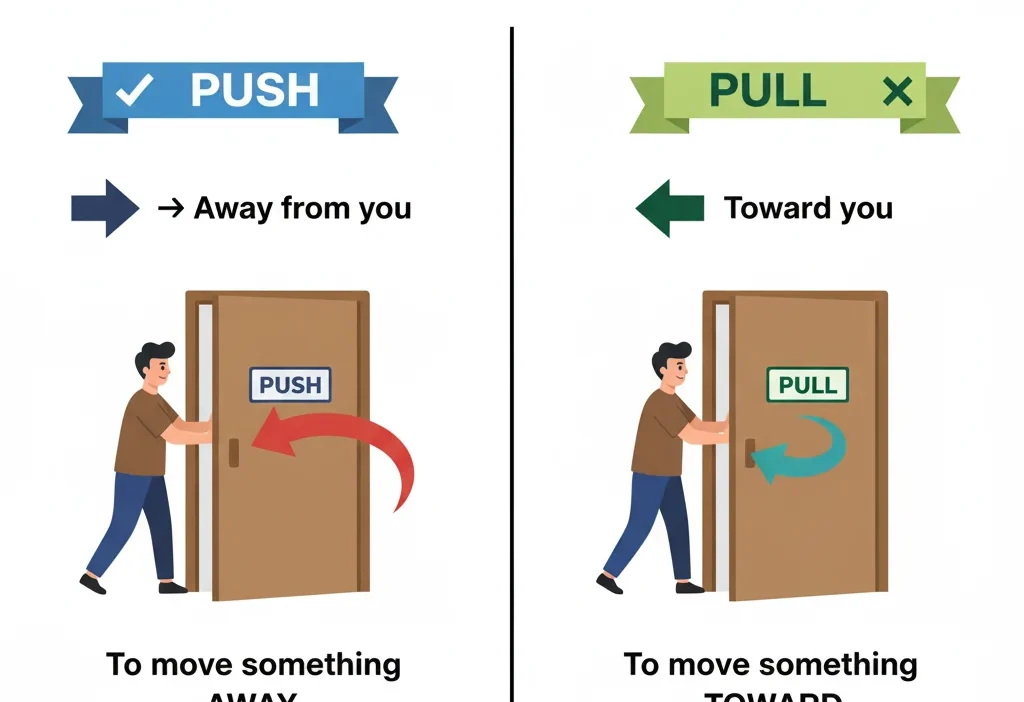
“Push means to move something away from you, while pull means to bring something toward you.”
Confused about whether to push or pull? This is a very common English confusion, especially when reading door signs, instructions, exams, or daily conversation. The difference between push and pull is simple—but only if you understand the direction of force.
- Push means applying force to move something away from yourself.
Example: “Push the door to open it.” - Pull means applying force to bring something toward yourself.
Example: “Pull the door to close it.”
Using the wrong word can lead to misunderstandings, unclear instructions, or exam mistakes. That’s why knowing the correct use of push vs pull is important for students, writers, ESL learners, and professionals.
In this article, you’ll learn:
- The clear and simple difference between push and pull
- Real-life and exam-friendly examples
- Common mistakes people make
- Easy memory tips to never confuse them again
By the end, you’ll confidently know when to push and when to pull, ensuring your English is clear, accurate, and natural.
🧠 What Does Each Word Mean?
🔹 Meaning of “Push”
Push means to move something away from you using force.
It’s an action verb — you use it when you apply pressure to move something forward, outward, or away.
Examples:
- I pushed the door to open it.
- Please push the cart to the corner.
- She pushed her chair under the table.
Think of push as “send it away.”
🔹 Meaning of “Pull”
Pull means to bring something toward you.
It’s also an action verb, but it’s the opposite of “push.”
Examples:
- I pulled the rope to lift the bucket.
- Don’t pull my hair!
- He pulled the door open.
Think of pull as “bring it close.”
⚖️ The Key Difference Between Push and Pull
Here’s a quick look at the difference between push and pull in one glance:
| Action | Meaning | Direction | Example Sentence |
|---|---|---|---|
| Push | Move something away from you | Outward | She pushed the box under the bed. |
| Pull | Move something toward you | Inward | He pulled the chair closer to the table. |
💡 Quick Tip:
👉 If your hands go forward, you’re pushing.
👉 If your hands come back, you’re pulling.
❌ Common Mistakes and How to Avoid Them
Mistake 1: Mixing up directions
❌ He pushed the rope to bring the bucket up.
✅ He pulled the rope to bring the bucket up.
👉 Why it’s wrong: You can’t “push” something up using a rope — ropes work by pulling!
Mistake 2: Using “push” in emotional expressions incorrectly
❌ She pulled him to try harder.
✅ She pushed him to try harder.
👉 Why: “Push” can also mean encourage or motivate someone, while “pull” doesn’t have that meaning.
Mistake 3: Using “pull” instead of “push” in directions
❌ Pull the door to enter the room.
✅ Push the door to enter the room.
👉 Why: You push a door to move it away from you.
🪟 When to Use “Push”
Use push when you’re moving something away from your body — physically or figuratively.
Examples:
- Push the door to go inside.
- The baby pushed the toy car.
- Please push the button to start.
- She pushed the box under the bed.
- He pushed himself to study harder.
🧩 Memory Hack:
👉 Think of “push-ups” — when you push your body up and away from the floor.
🧲 When to Use “Pull”
Use pull when you’re moving something closer to your body — physically or emotionally.
Examples:
- Pull the door to open it.
- He pulled the chair closer.
- They pulled the rope together.
- She pulled her friend out of danger.
- The train pulled into the station.
🧠 Memory Trick:
Imagine pulling a puppy — you always bring it toward you, not away.
🧩 Quick Recap: Push vs Pull
- Push = Move away
- Pull = Bring close
- Both are verbs showing opposite directions.
- You push doors, buttons, carts, and ideas forward.
- You pull ropes, drawers, chairs, or people closer.
- Easy test: If it moves away, it’s push. If it moves toward, it’s pull.
📚 Advanced Tips: Beyond the Basics
🔹 1. Figurative Meanings
- Push can also mean encourage or pressure someone.
- “My coach pushed me to do better.”
- Pull can mean attract or draw attention.
- “Her kindness pulled people toward her.”
🔹 2. In Business or Marketing
- Companies often say they use a push strategy (to promote products) or a pull strategy (to attract customers).
🔹 3. In Physics or Science
In science, “push and pull” are basic types of forces — one moves things away, the other toward.
🧠 Mini Quiz: Test Yourself!
Choose the correct word — push or pull.
- Please ___ the rope to lift the bucket.
- Don’t ___ the door; it says “PULL.”
- She ___ the cart to the corner.
- My teacher ___ me to study more.
- The magnet ___ the nail toward it.
- He ___ his chair closer to the table.
- The kids ___ the toy car down the hall.
✅ Answers:
- pull, 2. push, 3. pushed, 4. pushed, 5. pulled, 6. pulled, 7. pushed
❓ FAQs about Push and Pull
1. What is the main difference between push and pull?
Push means moving something away from you, while pull means bringing something toward you.
2. Are push and pull opposites?
Yes! They are exact opposites — push sends things away; pull brings them closer.
3. Can “push” mean encourage someone?
Yes. For example: “My mom pushed me to chase my dreams.”
4. How do I teach kids the difference?
Use physical actions — tell them to “push” a door and “pull” a rope. It’s easy to remember through movement.
5. What is a push-and-pull relationship?
It means a back-and-forth situation where one side pushes away while the other pulls close — common in friendships or emotions.
🏁 Conclusion
Now you know exactly when to use push and pull!
They’re simple opposites — one moves away, the other moves closer.
Keep practicing by noticing how you push doors or pull ropes in daily life.
Learning small word differences like these helps you sound clear, confident, and natural in English.
Keep pushing yourself — and let English pull you toward success! 🌟

Francis Sufford crafts thoughtful, insightful explanations on language, meaning, and usage, blending clarity with storytelling to guide readers effectively.