Have you ever walked up to a door, confidently pushed it… but it was actually a pull door? 😅
Don’t worry — many people mix up push and pull not only on doors, but also while speaking or writing in English.
Both words look simple, but they have different meanings and different directions of action. Understanding the difference between push and pull will help you:
- Use the correct word in sentences
- Understand action words (verbs) more clearly
- Improve your English communication — at school, at work, or in everyday life
In this easy guide, you will learn:
- What each word means
- The difference between push vs pull
- Correct usage with simple examples
- A memory trick (so you never forget!)
- A quick recap, advanced tips, and a mini quiz
This explanation is written in plain English. Even a 4th-grade student can understand it. Let’s begin!
🧠 What Does Each Word Mean?
✅ Meaning of PUSH
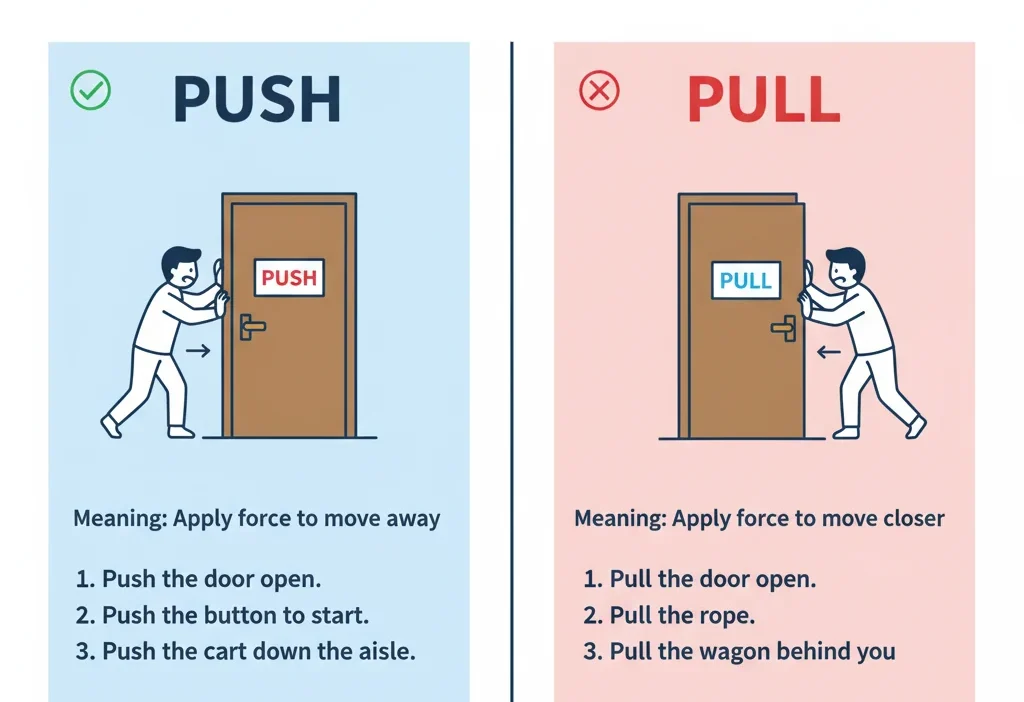
Push means to use force to move something away from you.
👉 Direction = Forward / Away from your body
Part of Speech: Verb (shows an action)
Easy Examples:
| Sentence | Meaning |
|---|---|
| She pushes the box across the floor. | She moves it away from herself. |
| He pushed the door to open it. | He used force forward. |
| Please push the chair towards the table. | Move it away from you. |
Imagine your hands are like little engines. When you push, you are sending something forward.
✅ Meaning of PULL
Pull means to use force to move something toward you.
👉 Direction = Backward / Toward your body
Part of Speech: Verb (shows an action)
Easy Examples:
| Sentence | Meaning |
|---|---|
| She pulls the rope. | She brings it toward herself. |
| Pull the door to open it. | Move it back, toward you. |
| The dog pulled the toy closer. | It brought it toward itself. |
Think of a magnet attracting something — that’s pulling.
⭐ The Key Difference Between Push and Pull
| Feature | Push | Pull |
|---|---|---|
| Definition | Move something away from you | Bring something toward you |
| Direction of force | Forward | Backward |
| Example sentence | “Please push the table.” | “Please pull the chair.” |
| Motion picture in your mind | ➡️ | ⬅️ |
✅ Quick Tip to Remember:
Push = away.
Pull = towards you.
🚫 Common Mistakes and How to Avoid Them
❌ Mistake 1:
“Can you pull the refrigerator towards the wall?”
🔧 Correction:
“Can you push the refrigerator towards the wall?”
🧠 Why?
The object is moving away from you, not toward you.
❌ Mistake 2:
“Please push the door to enter.”
🔧 Correction:
“Please pull the door to enter.”
🧠 Why?
You are bringing the door toward you, so you must pull.
❌ Mistake 3:
“They pushed the rope in the tug-of-war game.”
🔧 Correction:
“They pulled the rope in the tug-of-war game.”
🧠 Why?
Tug-of-war = pulling toward yourself.
✋ When to Use Push
You use push when:
- You move something away from your body
- You want something to go forward
- You apply force from behind
Examples of correct usage:
- She pushed the heavy cart.
- Push the button to start the machine.
- The child pushed his toy car across the floor.
- You must push the door to exit.
- Don’t push others in line.
Daily life clue:
When you extend your arms forward — you are pushing.
🤚 When to Use Pull
Use pull when:
- You move something toward your body
- You drag or draw something closer
- You apply force from the front
Examples of correct usage:
- Please pull the drawer to open it.
- The boy pulled his backpack toward him.
- Pull the rope to ring the bell.
- They pulled the table closer.
- Don’t pull your friend’s shirt.
Memory hack:
When you bend your arms toward you — you are pulling.
🔄 Quick Recap: Push vs Pull (Simple Rules)
- Push = away from you
- Pull = toward you
- Arms straight = push
- Arms bent = pull
✅ Just remember:
Push = send away
Pull = bring closer
📚 Advanced Tips (For Better English Writing)
| Situation | Best Choice | Example |
|---|---|---|
| Moving something forward | PUSH | “He pushed the shopping cart.” |
| Bringing something toward you | PULL | “She pulled the suitcase.” |
| Buttons, machines, devices | PUSH | “Push the start button.” |
| Ropes, drawers, handles | PULL | “Pull the drawer open.” |
Origin of the words:
| Word | Origin | Meaning originally |
|---|---|---|
| Push | Old French “pousser” | To thrust forward |
| Pull | Old English “pullian” | To drag or tug |
Knowing origins helps remember meaning:
- Push sounds like “push forward!”
- Pull sounds like “pull back!”
✅ Mini Quiz — Test Yourself!
Fill in the blanks with push or pull:
- Please _______ the door to enter.
- You need to _______ the button to start the fan.
- The car won’t move; can you _______ it forward?
- Don’t _______ your brother’s shirt.
- We must _______ the rope in tug-of-war.
Answers:
- pull
- push
- push
- pull
- pull
❓ FAQs About Push or Pull (SEO Optimized)
1. What is the difference between push and pull?
Push = move something away. Pull = move something toward you.
2. How can I remember push vs pull?
Push = straight arms. Pull = bent arms.
3. Is push or pull a verb?
Both are verbs. They show actions.
4. What is an example of push vs pull?
Push → “Push the door to exit.”
Pull → “Pull the door to enter.”
5. Which word is used for opening a drawer?
You pull a drawer (toward you).
✅ Conclusion
Understanding the difference between push and pull is simple:
- Push means move away.
- Pull means bring closer.
These two small action words appear everywhere — on doors, in instructions, and in daily conversations. Now that you know the correct usage, practice them at home, in school, or while reading signs outside.
Every time you use the correct word, your English improves.
Keep learning. Keep practicing. You’re doing great! 🧠✨

Jenn Ashworth offers clear, engaging explanations of language and usage, helping readers grasp meanings, nuances, and differences with accuracy and ease.