Have you ever heard the phrase “Ready or not, here I come!” in games like hide-and-seek?
This phrase is very common in English, but people get confused when they see it written in sentences, movie titles, or especially when discussing the Ready or Not ending (from stories, movies, or conversations). Learners often ask:
- What does “ready” mean?
- What does “not” change in the meaning?
- When do we say “ready,” and when do we say “not ready”?
This article will make everything super easy, even for beginners or 4th-grade students.
You will learn:
- The meaning of “ready” and “not (ready)”
- The difference between Ready and Not Ready
- How to correctly use the phrase “Ready or not”
- A simple comparison table
- Easy examples, memory tricks, and a short quiz
By the end, you’ll know the difference between Ready and Not Ready, and you’ll understand the meaning of “Ready or Not ending” clearly.
✅ What Does Each Word Mean?
Let’s break the phrase “Ready or Not” into two pieces:
🔹 Word 1: Ready
Part of speech: Adjective (describes a person or thing)
Meaning:
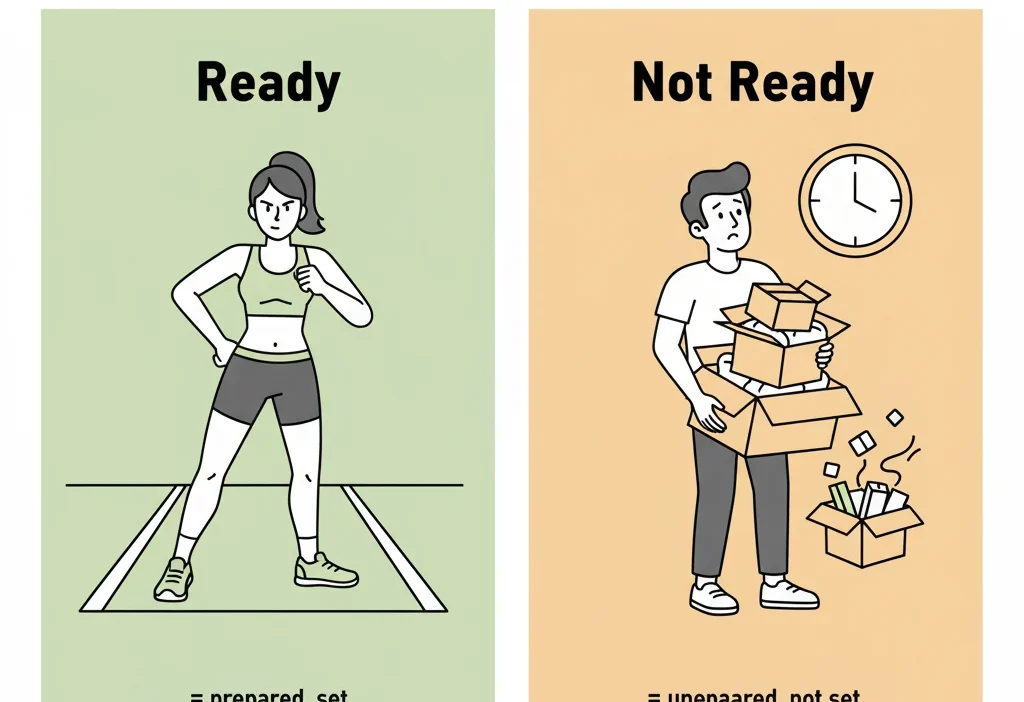
Ready means prepared.
If you are ready, you have everything you need to start something.
✅ Examples of “ready”
| Sentence | Meaning (simple) |
|---|---|
| I am ready for school. | I have my bag, books, and uniform. |
| Are you ready for the test? | Have you studied? |
| She is ready to leave. | She has everything and can go now. |
Mini-Story Example:
Sara packed her lunch, wore her shoes, and tied her hair. She smiled and said, “I am ready!”
🔹 Word 2: Not (Ready)
Part of speech: “Not” is an adverb — it changes the meaning to negative
Meaning:
Not ready means not prepared.
If you are not ready, you still need time.
✅ Examples of “not ready”
| Sentence | Meaning (simple) |
|---|---|
| I am not ready for school. | My things are not packed. |
| He is not ready to leave. | He needs more time. |
| They are not ready for the exam. | They did not study. |
Mini-Story Example:
Ali lost his notebook and his pen. He shouted, “I am not ready yet!”
✅ The Key Difference Between Ready and Not Ready
| Feature | Ready | Not Ready |
|---|---|---|
| Meaning | Prepared | Not prepared |
| Feeling | Confident, done, finished | Nervous, still working |
| Example | I am ready to start. | I am not ready yet. |
| Usage | Shows completion | Shows something missing |
⭐ Quick Tip to Remember
Ready = Go
Not Ready = Wait
Say it like a traffic signal in your mind. ✅ Green → Go (Ready)
⛔ Red → Stop (Not Ready)
✅ What Does “Ready or Not” Mean?
Ready or not is a phrase used when something will happen even if a person isn’t prepared.
“Ready or not” means: It will start anyway.
This phrase is used:
- In games (like hide-and-seek)
- In movies (like Ready or Not)
- In storytelling
- When someone needs to take action without delay
Example:
Ready or not, here we go!
→ We are starting, whether you’re prepared or not.
🎬 What Is the Meaning of the “Ready or Not Ending”? (Context Explanation)
Sometimes students or movie fans search for:
👉 “Ready or Not ending explained”
Here, “ready or not” refers to an ending where something happens suddenly — even if the person is not prepared.
A ready or not ending means: An ending that happens suddenly, with no waiting, no chance to prepare.
It can be used in:
- Movies
- Stories
- Real-life decisions (moving to another country, starting school, etc.)
Example sentence:
“The story has a ready or not ending—things happen fast and the characters must face the result.”
✅ Common Mistakes and How to Fix Them
| ❌ Incorrect | ✅ Correct | Why? |
|---|---|---|
| I am ready or not for the exam. | I am not ready for the exam. | You don’t use both together here. |
| He says ready not. | He says ready or not. | The correct phrase is “ready or not.” |
| Ready or not I am coming. | Ready or not, I am coming. | Comma makes the sentence clear. |
✅ When to Use Ready
Use ready when someone is prepared.
Example Sentences (Real-life & Simple)
- I am ready for breakfast.
- She is ready to play the piano.
- Are you ready for the big game?
- We are ready to start the class.
- My computer is ready to download the file.
✔ Ready = confident and prepared
✅ When to Use Not Ready
Use not ready when someone still needs time.
Example Sentences
- I am not ready to sleep.
- They are not ready to travel.
- The teacher said the test papers are not ready yet.
- He is not ready to make a decision.
- We are not ready for visitors.
✔ Not Ready = needs more time or preparation
✅ Quick Recap: Ready vs Not Ready
- Ready → prepared
- Not Ready → still preparing
- Ready or Not → something will start anyway
✅ Easy Memory Trick:
Ready = Go
Not Ready = No
⭐ Advanced Tips (Optional — for deeper understanding)
- “Ready” comes from the Old English word ræde, meaning “arranged or prepared.”
- In writing (essays, emails, or reports), use ready to show confidence and planning.
- In texting, people often shorten it to rdy or say “I’m not ready yet😩.”
✏ Mini Quiz: Choose the correct word.
Fill in the blanks with ready or not ready.
- I am ________ to start the test.
- She is ________ for dinner.
- We are ________ yet. Please wait!
- The class is ________ to begin.
- Are you ________ to watch the movie?
(Answers: 1. ready 2. ready 3. not ready 4. ready 5. ready)
❓ FAQs
1. What does “Ready or Not ending” mean?
It means an ending that happens suddenly — even if the characters are not prepared.
2. Is “ready or not” a complete sentence?
No, but it is commonly used in speech to signal the start of something.
3. Do I need a comma after “Ready or not”?
Yes: Ready or not, here I come.
4. Is “ready” an adjective or verb?
It is an adjective — it describes your preparation.
5. Can I use “not ready yet”?
Yes! “Not ready yet” means you need more time.
🏁 Conclusion
Now you clearly understand:
- Ready means prepared.
- Not Ready means you need more time.
- Ready or not means something begins — even if you’re not prepared.
You saw examples, a comparison table, memory tricks, and a mini quiz. Practice using these phrases in daily conversation, and your English will become smoother and more natural.
⭐ Keep learning a little every day — that’s how you become confident in English.

Eley Williams writes clear, engaging guides on confusing words and phrases, helping readers understand meanings, differences, and correct usage with ease.