English has many word pairs that look and sound similar, but they have completely different meanings. One of those confusing pairs is:
👉 repast vs repass
At first glance, only one letter is different — t vs s — and that small difference changes their entire meaning.
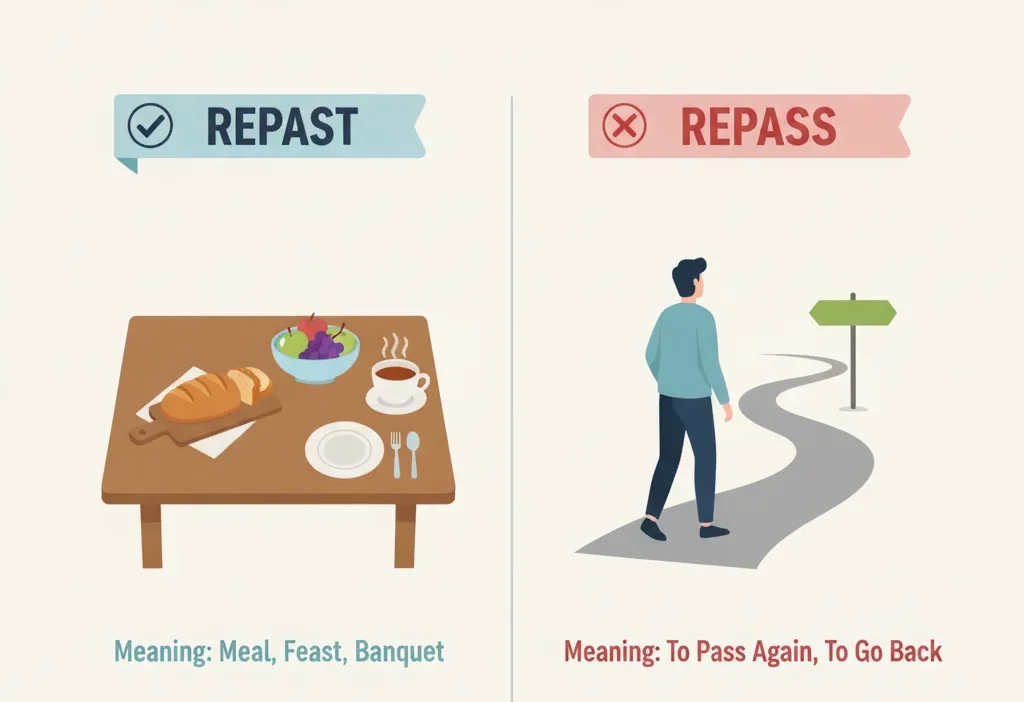
- Repast means a meal or the act of eating food.
- Repass means to pass something again or to go back the same way you came.
Many English learners mix these up because the spelling looks almost identical. This guide will show you the meaning, difference, and correct usage of repast and repass with super-easy examples that even a 4th-grade student can understand.
By the end of this guide, you will be able to confidently choose the correct word every time.
Let’s begin!
🍽️ What Does Repast Mean?
Repast (noun/verb) = a meal or the act of eating food.
Think of repast as another fancy word for meal, breakfast, lunch, or dinner.
✅ Part of Speech:
| Word | Part of Speech | Meaning |
|---|---|---|
| Repast | Noun / Verb | A meal / the act of eating |
✅ Easy definition:
If you are eating food, you are having a repast.
✅ 3 Super Easy Examples:
| Sentence | Explanation |
|---|---|
| We enjoyed a delicious repast at grandma’s house. | Repast = meal |
| After a long journey, the travelers sat for a repast. | Repast = eating together |
| The picnic repast included sandwiches and fruit. | Repast = food |
🔑 Memory Trick:
👉 RepasT has a T, and so does TasTy meal.
Think: RepaST → TaSTy meal
🚶♂️ What Does Repass Mean?
Repass (verb) = to pass again or go back the same way.
When someone repasses, they go through a place again. It can also mean to return.
✅ Part of Speech:
| Word | Part of Speech | Meaning |
|---|---|---|
| Repass | Verb | To pass again / return |
✅ 3 Super Easy Examples:
| Sentence | Explanation |
|---|---|
| We will repass this road on our way back. | Passing the road again |
| The students repassed the hallway after recess. | They walked through the same hallway again |
| Please repass the papers to the front. | Pass again |
🔑 Memory Trick:
👉 RepaSS has SS → think pasS again.
🔑 The Key Difference Between Repast and Repass
Here’s the difference in one sentence:
Repast = meal (food).
Repass = pass again (movement).
✅ Comparison Table
| Feature | Repast | Repass |
|---|---|---|
| Part of speech | Noun / Verb | Verb |
| Meaning | A meal / the act of eating | To pass again / return |
| Represents | Food | Movement |
| Example sentence | “We enjoyed a morning repast at the hotel.” | “We will repass this bridge later.” |
| When to use | When talking about eating | When talking about going somewhere again |
⭐ Quick Tip to Remember:
If it’s about food, use repasT.
If it’s about going or passing again, use repaSS.
❌ Common Mistakes & How to Avoid Them
| ❌ Incorrect | ✅ Correct | Why? |
|---|---|---|
| We repassed a tasty repass at the café. | We enjoyed a tasty repast at the café. | Repast = meal |
| We will repast this street again tomorrow. | We will repass this street again tomorrow. | Repass = pass again |
| After the repass, we ate dinner. | After the repast, we ate dinner. | Repast = meal |
👉 The mistake happens because people focus on the spelling instead of the meaning.
🍽️ When to Use Repast (With Examples)
Use repast when you talk about:
- Eating food
- Meals (breakfast, lunch, dinner)
- Sharing food with others
- A formal or special meal
✅ Example Sentences (Real-life and simple)
- We had a delicious repast with our friends.
- The hotel served a morning repast of fruit and eggs.
- After the long journey, everyone sat down for a quiet repast.
- Their repast included rice, bread, and soup.
- “Thank you for the lovely repast,” she said politely.
💡 Memory Hack:
Repast has T → think T for Table (meal on the table).
🚶♂️ When to Use Repass (With Examples)
Use repass when:
- Someone walks or travels again
- You’re returning the same way
- Something is passed back (like papers or objects)
✅ Example Sentences
- We will repass the store on our way home.
- The students repassed the door after the fire drill.
- Please repass the papers to the front of the class.
- We repassed the forest we crossed earlier.
- He repassed the finish line during warm-up.
💡 Memory Hack:
Repass has ss → think “Pass again.”
🧠 Quick Recap: Repast vs Repass
| Word | Meaning | Quick Memory |
|---|---|---|
| Repast | A meal, food, eating | T = Table of food |
| Repass | Pass something again | SS = pasS again |
⭐ Advanced Tips (For writers, students, & exam use)
| Topic | Repast | Repass |
|---|---|---|
| Level of formality | Sounds formal and elegant | Rare, mostly in formal writing |
| Usage in essays | Use when describing meals, events, hospitality | Use when describing movement or returning |
| Origin | Old French repast (meal) | Latin repassare (pass again) |
✏️ In literature, repast is used to make descriptions sound poetic or fancy.
✏️ Repass is rare in everyday speech. You’ll see it more in storytelling or older writing.
📝 Mini Quiz: Test Yourself!
Fill in the blanks with repast or repass.
- We will ______ this street again after shopping.
- The family shared a delicious ______ together.
- Please ______ these books back to the shelf.
- After a long hike, we sat down for a ______.
- The players ______ the field during warm-ups.
(Answers: 1. repass, 2. repast, 3. repass, 4. repast, 5. repassed)
❓ FAQs (Featured Snippet Style)
1. Is “repast” a fancy word for meal?
Yes. Repast simply means a meal or eating food.
2. Can we use “repass” to mean return?
Yes. Repass means to pass again or return through the same path.
3. Which word is about food — repast or repass?
Repast = food / meal.
4. Is repass commonly used in daily English?
Not really. It is more formal and less common.
5. How do I remember the difference easily?
- RepasT → TasTy meal
- RepaSS → paSS again
✅ Conclusion
Now you know exactly when to use repast and when to use repass.
- Repast is about food.
- Repass is about passing again.
With simple memory tricks and clear examples, you can confidently avoid mistakes that many English speakers make. The more you practice, the better you will become at choosing the correct word in your writing or speaking.

Gwendoline Riley delivers clear, compelling insights into language and usage, helping readers understand meanings, nuances, and differences with confidence.