Many people often get confused between a resume and a CV. Both are documents used to showcase your skills, education, and experience, but they are not the same. Understanding the difference can make a huge impact when applying for jobs or internships.
In this guide, you will learn the exact meaning of resume and CV, how they differ, when to use each, and simple examples to avoid common mistakes. Whether you are a student, a professional, or just starting your career journey, this guide will make it easy to understand and use the right term every time.
By the end, you will feel confident in writing or talking about your resume / CV correctly.
What Does Each Word Mean?
Resume
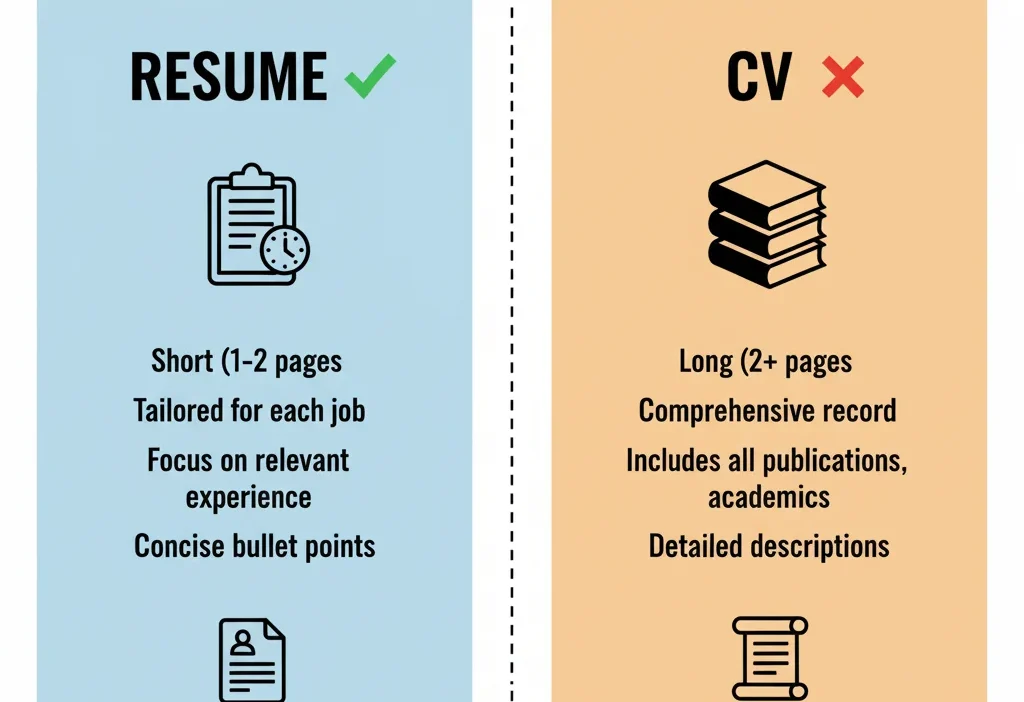
A resume is a short, concise document that summarizes your education, work experience, and skills. It is usually 1–2 pages long and focuses on your most recent achievements.
- Part of speech: Noun
- Purpose: To apply for a specific job
- Examples:
- I updated my resume before applying for the marketing job.
- Her resume highlights her experience in graphic design.
- Make sure your resume is clear and easy to read.
Think of a resume as a quick snapshot of your career that employers can scan in a few minutes.
CV
A CV (Curriculum Vitae) is a detailed document showing your entire academic and professional history. It can be 2–10 pages or longer, depending on experience. CVs are often used in academia, research, or international job applications.
- Part of speech: Noun
- Purpose: To provide a full overview of your career
- Examples:
- She submitted her CV for the university professor position.
- The CV includes publications, awards, and research projects.
- Academic jobs usually require a detailed CV rather than a resume.
Think of a CV as a full story of your career, not just a snapshot.
The Key Difference Between Resume and CV
| Feature | Resume | CV |
|---|---|---|
| Length | 1–2 pages | Can be multiple pages |
| Focus | Skills and recent experience | Full career history |
| Use Case | Job applications | Academic, research, or international jobs |
| Detail Level | Brief and targeted | Detailed and comprehensive |
| Example Sentence | “I sent my resume for the internship.” | “I submitted my CV for the teaching position.” |
Quick Tip: If you need something short and job-specific, use a resume. If you need something detailed or academic, use a CV.
Common Mistakes and How to Avoid Them
Mistake 1: Using the wrong term in job applications
- ❌ Incorrect: I sent my CV for a retail job.
- ✅ Correct: I sent my resume for a retail job.
Mistake 2: Making a resume too long
- ❌ Incorrect: My 10-page resume lists every single task from college.
- ✅ Correct: My resume is 2 pages long with only the most relevant achievements.
Mistake 3: Confusing CV and resume internationally
- ❌ Incorrect: Applying for a UK job with a short 1-page resume.
- ✅ Correct: In the UK, a CV is usually expected, not a short resume.
When to Use Resume
A resume is best when:
- Applying for most corporate or business jobs
- Sending a quick summary of your skills and experience
- You need a concise document for HR or recruiters
- You are emphasizing recent achievements
Examples:
- I emailed my resume to the HR manager for the graphic design position.
- Always tailor your resume for each job application.
- Keep your resume under 2 pages to ensure readability.
- Add keywords from the job description to your resume.
Memory Hack: Resume = Brief and Relevant (both start with B).
When to Use CV
A CV is best when:
- Applying for academic, research, or teaching positions
- You need to list detailed education, publications, and awards
- Applying internationally in countries like the UK, Europe, or Asia
Examples:
- She updated her CV to include her recent research papers.
- Universities prefer a detailed CV over a short resume.
- Include all significant achievements in your CV, no matter how old.
- Academic conferences often require a full CV.
Trick: Think of CV = Complete View (both start with C).
Quick Recap: Resume vs CV
- Resume: Short, 1–2 pages, focuses on skills and recent experience.
- CV: Long, detailed, covers full academic and professional history.
- Use resume for most jobs; use CV for academic or international roles.
- Remember: Resume = Brief & Relevant | CV = Complete View
Advanced Tips
- Origin: “Curriculum Vitae” is Latin for “course of life.” Resume comes from French, meaning “summary.”
- Formal Writing: Always check the required document type in job postings.
- Online Use: A wrong term in emails or LinkedIn can confuse recruiters.
Mini Quiz
Fill in the blanks with resume or CV:
- I submitted my _____ for the summer internship.
- Professors often keep a detailed _____ with their publications.
- A one-page _____ is enough for most business jobs.
- Universities prefer a _____ that lists your entire academic history.
- Make sure your _____ highlights the most relevant experience.
- She sent her _____ to the international research program.
- Always tailor your _____ for each job application.
FAQs
1. Is a resume the same as a CV?
No, a resume is short and targeted, while a CV is long and detailed.
2. How long should a resume be?
Typically 1–2 pages; never more than 2 for most jobs.
3. Do I need a CV for a job in the US?
Most US jobs require a resume, except academic or research positions.
4. Can I use the same document as both resume and CV?
Not recommended. Tailor the content and length for the specific purpose.
5. Which is better for a fresh graduate?
Use a resume for job applications and a CV if applying for research or international programs.
Conclusion
Now you know the difference between a resume and a CV, their meanings, correct usage, and when to use each. By practicing these simple rules, you can confidently apply for jobs or academic positions without confusion. Remember, using the right document shows professionalism and attention to detail. Keep learning, keep practicing, and soon using resume / CV correctly will feel natural.

Eley Williams writes clear, engaging guides on confusing words and phrases, helping readers understand meanings, differences, and correct usage with ease.