Many people get confused between resume or CV because both documents are used when applying for jobs. They look similar at first, but they are not the same. A resume and a CV have different purposes, different lengths, and different ways of showing your skills. Because of this, students, job seekers, and even working professionals often use the wrong one.
In this simple guide, you will learn the exact meaning, the difference between a resume and a CV, the correct usage, and easy examples anyone can understand—even a 4th-grade student. We will break everything into short sentences, simple words, and real-life examples.
By the end, you will know exactly when to use a resume, when to use a CV, how to avoid common mistakes, and how to remember the difference forever.
What Does Each Word Mean?
What Is a Resume?
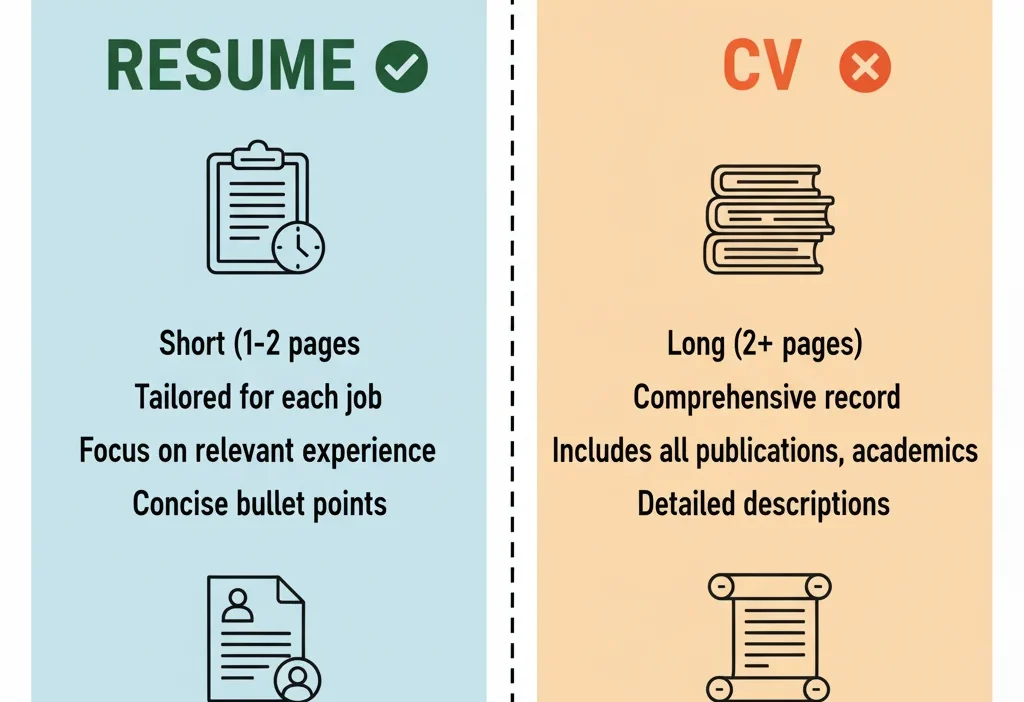
A resume is a short document that gives a quick summary of your skills, education, and work experience.
Part of Speech:
Noun — a thing used for job applications.
Simple Meaning:
A resume is a short, 1-page summary about you.
3 Easy Examples:
- I made a resume to apply for a part-time job.
- Her resume shows her computer skills.
- The company asked me to send my resume by email.
What Is a CV?
A CV, also called a Curriculum Vitae, is a long document that shows your full academic and professional life.
Part of Speech:
Noun — a detailed record of your education and achievements.
Simple Meaning:
A CV is a long, detailed document about your career.
3 Easy Examples:
- My teacher told me to prepare a CV for university admission.
- His CV includes all his research papers.
- A CV usually has more pages than a resume.
The Key Difference Between Resume and CV
Here is the simplest explanation:
A resume is short, like a movie trailer.
A CV is long, like the full movie.
Comparison Table: Resume vs CV
| Feature | Resume | CV |
|---|---|---|
| Meaning | Short summary of skills & experience | Detailed record of all academic and work history |
| Length | 1 page (sometimes 2) | Many pages (2–10+) |
| Purpose | Job applications | Academic jobs, research, scholarships |
| Focus | Skills & achievements | Full history, details, publications |
| Example | Applying to a company | Applying to a university or research job |
Quick Tip to Remember
“Resume = Rapid summary”
“CV = Complete Version of your life”
Common Mistakes and How to Avoid Them
Mistake 1: Using a CV for a normal job
❌ Incorrect: Sending a 10-page CV for a cashier job.
✅ Correct: Send a 1-page resume.
Why?
Companies only want quick information, not your whole life story.
Mistake 2: Using a resume for a research job
❌ Incorrect: Sending a short resume for a university research position.
✅ Correct: Send a CV with full details.
Why?
Universities want to see your academic journey and achievements.
Mistake 3: Mixing resume and CV in one document
❌ Incorrect: Adding too much info to a resume.
❌ Incorrect: Shortening a CV to 1 page.
✅ Correct: Keep each document in its correct style.
When to Use a Resume
Use a resume when applying for:
- Company jobs
- Internships
- Private-sector work
- Part-time or full-time jobs
- Customer service, IT, marketing, or business jobs
Resume Example Sentences
- I used my resume to apply for a job at a grocery store.
- She updated her resume before the interview.
- My resume shows my computer and communication skills.
- The employer asked for a one-page resume only.
- I changed my resume to match the job requirements.
When to Use a CV
Use a CV when applying for:
- University admissions
- Academic jobs
- Research positions
- Scholarships
- Teaching roles
- Scientific or medical positions
CV Example Sentences
- My CV includes all my school and college achievements.
- A research job needs a detailed CV.
- She sent her CV to apply for a scholarship.
- My CV has my awards, projects, and certificates.
- Teachers often use a CV instead of a resume.
Memory Hack
Resume = Short → Think “Re-small-me”
CV = Long → Think “C-V = See Very much (a lot)”
Quick Recap: Resume vs CV
- Resume = short summary (1 page)
- CV = long and detailed (many pages)
- Resume = jobs
- CV = academic and research
- Resume shows highlights
- CV shows everything
- Resume = short
- CV = complete
Advanced Tips (Optional but Useful)
1. History of the Words
- The word resume comes from French and means “summary.”
- The term Curriculum Vitae is Latin and means “course of life.”
2. Usage in Different Countries
- In the US and Canada, resume and CV are very different.
- In Europe, CV is used for all job applications.
- In Asia, many people mix them by mistake.
3. Formal Writing Tips
- Never lie in your resume or CV.
- Use clear headings and bullet points.
- Keep your resume short and easy to read.
- Keep your CV detailed and complete.
4. Online Writing Mistakes
People often mix both terms in emails or job portals.
Example:
❌ “I have attached my CV (but they attach a resume)”
Always double-check the job description.
Mini Quiz (Test Yourself!)
Fill in the blanks with resume or CV:
- A research job needs a detailed ________.
- For a normal company job, you should send a one-page ________.
- My teacher helped me prepare my ________ for university.
- The manager asked for my updated ________.
- A ________ includes your full educational history.
(Answers: 1. CV, 2. resume, 3. CV, 4. resume, 5. CV)
5 FAQs
1. What is the main difference between a resume and a CV?
A resume is short and highlights key skills, while a CV is long and includes your full academic and career history.
2. When should I use a resume?
Use a resume for regular jobs in companies, shops, offices, and private-sector positions.
3. When should I use a CV?
Use a CV for university applications, academic jobs, research positions, and scholarships.
4. Which one is longer: resume or CV?
A CV is always longer. A resume is usually one page.
5. Can I use resume and CV for the same job?
No. Use whichever the company or school asks for.
Conclusion
Now you clearly understand the difference between resume or CV, their meanings, and the correct time to use each. A resume is short and perfect for normal jobs. A CV is detailed and best for academic or research positions. When you use the correct document, you make a stronger impression and increase your chances of success.
Keep practicing, keep improving, and soon writing a resume or CV will feel very easy. The more you learn, the better your communication skills become. Continue exploring new words and keep growing your English every day

Francis Sufford crafts thoughtful, insightful explanations on language, meaning, and usage, blending clarity with storytelling to guide readers effectively.