Have you ever wondered what the real difference is between a resume and a CV? Many people think they mean the same thing — but they don’t! These two documents are used for different purposes, and mixing them up can cause confusion when applying for jobs.
In this guide, you’ll learn the meaning, key differences, and correct usage of a resume and CV. We’ll explore examples, common mistakes, and easy tips to remember which one to use — so that even a beginner can understand and use them confidently.
What Does Each Word Mean?
Let’s start by understanding what a resume and a CV actually are.
Resume Meaning
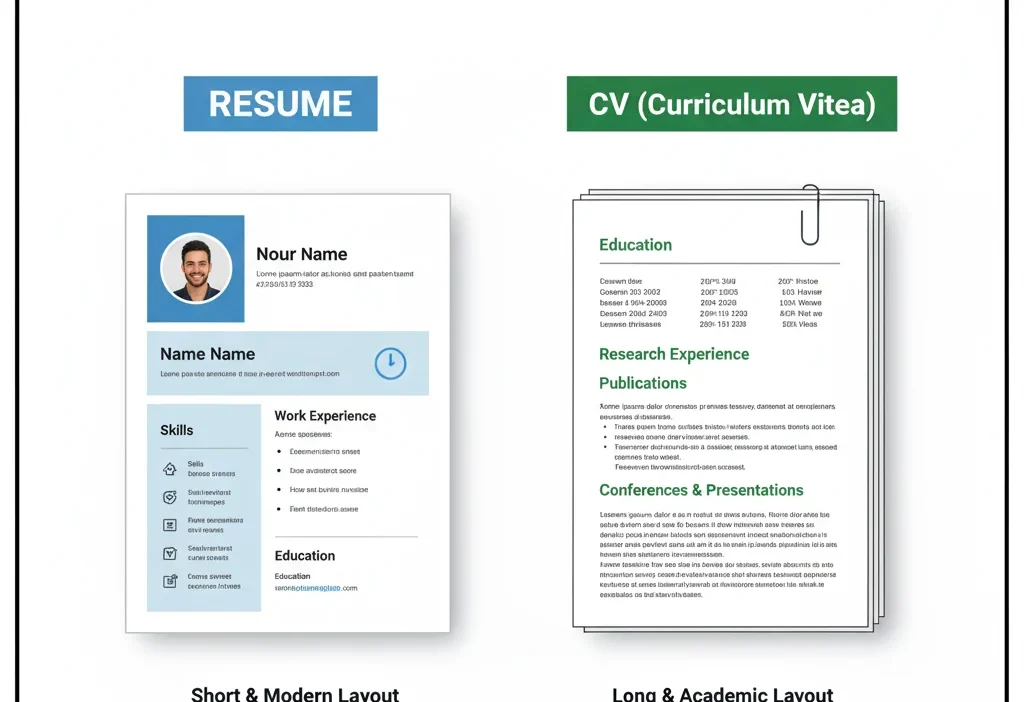
A resume is a short summary of your work experience, education, and skills. It’s usually 1–2 pages long and is customized for a specific job you’re applying for.
Think of it as your highlight reel — it shows your best moments, not your whole life story.
Part of Speech: Noun
Examples:
- I updated my resume before applying for the marketing job.
- Please send your resume along with the application form.
- Her resume highlights her leadership and teamwork skills.
CV Meaning
A CV, short for Curriculum Vitae, is a detailed document that lists your entire academic and professional history. It can be 2 to 10+ pages long, depending on your experience.
It’s mostly used for academic, research, or international jobs. Think of it as a complete story of your professional journey.
Part of Speech: Noun
Examples:
- The professor submitted his CV for the university grant.
- My CV includes all my research papers and conference talks.
- In Europe, employers often ask for a CV instead of a resume.
The Key Difference Between Resume and CV
Here’s a simple table that makes it easy to remember the main differences between the two.
| Feature | Resume | CV |
|---|---|---|
| Meaning | A short summary of your qualifications for a specific job. | A detailed record of your entire professional and academic career. |
| Length | 1–2 pages | 2–10+ pages |
| Purpose | Job applications in business, private sector, or industry. | Academic, research, or international job applications. |
| Focus | Skills, achievements, and work experience. | Full career history, including publications and projects. |
| Format | Customized for each job. | Stays mostly the same; updated over time. |
| Used In | USA, Canada | UK, Europe, Asia, Africa |
Quick Tip:
👉 Use a resume when applying for jobs in business or industry.
👉 Use a CV when applying for academic, research, or international positions.
210+ Parents’ vs Parent’s Grammar Difference 📚 2025 English Help
Common Mistakes and How to Avoid Them
Even experienced job seekers make these common mistakes:
❌ Mistake 1: Sending a resume when a CV is required
Why it happens: People assume both documents mean the same.
How to fix it: Always check the job description — if it says “Curriculum Vitae,” send a CV with full details.
❌ Mistake 2: Making your resume too long
Why it happens: Trying to include everything you’ve ever done.
How to fix it: Keep your resume short — highlight only relevant experience for that job.
❌ Mistake 3: Using the same document worldwide
Why it happens: Many don’t know that “resume” and “CV” are used differently in different countries.
How to fix it:
- In the U.S. and Canada, use a resume for most jobs.
- In Europe, Asia, and Africa, use a CV.
When to Use a Resume
Use a resume when you want to apply for:
- Corporate or private sector jobs
- Government or nonprofit jobs
- Internships or entry-level positions
Examples:
- She wrote a one-page resume for the bank job.
- Your resume should include only relevant skills and experience.
- I attached my resume to the email before sending it.
- He created a modern resume using an online builder.
- A short and focused resume makes a strong first impression.
Memory Trick:
🧠 “Resume = Re-summarize.” It’s short, just like the word itself.
When to Use a CV
Use a CV when applying for:
- Teaching or research positions
- Scholarships or fellowships
- Graduate school admissions
- Jobs outside North America
Examples:
- She added her published papers to her CV.
- Universities usually ask for a CV, not a resume.
- My CV includes all my academic awards and conferences.
- He prepared a detailed CV for the research grant.
- I keep updating my CV every year as I achieve more.
Memory Hack:
📘 “CV = Complete Version.” It tells your whole story.
Quick Recap: Resume vs CV
Here’s a simple summary to help you remember:
✅ Resume:
- Short (1–2 pages)
- For job applications
- Focuses on key skills and experiences
✅ CV:
- Long and detailed
- For academic or international positions
- Includes all qualifications, publications, and achievements
In short:
👉 A resume is a summary.
👉 A CV is a story.
Advanced Tips: Origins, Global Use, and Writing Advice
- Origin: “Resume” comes from the French word résumé, meaning “summary.” “Curriculum Vitae” is Latin for “course of life.”
- Global Use:
- U.S. & Canada: Resume for jobs, CV for academics.
- UK & Europe: CV for all job applications.
- In Formal Writing: Use “Curriculum Vitae” in full for academic settings.
- Online Tip: When uploading documents, name them clearly — for example, JohnDoe_Resume.pdf or JohnDoe_CV.pdf.
- Bonus Tip: Never send both unless asked. Choose the one that fits the job type.
Mini Quiz: Test Your Understanding
Fill in the blanks with resume or CV:
- My professor asked for my _______ before recommending me for the scholarship.
- I sent my updated _______ to apply for the marketing role.
- A _______ is usually longer and includes publications.
- You should tailor your _______ for each company you apply to.
- In the U.K., most job seekers submit a _______.
- A short and focused _______ impresses employers faster.
- A _______ gives a full record of your career journey.
(Answers: 1. CV, 2. resume, 3. CV, 4. resume, 5. CV, 6. resume, 7. CV)
5 FAQs About Resume vs CV
1. Is a resume the same as a CV?
No, a resume is short and job-specific, while a CV is long and detailed.
2. How many pages should a resume be?
Usually one page for beginners, and up to two pages for professionals.
3. What should I include in my CV?
Your education, research, work history, awards, and publications.
4. Can I use a resume for a university job?
No, most universities require a CV.
5. What’s the best format for a resume or CV?
Use clean headings, bullet points, and clear fonts like Arial or Calibri.
Conclusion
Now you know the real difference between a resume and a CV! A resume is your short story for specific jobs, while a CV is your complete career journey. Remember — short for jobs, long for academics.
Keep your documents clear, updated, and honest. Practice writing them both, and soon you’ll be confident about which one to use anywhere in the world.

Eley Williams writes clear, engaging guides on confusing words and phrases, helping readers understand meanings, differences, and correct usage with ease.