Have you ever seen the phrase “roll or die” and wondered what it really means? Many English learners and even native speakers mix it up because it sounds dramatic and a bit tricky. Understanding it is important, especially if you enjoy games, movies, or phrases used in challenges.
In this guide, we will explain the meanings of roll and die, how they are used in everyday English, and why people confuse them. You will also get clear examples, memory tips, and common mistakes to avoid. By the end of this article, even beginners will be able to confidently use roll and die correctly, whether in writing, texting, or speaking. Think of it as a mini English adventure—without the fear!
What Does Each Word Mean?
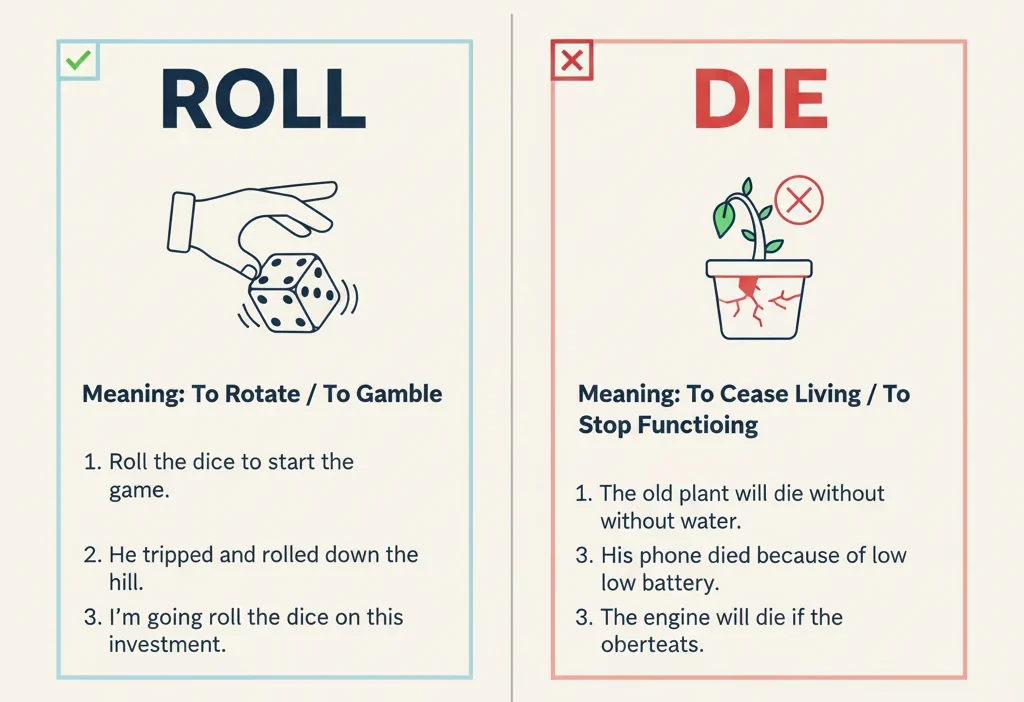
1. Roll
Meaning:
- To move something by turning it over and over.
- Can also mean to move smoothly, like a ball or dice.
Part of Speech: Verb
Examples:
- I will roll the ball to you.
- She likes to roll the dice in board games.
- The car started to roll down the hill.
Memory Tip: Think of a wheel or a ball—it keeps rolling!
2. Die
Meaning:
- To stop living; to pass away.
- Can also be used figuratively to describe failure or the end of something.
Part of Speech: Verb
Examples:
- Plants die without water.
- The old battery will die soon.
- He felt like his hopes might die after the loss.
Memory Tip: “Die” ends all action—like when something stops completely.
The Key Difference Between Roll and Die
| Feature | Roll 🎲 | Die 💀 |
|---|---|---|
| Meaning | Move by turning over | Stop living or fail |
| Part of Speech | Verb | Verb |
| Usage Example 1 | Roll the dice carefully. | The flowers will die. |
| Usage Example 2 | The ball rolled away. | His old phone finally died. |
| Quick Tip | Roll = motion | Die = stop/end |
Quick Tip: If it moves, it’s roll. If it stops forever, it’s die.
Common Mistakes and How to Avoid Them
Mistake 1: “The ball will die down the hill.”
Correction: “The ball will roll down the hill.”
Why: People confuse dramatic sounding words. A ball moves—it does not die.
Mistake 2: “My phone will roll soon.”
Correction: “My phone will die soon.”
Why: Phones don’t move on their own; they stop working.
Mistake 3: “I hope my energy dies tonight.”
Correction: “I hope my energy rolls tonight.” (if you mean activity continues)
Why: Rolling implies motion or flow; dying implies ending.
When to Use Roll
Situations to Use Roll:
- Talking about objects that move (dice, ball, wheel).
- Referring to smooth continuous movement.
- In games: dice or rolling logs.
Examples:
- Roll the dice to start the game.
- The ball rolled across the field.
- He likes to roll sushi at home.
- Cars rolled past the street festival.
- The thunder rolled in the distance.
Memory Hack: Picture a wheel spinning—anything moving like that = roll.
When to Use Die
Situations to Use Die:
- When living beings or objects stop working.
- To show the end of something, literally or figuratively.
- Talking about machines or electronics running out of power.
Examples:
- If you forget to water the plant, it will die.
- My old laptop finally died yesterday.
- The lights died during the storm.
- Dreams can die if you don’t try.
- Sometimes old habits must die to make room for new ones.
Memory Hack: Picture an X mark—something that has completely stopped = die.
Quick Recap: Roll vs Die
- Roll: Motion, turning, movement.
- Die: Stop, end, pass away.
- Tip: If it moves, use roll. If it stops permanently, use die.
- Common Mistake: Mixing these words in games or daily life.
- Easy Recall: Roll = wheel/ball; Die = X mark/end.
Advanced Tips (Optional)
- Origin:
- Roll comes from Old English rollian, meaning “to revolve.”
- Die comes from Old English dīegan, meaning “to cease living.”
- Formal Writing: Use die in academic or serious contexts for life, death, or machinery. Roll is fine in casual, storytelling, or descriptive contexts.
- Online Writing: Saying “my phone rolled” is incorrect; “my phone died” is correct. Misusing these can confuse readers.
Mini Quiz (Optional)
Fill in the blanks:
- The ball ______ down the hill.
- Without water, plants will ______.
- He ______ the dice carefully.
- My old phone finally ______ yesterday.
- Clouds ______ across the sky.
- Hopes can ______ if you stop trying.
- The log ______ along the river.
FAQs
Q1: What does “roll or die” mean?
A: It refers to either taking action/moving forward (roll) or facing failure/end (die).
Q2: Can you use “roll” for humans?
A: Only in figurative or playful contexts, e.g., “He rolled with laughter.”
Q3: Is “die” always literal?
A: No, it can also describe the end of machines, ideas, or feelings.
Q4: How do I remember the difference between roll and die?
A: Roll = movement; Die = stop/end. Picture a spinning wheel versus an X mark.
Q5: Are these words common in games?
A: Yes, roll is used for dice or ball games, die is often dramatic or figurative.
Conclusion
Understanding roll or die is easier than it seems! Remember: roll is all about motion, while die is about stopping or ending. By using the tips, examples, and memory hacks in this guide, you can avoid common mistakes and confidently use both words in daily life, writing, and games. Practice by spotting these words around you, in movies, or in conversations. Over time, distinguishing them will become automatic. Every small step improves your English, and mastering tricky word pairs like roll or die is a fun way to grow. Keep practicing, and soon, these words will feel natural—like rolling a ball or letting go of something that must die.

Eley Williams writes clear, engaging guides on confusing words and phrases, helping readers understand meanings, differences, and correct usage with ease.