Have you ever wondered if Santa’s reindeer are boys or girls? It’s a surprisingly tricky question, and the answer might not be what you think! Let’s dive into the magical world of Santa’s team and find out once and for all.
Many people ask the same question every Christmas: “Are Santa’s reindeer male or female?” It seems simple, but the answer isn’t as obvious as you might think. The confusion comes from stories, songs, and movies that rarely mention the reindeer’s gender. Knowing whether these iconic animals are male or female can make Santa’s legend even more fascinating.
In this guide, you’ll learn the meaning behind Santa’s reindeer gender, the differences between male and female reindeer, and how to remember which is which. We’ll also share fun examples, common mistakes, and quick tips so you can impress your friends and family with your festive knowledge. By the end, even beginners will understand the answer clearly and easily.
What Does Each Gender Mean?
Before answering the main question, let’s quickly define male and female reindeer:
Male Reindeer
- Definition: Male reindeer are called bulls. They are usually larger, with heavier antlers, and often lead during fights for mates.
- Part of Speech: Noun (refers to the animal)
- Examples:
- The male reindeer competed for the best feeding spot.
- A bull reindeer has massive antlers in winter.
- Male reindeer usually shed their antlers after mating season.
Female Reindeer
- Definition: Female reindeer are called cows. They are smaller than males and often lead herds during migration.
- Part of Speech: Noun (refers to the animal)
- Examples:
- The female reindeer guided the younger calves across the snowy forest.
- Cows keep their antlers until spring.
- Female reindeer are essential for pulling Santa’s sleigh in stories.
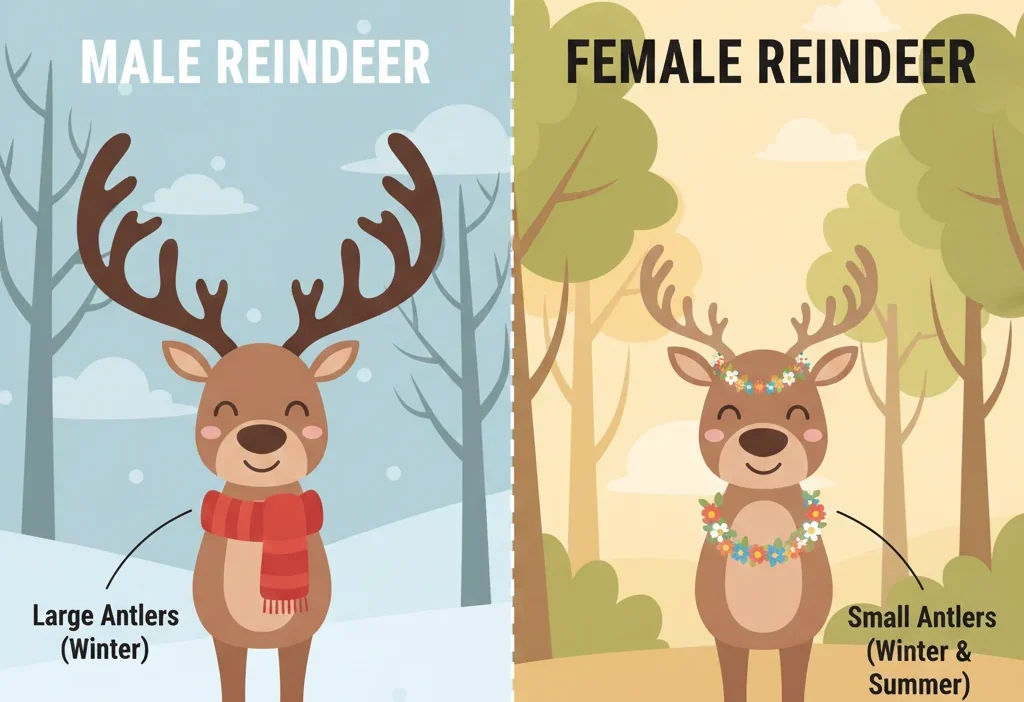
Tip: Remember, in nature, antlers in winter are usually a female trait — a key clue when thinking about Santa’s sleigh team!
The Key Difference Between Male and Female Reindeer
| Feature | Male Reindeer (Bull) | Female Reindeer (Cow) | Example Sentence |
|---|---|---|---|
| Antlers in Winter | Usually shed after mating season | Keep antlers through winter | “Santa’s reindeer must have antlers in December, so they are likely female!” |
| Size | Larger, heavier | Smaller, lighter | “The bull reindeer is strong but not on Santa’s sleigh in winter.” |
| Role in Herd | Competes for mates | Leads the herd and protects calves | “The female reindeer guides the younger ones safely.” |
Quick Tip: If your reindeer has antlers on Christmas Eve, it’s most likely female!
Common Mistakes and How to Avoid Them
Many people assume Santa’s reindeer are male because of songs like Rudolph the Red-Nosed Reindeer, but this is a mistake.
Incorrect: “All of Santa’s reindeer are bulls.”
Correct: “Most of Santa’s reindeer are female because they keep their antlers in winter.”
Incorrect: “Rudolph is a boy because he’s strong.”
Correct: “Rudolph could actually be female; strength doesn’t determine gender in reindeer.”
Why the Mistake Happens: Cultural assumptions and stories usually depict reindeer as masculine. In reality, biology gives us the real answer.
When to Consider Male Reindeer
While Santa’s sleigh team is mostly female, male reindeer are important in nature:
- During mating season – male reindeer compete for mates.
- In summer months – bulls grow massive antlers.
- In stories or zoos – to show realistic animal behavior.
Examples in Sentences:
- The male reindeer lost his antlers in November.
- Male reindeer are much heavier than females.
- During summer, bull reindeer roam freely in herds.
- Scientists track male reindeer for research on migration.
When to Consider Female Reindeer
Female reindeer are the real heroes of Santa’s winter team.
- Why? They keep their antlers during Christmas, which makes them perfect for the sleigh team.
- Traits: Smaller, lighter, and good at leading herds.
Examples in Sentences:
- Santa’s female reindeer pull the sleigh through snowstorms.
- Cows keep their antlers long enough to reach Christmas Eve.
- The youngest reindeer learn from female leaders in the herd.
- Female reindeer are strong, smart, and agile — perfect for magical flight!
Memory Hack: Think “C” for Christmas and Cow — females have antlers at Christmas!
Quick Recap: Male vs Female Reindeer
- Male Reindeer (Bulls): Larger, shed antlers before winter, compete for mates.
- Female Reindeer (Cows): Smaller, keep antlers through winter, lead herds, and pull Santa’s sleigh.
- Tip: Winter antlers = female; summer antlers = male.
- Common Mistake: Assuming strength or stories = male.
Advanced Tips
- Origin: The word “reindeer” comes from Old Norse “hreindýr” meaning “horned animal.”
- Formal Writing: In essays about wildlife, always specify bull (male) or cow (female) for accuracy.
- Online Misuse: Saying “Santa’s reindeer are all bulls” in social media can spread misinformation — now you know the truth!
Mini Quiz
Fill in the blanks to test your understanding:
- Santa’s reindeer likely have _______ antlers at Christmas.
- Male reindeer usually shed their antlers in _______.
- The leader of the reindeer herd in winter is usually a _______.
- _______ reindeer are smaller and lighter.
- Bulls compete for _______ during mating season.
Answers: 1. female 2. November 3. female 4. female 5. mates
FAQs
1. Are all of Santa’s reindeer female?
Yes, most are female because they keep their antlers through Christmas.
2. Why do people think they are male?
Songs, movies, and cultural assumptions often portray them as male.
3. Do male reindeer ever pull sleighs?
Not typically in December — male reindeer shed antlers before winter.
4. How can you tell male and female reindeer apart?
Check antlers in winter: females keep them, males do not.
5. Is Rudolph male or female?
Rudolph could be female, biologically speaking, since he has antlers on Christmas Eve.
Conclusion
Now you know the secret behind Santa’s reindeer male or female question! Most of Santa’s magical helpers are female, keeping their antlers to lead the sleigh safely. Remember: antlers in winter = female.
By understanding this simple biology fact, you can confidently answer any festive debate and even impress your friends with accurate Christmas trivia. Keep practicing and exploring the world of English and nature — learning can be magical, just like Santa’s reindeer.

Jenn Ashworth offers clear, engaging explanations of language and usage, helping readers grasp meanings, nuances, and differences with accuracy and ease.