Have you ever paused mid-sentence, wondering if you should say “I seen” or “I saw”? You’re not alone. Many English learners — and even native speakers — get confused between seen and saw because both come from the same verb, see.
In this easy guide, you’ll learn the meaning, difference, and correct usage of seen and saw with simple explanations, real-life examples, and helpful memory tricks. By the end, you’ll never mix them up again — whether you’re writing an essay, chatting online, or talking to friends.
What Does Each Word Mean?
Both seen and saw come from the verb “to see,” which means to look at something or notice something with your eyes.
However, they are not used the same way. Let’s break down what each one means.
🟢 “Saw” – Simple Past Tense
“Saw” is the past tense form of see.
You use it when you’re talking about something that already happened — and you don’t need a helping verb.
Examples:
- I saw a rainbow yesterday.
- She saw her friend at the park.
- We saw a movie last night.
Think of “saw” as something you use alone — it doesn’t need “have,” “has,” or “had” in front of it.
🔵 “Seen” – Past Participle
“Seen” is the past participle form of see.
That means you can’t use it by itself — it needs a helping verb like have, has, or had.
Examples:
- I have seen that movie before.
- She has seen her cousin recently.
- We had seen the results already.
So, if you’re using have, has, or had, the correct word is seen.
Simple Story Trick
Imagine “Saw” likes working alone — it’s independent.
But “Seen” always wants a partner — have, has, or had.
If you remember that, you’ll never mix them up again!
The Key Difference Between Seen and Saw
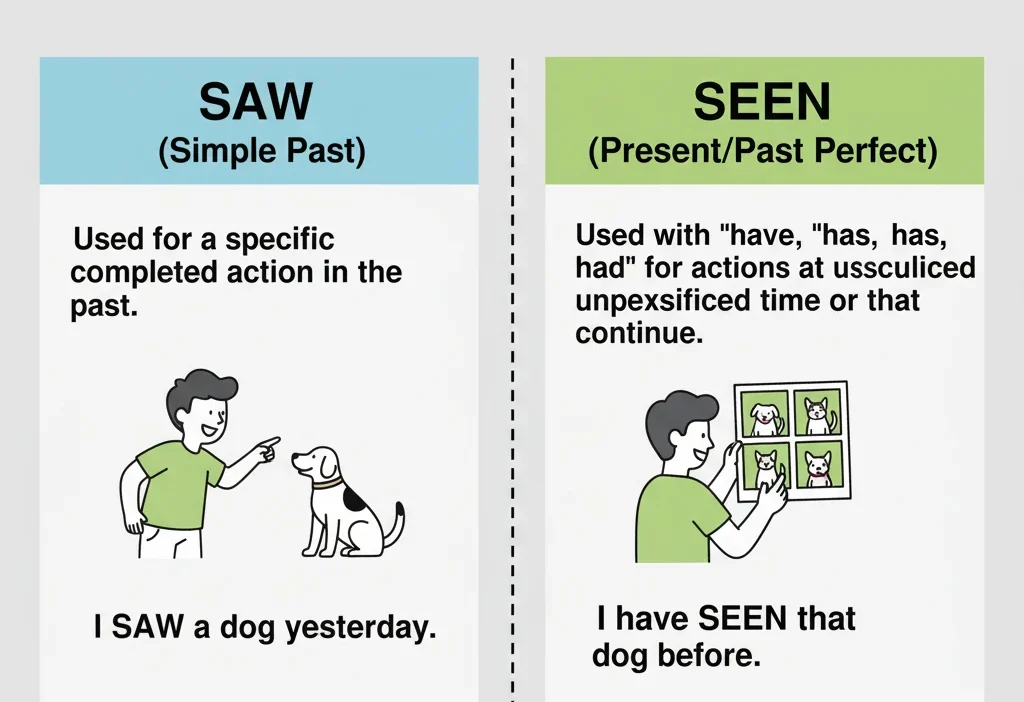
Here’s a quick visual to help you remember the difference between “seen” and “saw.”
| Feature | Saw | Seen |
|---|---|---|
| Tense Type | Simple Past Tense | Past Participle |
| Used With | No helping verb | Needs helping verb (have/has/had) |
| Example Sentence | I saw a bird. | I have seen a bird. |
| Common Error | ❌ I seen a bird. | ❌ I have saw a bird. |
| Correct Form | ✅ I saw a bird. | ✅ I have seen a bird. |
Quick Tip to Remember:
✅ “SAW” stands alone.
✅ “SEEN” needs help.
❌ Never say “I seen” without “have.”
Common Mistakes and How to Avoid Them
Even fluent speakers sometimes make these small grammar slips. Let’s fix them!
❌ Incorrect:
I seen a lion at the zoo.
✅ Correct:
I saw a lion at the zoo.
Why it’s wrong:
“Seen” needs have, has, or had. There’s no helping verb here, so it should be saw.
❌ Incorrect:
I have saw that movie already.
✅ Correct:
I have seen that movie already.
Why it’s wrong:
When you use have, the correct form is seen.
❌ Incorrect:
We seen him yesterday at school.
✅ Correct:
We saw him yesterday at school.
Why it’s wrong:
The sentence talks about the past (yesterday) and doesn’t need a helping verb — so use saw.
When to Use “Saw”
Use “saw” when you are simply talking about something that happened in the past.
It’s a simple past tense verb.
Examples:
- I saw a shooting star last night.
- She saw a beautiful dress at the mall.
- We saw the teacher in the library.
- They saw him running across the street.
- He saw a funny meme online.
Memory Hack:
Think of “saw” like a past snapshot — a single event that already happened.
When to Use “Seen”
Use “seen” only when it has a helping verb (have, has, or had) before it.
It describes something you have experienced or completed before now.
Examples:
- I have seen this movie three times.
- She has seen her favorite singer perform live.
- We had seen the news before you told us.
- They have seen snow only once.
- He has seen this kind of mistake many times.
Memory Trick:
“Seen” never walks alone — it always walks with have, has, or had.
Quick Recap: Seen vs Saw
Here’s everything you need to remember — quick and easy:
- “Saw” = past tense → I saw a dog.
- “Seen” = past participle → I have seen a dog.
- “Saw” doesn’t need a helper.
- “Seen” needs have, has, or had.
- Never say “I seen” without “have.”
- Both come from the verb “see.”
✅ Simple Formula:
If “have/has/had” is in your sentence → use seen.
If not → use saw.
Advanced Tips: Grammar, History & Usage
- Word Origin:
Both “seen” and “saw” come from the Old English word seon, meaning to perceive or look at. Over time, English developed separate past and participle forms — saw and seen. - Formal Writing Tip:
In essays, academic writing, or exams, using “I seen” instead of “I saw” is considered a grammar error. Always double-check for helping verbs. - In Texting or Speech:
In casual speech or dialects (like some regional English varieties), people might say “I seen” — but remember, it’s not standard English. - In Storytelling:
Writers sometimes use both forms for tense shifts —
“Yesterday, I saw a comet. I have never seen anything so bright before.”
That’s the correct and natural way to use both together!
Mini Quiz: Test Yourself!
Fill in the blanks with seen or saw.
(Answers below the list!)
- I ____ a butterfly in the garden.
- Have you ever ____ a shooting star?
- We ____ him at the game last night.
- She has never ____ snow before.
- They ____ that movie last weekend.
- I have ____ your brother at the store.
- He ____ a bird building a nest.
Answers:
- saw
- seen
- saw
- seen
- saw
- seen
- saw
FAQs About “Seen or Saw”
1. What is the main difference between “seen” and “saw”?
“Saw” is simple past tense (used alone), while “seen” is a past participle (used with have/has/had).
2. Is it correct to say “I seen”?
No, that’s grammatically incorrect. You should say “I saw” or “I have seen.”
3. When do I use “have seen”?
Use “have seen” when you’re talking about something you experienced before now, not just at a specific time.
4. Can I use “seen” without “have”?
No. “Seen” always needs a helping verb like have, has, or had.
5. What’s an easy way to remember?
Think: “Seen” needs a helper. “Saw” stands alone.
Conclusion
Now you know the clear difference between seen and saw.
Use saw for things that happened in the past, and seen only when it has a helper — have, has, or had.
Practice these daily in your conversations and writing. Soon, choosing the right one will feel natural and easy.
Keep learning — every small grammar win makes your English stronger and more confident!

Cynan Jones loves diving into the world of words and uncovering what makes each one unique. Through Meandiff.com, he brings clarity, curiosity, and creativity to the art of language learning.