Have you ever paused while writing and thought, “Should I say I seen or I saw?” Don’t worry — you’re not alone! Many English learners (and even native speakers) confuse seen and saw because both come from the verb “see.” But they are not interchangeable. Using the wrong one can make your sentence sound incorrect.
In this simple guide, you’ll learn the difference between “seen” and “saw,” their correct usage, and easy examples to remember which one fits where. By the end, you’ll be able to use both words confidently — whether in school writing, daily conversations, or formal English exams.
🧠 What Does Each Word Mean?
Let’s start by understanding what each word means and how they work in a sentence.
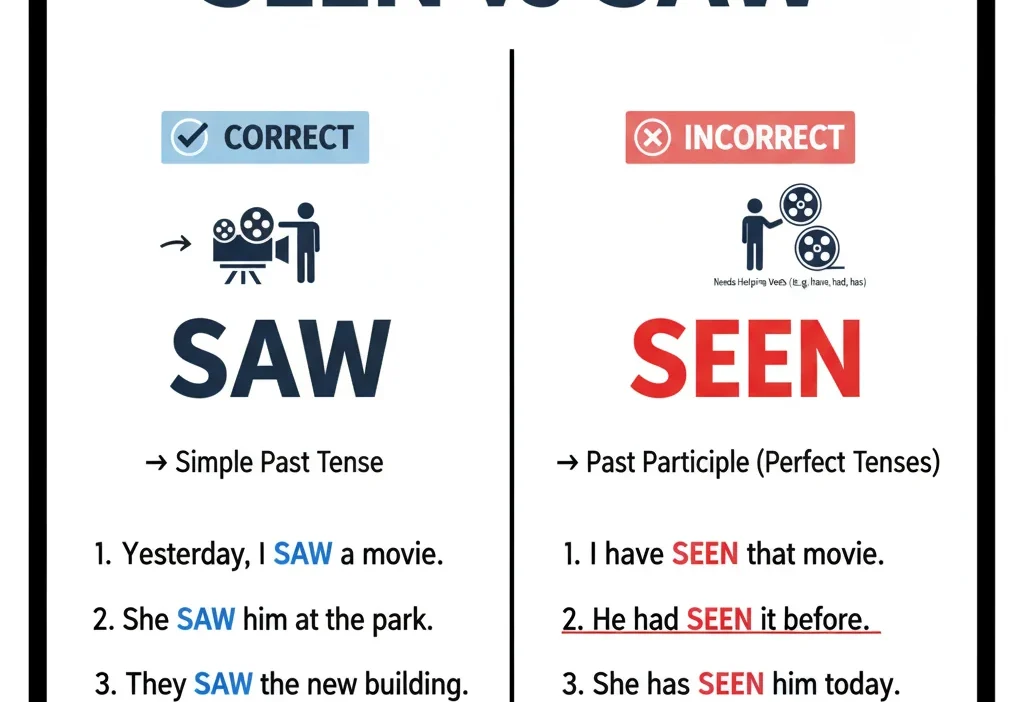
✅ “Saw” — The Simple Past Tense of “See”
Meaning: “Saw” is used when something happened in the past and is already complete.
Part of speech: Verb (past tense of see).
Examples:
- I saw a rainbow after the rain.
- She saw her friend at the park yesterday.
- We saw a funny movie last night.
🪄 Tip: If the action happened once and is finished, use saw.
✅ “Seen” — The Past Participle of “See”
Meaning: “Seen” is used with a helping verb like have, has, or had. It shows an action that happened before now or before another time.
Part of speech: Verb (past participle of see).
Examples:
- I have seen that movie before.
- She has seen a shooting star once.
- They had seen the results before the teacher announced them.
🪄 Tip: If you use have, has, or had, you must use seen.
⚖️ The Key Difference Between “Seen” and “Saw”
Here’s a quick comparison to help you understand:
| Feature | Saw | Seen |
|---|---|---|
| Verb Type | Simple Past | Past Participle |
| Helper Verb | ❌ No helper needed | ✅ Must have have / has / had |
| Used For | Completed actions in the past | Actions that connect to now or another past event |
| Example 1 | I saw a cat. | I have seen a cat. |
| Example 2 | We saw him yesterday. | We had seen him before. |
🎯 Quick Memory Trick:
If you see “have,” “has,” or “had” — pick seen.
If not — pick saw.
🚫 Common Mistakes and How to Avoid Them
Let’s fix some common mix-ups:
❌ Wrong: I seen her yesterday.
✅ Correct: I saw her yesterday.
Why? No helping verb — so use saw.
❌ Wrong: I have saw that movie before.
✅ Correct: I have seen that movie before.
Why? After “have,” always use seen.
❌ Wrong: We seen it already.
✅ Correct: We have seen it already.
Why? Add the helper “have” to make it correct.
✨ Tip: Whenever you write “seen,” double-check — do you have a helper verb? If not, it’s probably wrong!
🕰️ When to Use “Saw”
Use saw when:
- The action happened in the past.
- It’s a completed event.
- There is no helper verb.
Examples:
- I saw my teacher at the store.
- We saw the fireworks on New Year’s Eve.
- She saw a shooting star last night.
- They saw the final score after the match.
- He saw a ghost in his dream.
Memory Hack:
Think of “saw” like a camera click — one quick moment in the past! 📸
🪞 When to Use “Seen”
Use seen when:
- It comes with have, has, or had.
- The action connects to the present or another past event.
Examples:
- I have seen that movie many times.
- She has seen her friend’s new house.
- We had seen the signs before the storm hit.
- They have seen better days.
- He has seen this problem before.
Memory Hack:
If you “have” something, you “have seen” it — never “have saw.”
🔁 Quick Recap: Seen vs Saw
- Saw = Past tense (no helper verb).
- Seen = Used with have / has / had.
- Saw → I saw a bird yesterday.
- Seen → I have seen that bird before.
- “Seen” always needs a partner (helping verb).
- “Saw” works alone!
🧩 Super Simple Rule:
Saw stands alone.
Seen never stands alone.
💡 Advanced Tips and Fun Facts
- Both words come from the Old English verb seon, meaning “to see.”
- In formal writing, always use them correctly — mistakes like “I seen” can sound uneducated in essays or job applications.
- In casual speech, some people say “I seen” — but remember, it’s grammatically incorrect.
- In texting or informal talk, people might skip helper verbs — but always use proper grammar in writing!
🧩 Mini Quiz — Test Your Grammar!
Fill in the blanks with seen or saw:
- I ____ a shooting star last night.
- She has ____ that movie before.
- We ____ our teacher in the market.
- They have ____ the Eiffel Tower in photos.
- He ____ a big dog outside the school.
- I had ____ that problem before the exam.
- My friend ____ a rainbow yesterday morning.
📝 Answers:
- saw
- seen
- saw
- seen
- saw
- seen
- saw
❓ FAQs
1. What is the main difference between seen and saw?
“Saw” is the past tense. “Seen” is the past participle used with have, has, or had.
2. Can I say “I seen” something?
No. Always say “I saw.” “Seen” needs a helper verb.
3. How do I remember when to use seen or saw?
If there’s have / has / had, use “seen.” If not, use “saw.”
4. Is “have saw” correct?
No, it’s wrong. The correct form is “have seen.”
5. Why do people say “I seen”?
It’s a common regional or casual speech mistake, but not correct grammar.
🎯 Conclusion
Now you know the difference between seen and saw!
Use saw for simple past actions and seen with helper verbs (have, has, had).
Practice these daily in your writing and conversations to make your English sound smooth and correct.
Remember — great grammar makes great communication. Keep learning, keep practicing, and soon you’ll never mix up “seen” and “saw” again! 🌟

Francis Sufford crafts thoughtful, insightful explanations on language, meaning, and usage, blending clarity with storytelling to guide readers effectively.