Have you ever been typing an important email or document and suddenly paused, your fingers hovering over the keyboard, wondering: is it seize or sieze? You’re not alone. This simple four-letter word causes disproportionate confusion, tripping up native speakers and English learners alike.
The battle between seize and sieze is one of the most common spelling dilemmas in the English language. People search for this keyword not out of casual curiosity, but from a place of genuine uncertainty—right before hitting “send” on a job application, submitting a legal document, or publishing written content.
This confusion stems from the notorious “i before e except after c” rule, which this word famously violates, leaving writers second-guessing themselves. Understanding the correct spelling of seize is more than a trivial grammar exercise; it’s about ensuring clarity, professionalism, and credibility in your communication.
This article will dismantle the confusion, provide a definitive answer, and equip you with the knowledge to use this word with confidence in any context. We’ll explore its origins, compare British and American conventions, examine common mistakes, and provide practical examples to help you seize the day without a spelling error.
Seize / Sieze
The correct spelling is seize. The spelling sieze is always incorrect. The word follows the “i before e except after c” rule because it contains the sound /iː/ (like in “see”) and is not preceded by a ‘c’. The ‘e’ comes before the ‘i’: S-E-I-Z-E.
Examples of Correct Usage:
- The army will seize control of the capital.
- She seized the opportunity to speak.
- The engine has seized from lack of oil.

The Origin of Seize
The word seize has a long and winding history that explains its unique spelling. It entered Middle English in the 13th century from the Old French word seisir, which meant “to put in possession of, to take possession of.” The Old French term itself came from a popular Latin verb sacīre, found in the phrase ad proprium sacire, meaning “to claim as one’s own.” This Latin root is also linked to a Germanic source.
The spelling with “-ei-” was solidified in English to represent the long ‘e’ sound (/iː/). This directly contradicts the simpler “i before e” pattern that many learn, making it a classic exception. Words like “seize,” “weird,” and “protein” are often cited as the key examples that break the famous spelling rule. The persistence of the sieze misspelling is a direct result of people over-applying the basic “i before e” rule without learning its important exceptions. The history of the word shows its spelling was fixed centuries ago based on its French and Latin origins, not modern English phonics.
British English vs. American English Spelling
When it comes to the spelling of seize, there is a rare and beautiful point of agreement: both British English and American English use seize. Unlike words like “colour/color” or “organise/organize,” this word has no transatlantic variation.
However, the context of the “i before e” rule is taught differently. In British English, the full rhyme is often taught as: “i before e, except after c, or when sounded as ‘a’ as in ‘neighbour’ and ‘weigh.’” American classrooms frequently use a shortened version. Despite these different teaching approaches, the agreed-upon exception list for both dialects includes seize.
Examples in Both Dialects:
- (UK) The police have the power to seize the assets.
- (US) The police have the power to seize the assets.
Comparison Table: Seize vs. Common Misspellings
| Correct Spelling (UK & US) | Common Incorrect Spelling | Reason for Error |
|---|---|---|
| seize | sieze | Over-application of “i before e” rule. |
| seized | siezed | Incorrect base spelling carried into past tense. |
| seizing | siezing | Incorrect base spelling carried into present participle. |
| seizes | siezes | Incorrect base spelling carried into third-person present. |
Which Spelling Should You Use?
The answer is universal: always use seize.
- For a US Audience: Use seize. American English dictionaries and style guides (like APA or Chicago) list only this spelling.
- For a UK/Commonwealth Audience: Use seize. The Oxford English Dictionary and other UK style guides confirm this as the only correct form.
- For Global/International English: Use seize. It is the standardized, globally recognized spelling in all formal and professional contexts, from legal treaties to academic papers and international business communication.
Using sieze will be flagged as a spelling error by every major word processor (Microsoft Word, Google Docs) and grammar checker (Grammarly). To maintain professionalism and accuracy, seize is the only acceptable choice.
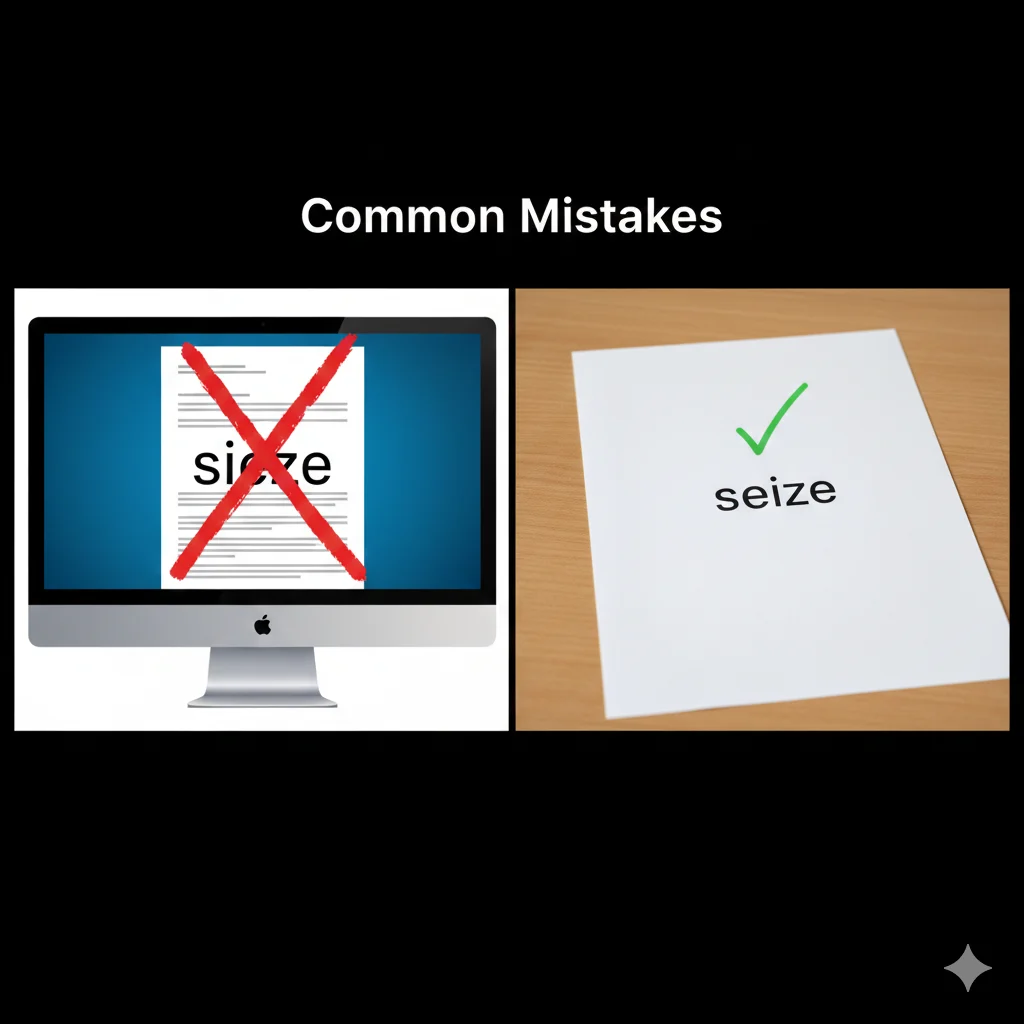
Common Mistakes with Seize
The primary and most frequent mistake is, of course, spelling it as sieze. This error almost always originates from misremembering the “i before e” rule. Let’s correct the most common variants:
- Incorrect: The government plans to sieze the property.
Correct: The government plans to seize the property. - Incorrect: He siezed the moment and proposed.
Correct: He seized the moment and proposed. - Incorrect: Siezing power is their main objective.
Correct: Seizing power is their main objective.
Another less common but related error is confusing seize with cease (which means to stop). For example: “The factory will seize operations” is incorrect; it should be “The factory will cease operations.”
Seize in Everyday Examples
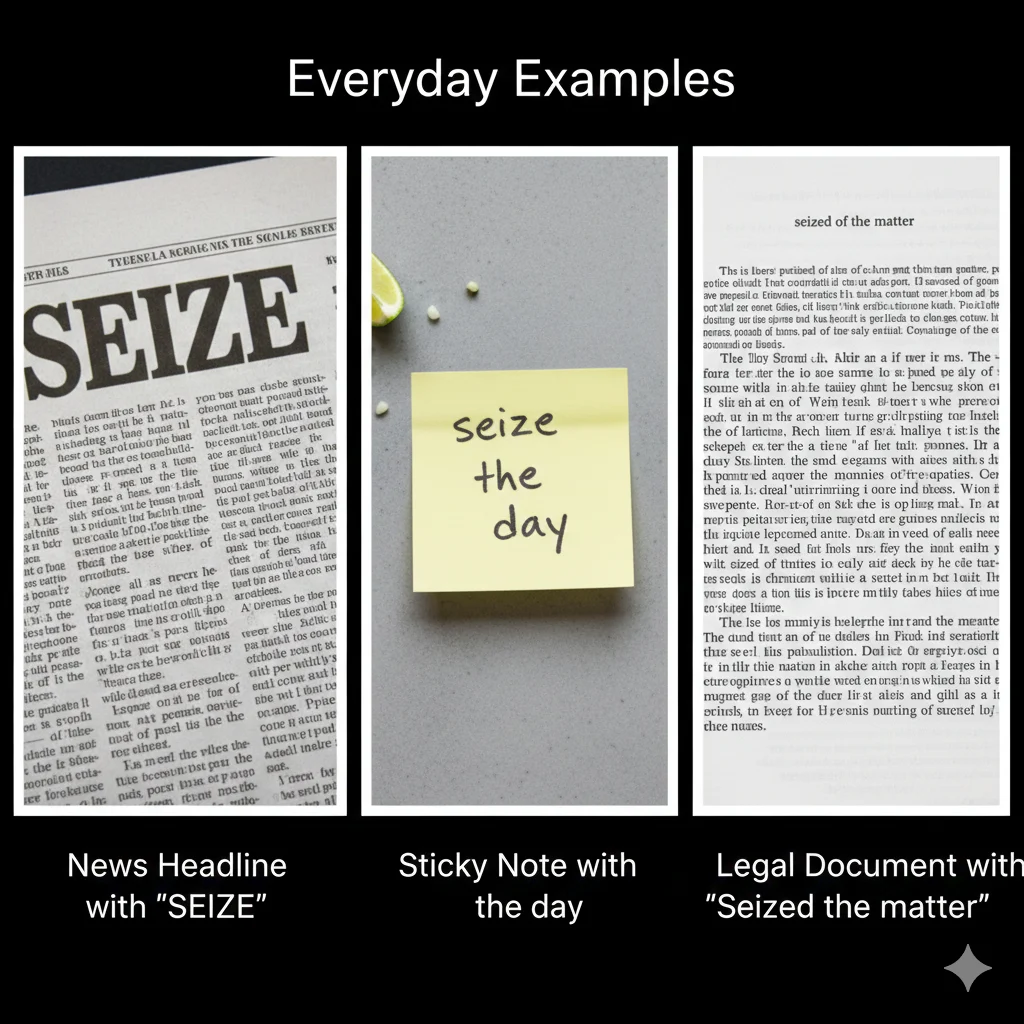
Understanding a word means seeing it in action. Here’s how seize is correctly used across different contexts.
- Professional Email: “We must seize this market opportunity before our competitors do.”
- News Headline: “Regulators Seize Troubled Bank to Protect Depositors.”
- Social Media Post: “Just going to seize the day and start that project I’ve been putting off! #MotivationMonday”
- Formal/ Legal Writing: “The court is seized of the matter and will issue a ruling in due course.” (Note the formal phrase “seized of”).
- Casual Conversation: “My car engine seized up in the cold, so I had to get a tow.”
Seize – Google Trends & Usage Data
Analysis of Google search data reveals a telling story. Searches for the incorrect spelling “sieze” are consistently made worldwide, proving the widespread nature of this confusion. Interest in the correct spelling “seize” is stable and correlates with news events involving authorities seizing assets, military actions, or discussions of seizing opportunities.
Regionally, searches for both terms are common in English-speaking countries like the US, UK, Canada, and Australia. The data shows no regional preference for the misspelling—it is a universal error. This highlights that the challenge isn’t dialect-based but rooted in the tricky exception to a basic spelling rule.
(FAQs)
1. Is it sieze or seize?
It is always seize. Sieze is an incorrect spelling.
2. What is the v3 of seize?
In English grammar, V3 is the past participle. For seize, all past forms are seized (simple past: seized, past participle: seized).
3. What is meant by seize?
To seize means to take hold of suddenly and forcibly, to capture, to take possession of by legal authority, or to take advantage of eagerly (as in an opportunity).
4. What’s a synonym for “seize” in a game?
In gaming contexts, synonyms include capture, take, claim, secure, or conquer. E.g., “Seize the enemy’s flag.”
5. What does “seize the day” mean?
“Seize the day” (from Latin carpe diem) is an idiom meaning to make the most of the present time and opportunities, rather than postponing action.
6. What does “seized of meaning” mean?
This is a formal, primarily legal phrase. If a court is “seized of a case,” it means it has taken jurisdiction over it and is actively dealing with it.
7. What is the difference between cease and seize?
Cease means to stop or come to an end. Seize means to take hold of forcibly. They are different words with different meanings (e.g., “Cease fire!” vs. “Seize the weapon!”).
Conclusion
Mastering the correct spelling of seize is a small but significant step toward impeccable written English. As we’ve explored, the confusion with sieze is a classic case of a rule’s exception causing persistent error. Remember, the “i before e” rule has a crucial caveat, and seize is one of its most famous exceptions. There is no debate between British and American English on this point—seize is the only accepted spelling globally.
Whether you’re drafting a legal notice, writing a business proposal, or simply sending a text, using the correct form enhances your credibility. Let this be the last time you hesitate. Internalize the correct spelling: S-E-I-Z-E. Now, equipped with its history, usage, and clear examples, you can confidently seize every writing opportunity without fear of a spelling mistake holding you back.

Polly Clark creates clear, insightful guides on language and usage, helping readers understand meanings, differences, and nuances with clarity and confidence.