Have you ever wondered whether you should say “The car shined” or “The car shone”? 🤔
You’re not alone! Many English learners — even native speakers — get confused between shined and shone because both come from the same base word “shine.”
In this simple grammar guide, we’ll explain:
✅ The meaning of both words
✅ The difference between shined and shone
✅ How and when to use each word correctly
✅ Common mistakes and quick memory hacks
By the end, you’ll never be unsure about shined vs shone again — promise! 🌟
🌞 What Does Each Word Mean?
Let’s start by understanding what both words mean and how they are used in English.
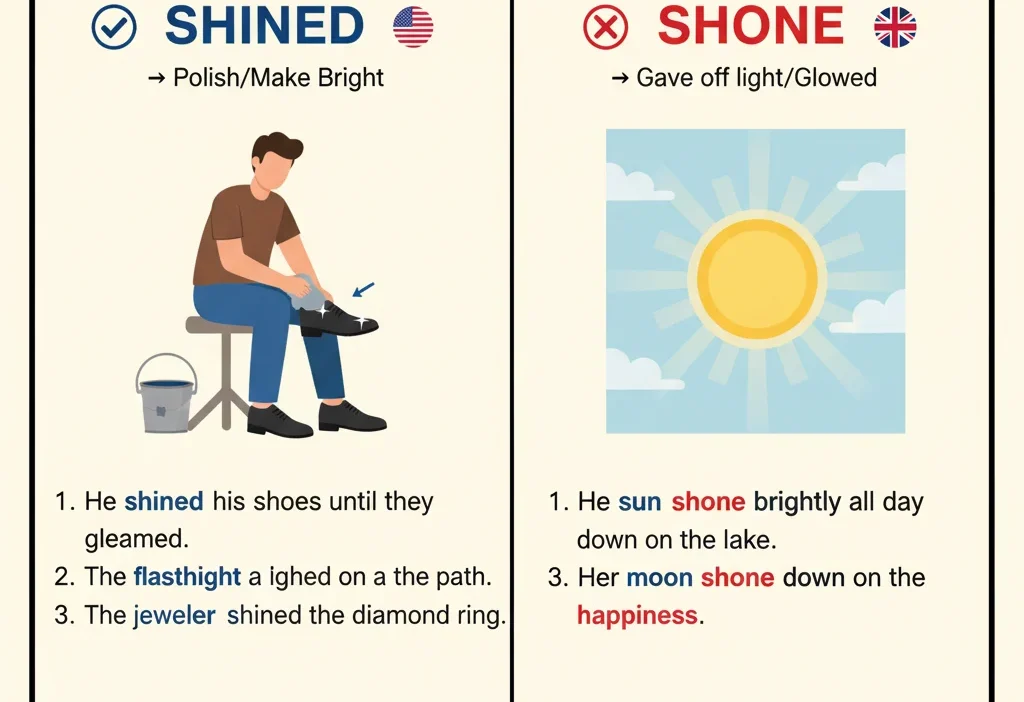
1. Shined — (Past tense of “shine,” used when someone polishes something)
Part of Speech: Verb (action word)
Meaning:
“Shined” means to make something bright or polished by rubbing or cleaning it.
Easy Examples:
- She shined her shoes before going to school. 👞
- He shined the table until it looked new.
- Mom shined the silver spoons for the dinner party.
So, use shined when you’re talking about polishing or cleaning something.
2. Shone — (Past tense of “shine,” used when light glows or radiates)
Part of Speech: Verb (action word)
Meaning:
“Shone” means to give off light or to glow brightly.
Easy Examples:
- The sun shone brightly in the morning sky. ☀️
- Her eyes shone with happiness.
- The moon shone over the quiet lake. 🌙
So, use shone when you mean light coming from something.
⚖️ The Key Difference Between Shined and Shone
| Feature | Shined | Shone |
|---|---|---|
| Meaning | Polished or cleaned something | Gave off light or glowed |
| Used For | Physical objects (like shoes, silver, tables) | Light sources (like sun, moon, stars) |
| Example | He shined his boots before the parade. | The stars shone brightly last night. |
| Quick Tip | Think “shine + polish” = shined | Think “shine + light” = shone |
💡 Quick Memory Trick:
👉 If you can rub it, use shined.
👉 If it glows, use shone.
❌ Common Mistakes and How to Avoid Them
Many people use the wrong word because both look similar. Let’s fix that!
Mistake 1:
❌ The sun shined brightly in the sky.
✅ Correct: The sun shone brightly in the sky.
Why?
Because the sun gives light — not something you can polish.
Mistake 2:
❌ She shone her shoes before leaving.
✅ Correct: She shined her shoes before leaving.
Why?
Because shoes are polished, not glowing.
🧽 When to Use Shined
Use shined when talking about polishing, rubbing, or cleaning something to make it bright.
Examples:
- I shined my bicycle before the race. 🚴
- The waiter shined the glasses before serving drinks.
- Dad shined the car for the weekend trip. 🚗
- The butler shined the silver plates.
- She shined her boots so they’d sparkle.
Memory Hack:
✨ If you’re making an object look shiny, use shined.
🌟 When to Use Shone
Use shone when something gives off light or glows naturally.
Examples:
- The stars shone brightly in the dark sky. 🌌
- Her face shone with pride after winning.
- The lamp shone softly in the corner.
- The diamonds shone under the light. 💎
- The moon shone over the ocean.
Memory Hack:
🌕 If something glows by itself, use shone.
🔁 Quick Recap: Shined vs Shone
- Shined = Polished something (You can rub it).
🧽 Example: She shined her shoes. - Shone = Gave off light (It glows).
☀️ Example: The sun shone brightly. - Tip: “Shined” is for objects you clean. “Shone” is for things that glow.
🧠 Advanced Grammar Tips (For Curious Learners)
- Origin: Both come from the Old English word scīnan, meaning to emit light or look bright.
- Modern Use:
- In American English, “shined” can sometimes replace “shone” in casual speech (“The sun shined all day”).
- In British English, “shone” is preferred for glowing light.
- In Exams or Formal Writing:
Always use “shone” for light and “shined” for polished things. It’s the grammatically correct distinction.
Bonus Tip:
Don’t confuse shine with shown (past participle of show). Example:
❌ “He has shine his shoes.”
✅ “He has shined his shoes.”
✏️ Mini Quiz: Test Your Understanding
Fill in the blanks with shined or shone 👇
- The stars ______ brightly last night.
- She ______ her necklace until it sparkled.
- The sun ______ through the clouds.
- He ______ his car before selling it.
- The diamond ______ in the jewelry store light.
- The waiter ______ the silver tray carefully.
- The moon ______ softly over the garden.
(Answers: 1. shone, 2. shined, 3. shone, 4. shined, 5. shone, 6. shined, 7. shone)
❓ FAQs About “Shined vs Shone”
1. Is it correct to say “The sun shined”?
Technically, no. The correct form is “The sun shone.” Use “shined” only for polishing actions.
2. Can I use “shined” in American English for light?
Yes, in informal American English, “shined” can sometimes replace “shone,” but “shone” is preferred in formal writing.
3. What’s the past participle of “shine”?
Both are correct:
- He has shined his shoes.
- The stars have shone all night.
4. Why are there two forms for one verb?
Because English evolved from older forms — “shone” came from British English, and “shined” from American usage.
5. How can I easily remember the difference?
If you rub it → shined.
If it glows → shone.
🏁 Conclusion
Now you know exactly when to use shined and when to use shone! 🌟
- Use shined for polishing or cleaning.
- Use shone for glowing or giving light.
Keep practicing with daily examples — talk about the sun that shone and the shoes you shined.
With time, you’ll use both words naturally and confidently.

Eley Williams writes clear, engaging guides on confusing words and phrases, helping readers understand meanings, differences, and correct usage with ease.