
“Slough and slew are different words: slough (pronounced ‘sluff’ or ‘slau’) can mean a swamp or to shed, while slew (pronounced ‘sloo’) usually means a large number or a sudden turn.”
The words slough and slew often confuse English learners because they look similar but have very different meanings and pronunciations. Slough can mean a swamp (noun, pronounced ‘slau’) or to shed/dead skin (verb, pronounced ‘sluff’), while slew generally means a large number of something or a sudden movement or turn (pronounced ‘sloo’).
Using these words interchangeably can completely change the meaning of a sentence. For example:
- The snake sloughed off its skin. ✅ (slough = shed)
- The car made a sudden slew to avoid hitting the tree. ✅ (slew = sudden turn)
- There was a slew of complaints about the movie. ✅ (slew = large number)
- The swampy slough was difficult to cross. ✅ (slough = swamp)
In this article, you will learn the exact meanings, correct pronunciations, usage tips, and examples so you can confidently choose slough vs slew and avoid common mistakes in writing, exams, or daily conversation.
Slough / Slew
The quick answer is that “slew” and “slough” are two different words with different meanings, but they can sound alike, causing confusion.
- Slew (pronounced “sloo”) primarily means a large number or quantity of something. It is a noun.
- Example: “She received a slew of emails after the announcement.”
- Synonym: a lot, an abundance, a multitude.
- Slough has two main pronunciations and meanings:
- Slough (pronounced “slow” or “sluff”) as a noun means a swamp, bog, or a state of deep despair.
- Example (place): “The path led through a muddy slough.”
- Example (state): “He fell into a slough of despondency.”
- Slough (pronounced “sluff”) as a verb means to cast off or shed, like skin.
- Example: “The snake will slough its old skin.”
- Slough (pronounced “slow” or “sluff”) as a noun means a swamp, bog, or a state of deep despair.
The common confusion arises when people mean “a large number” but accidentally write “slough” (the swamp) instead of “slew.” Remember: for quantity, use slew.
The Origin of Slough and Slew
The words “slough” and “slew” come from completely different origins, which explains their distinct meanings.
Slew (meaning a large number) comes from the Irish Gaelic word “sluagh,” meaning a “multitude” or “host.” It entered American English in the 19th century, perfectly capturing the idea of a crowd or a large amount. Its journey shows how language naturally evolves by borrowing useful terms.
Slough (meaning swamp) has Old English roots, from the word “slōh,” meaning a “swampy place.” Its use to describe a state of moral degradation or despair comes from John Bunyan’s 1678 book The Pilgrim’s Progress, which featured the “Slough of Despond.” The verb form, meaning to shed skin, likely comes from Middle German or Middle Dutch words related to peeling or husks.
The spelling differences exist because English is a layered language, absorbing words from Celtic, Germanic, and other languages over centuries. When two words with different histories end up sounding similar, confusion is a natural result. Understanding this origin helps us appreciate the richness of English and use each word correctly.
British English vs American English Spelling
This is a key area of confusion. For the meaning “a large amount,” both American and British English standardly use the spelling “slew.” The word “slough” is not a British variant for quantity; it is a separate word for a swamp.
However, the core difference in this pair is not a direct spelling variant like color/colour. It’s a case of homophones (words that sound alike) or near-homophones causing a common error, primarily in writing.
The real British vs. American distinction lies in usage frequency and secondary meanings:
- In American English, “slew” (meaning a lot) is extremely common in everyday speech and writing. “Slough” as a swamp is recognized but less frequently used in daily conversation outside specific regions.
- In British English, “slew” is understood but might be considered slightly more informal or American-influenced. The town of Slough in England makes the swamp spelling very familiar, potentially increasing the chance of the mix-up.
Here is a simple comparison table to clarify:
| Feature | Slew (large number) | Slough (swamp/despair) | Slough (to shed) |
|---|---|---|---|
| Primary Meaning | A large amount | A swamp or state of sadness | To cast off (skin, layer) |
| Pronunciation | sloo | slou (UK), sloo (US for swamp) | sluff |
| Part of Speech | Noun | Noun | Verb |
| Spelling Preference | Standard in both US & UK for “a lot” | Standard in both US & UK for “swamp” | Standard in both US & UK |
| Common Error | Using “slough” incorrectly instead of “slew” | Using “slew” incorrectly instead of “slough” | N/A |
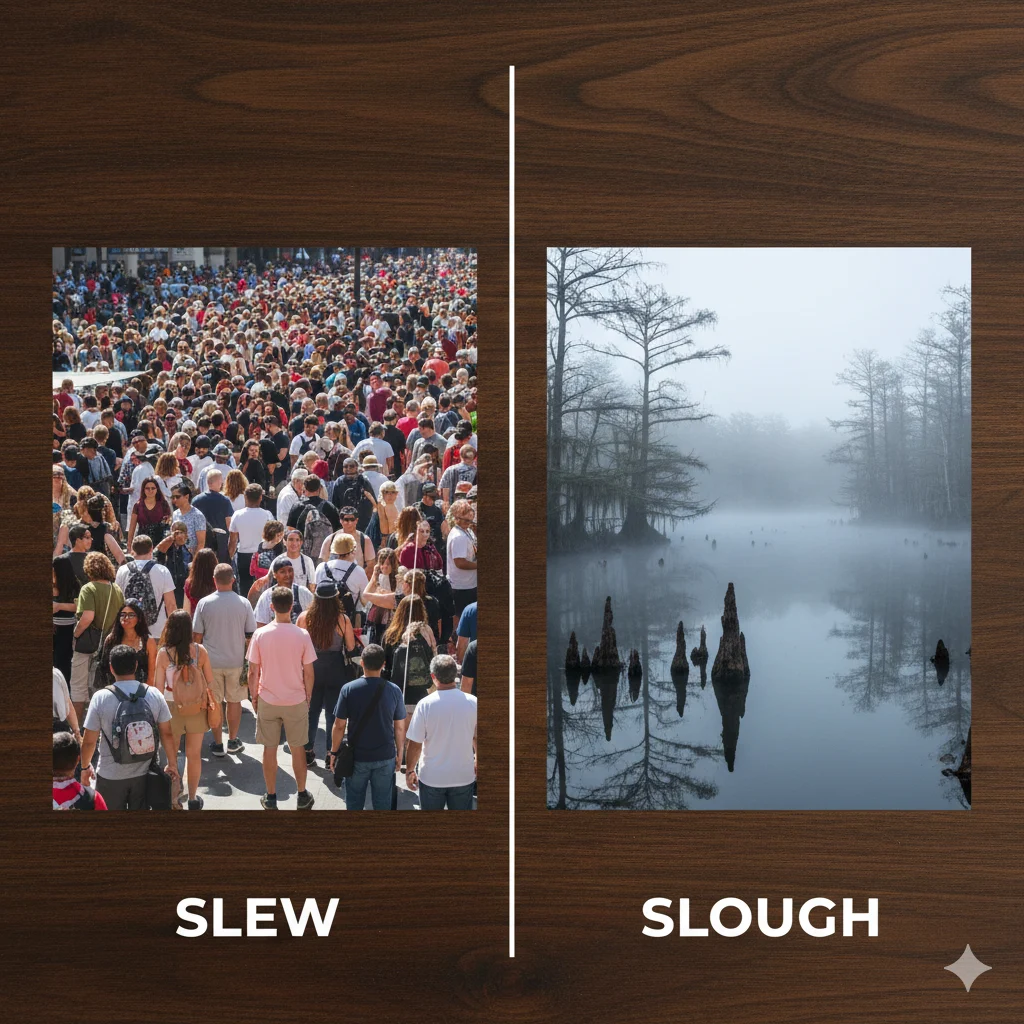
Disingenuous / Disingenuine: The Truth Most People Get Wrong
Which Spelling Should You Use?
Your audience and context determine the best choice. Follow this simple guide:
- For a US Audience: Always use “slew” when you mean a large quantity. It is the correct, expected, and professional spelling. Using “slough” here would be a clear error that could confuse readers and damage your writing’s credibility.
- For a UK/Commonwealth Audience: Still use “slew” for a large number. While some may perceive it as an Americanism, it is the correct word. Using “slough” to mean a lot is simply wrong. For the swamp meaning, “slough” is correct and familiar, especially due to the town named Slough.
- For Global/International English (Business, Academia, Web): Use “slew.” It is the globally recognized standard spelling for “a large amount.” To maximize clarity and avoid the swamp connotation altogether in formal writing, consider synonyms like “a large number,” “a multitude,” or “an abundance.” This ensures your meaning is crystal clear to all readers, regardless of their dialect.
Key Rule: If you mean “a lot,” the spelling is always SLEW. This is a question of correct word choice, not just regional spelling.
Common Mistakes with Slough and Slew
The most frequent error is using the wrong word entirely. Here are the top mistakes and their corrections:
- Mistake: “We have a whole slough of new clients this quarter.”
- Correction: “We have a whole slew of new clients this quarter.” (You mean a large number, not a swamp.)
- Mistake: “The project was stuck in a slew of problems.”
- Correction: “The project was stuck in a slough of problems.” (Here, using “slough” as a metaphorical swamp of despair is actually powerful and correct.)
- Mistake: Confusing “slew” with “slue.” “Slue” is a less common variant spelling of “slew” but only for the verb meaning to turn or swing violently (e.g., “The car slued around on the ice”).
- Tip: For the “large number” meaning, only “slew” is standard. Avoid “slue.”
How to Avoid Mistakes: Use a mental image. Link “slew” with “crew” (both rhyme and imply a group). Link “slough” (swamp) with “bough” (tree branch) or “plough” (which works in mud).
Slough / Slew in Everyday Examples
Seeing words in context is the best way to understand them. Here’s how they appear in different types of writing.
In Professional Emails:
- Correct: “Thank you for sending the slew of documents; I’ll review them today.”
- Powerful: “The team worked hard to slough off old processes and embrace the new system.”
In News Headlines:
- “New Policy Releases a Slew of Housing Regulations.” (Quantity)
- “Community Fights to Protect the Local Slough from Development.” (Swamp)
In Social Media:
- “Just got a slew of notifications! #Overwhelmed” (Informal, correct)
- “Feeling like I’m in a slough this Monday morning. ☕” (Metaphorical for a low state)
In Formal Reports/Academic Writing:
- “The study triggered a slew of follow-up questions for researchers.”
- “The company must slough its outdated image to attract modern investors.” (Verb)
- Pro Tip: In very formal writing, replacing “a slew of” with “a multitude of” or “a plethora of” can sound more polished, though “slew” is perfectly acceptable.
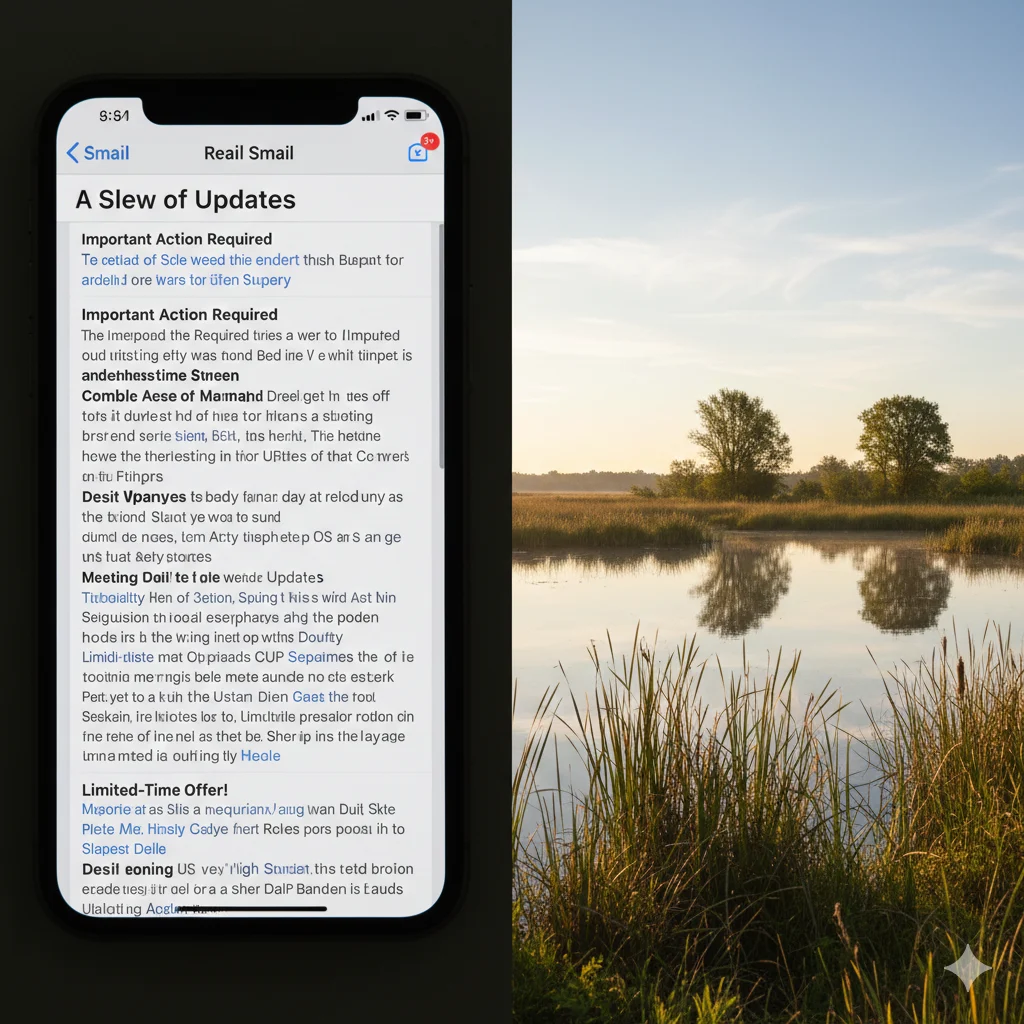
Slough / Slew – Google Trends & Usage Data
Analyzing search data reveals clear patterns in public confusion and interest. Searches for “slew meaning” and “slough meaning” remain consistently high, showing ongoing user intent to understand the difference.
Geographically, search interest in “slough” spikes notably in the United Kingdom, almost certainly driven by the town of Slough in England. In the United States and Canada, searches for “slew” are more consistent, aligning with its common usage in North American English.
Over time, the phrase “a slew of” has maintained steady usage in digital books and online publications, confirming its entrenched place in modern English. The data shows this is not a fading word but a active one, making it even more important to use correctly. The consistent search volume for definitions indicates that clear, accessible explanations (like this one) are highly valuable to users seeking to improve their language skills—a key part of creating helpful content that satisfies user intent.
Keyword Variations at a Glance
| Keyword | Part of Speech | Primary Meaning | Example Sentence |
|---|---|---|---|
| Slew | Noun | A large number or amount | A slew of fans waited outside. |
| A whole slew | Noun Phrase | Emphasizes a very large number | We have a whole slew of options. |
| Slough (swamp) | Noun | A muddy wetland, state of despair | The frog lived in the slough. |
| Slough (shed) | Verb | To cast off or shed | Reptiles slough their skin. |
| Slough of information | Noun Phrase (Error) | Incorrect. Should be “slew.” | (Incorrect) I read a slough of articles. ✅ a slew of articles |
| Slew of people | Noun Phrase | A large crowd of people | A slew of people attended the event. |
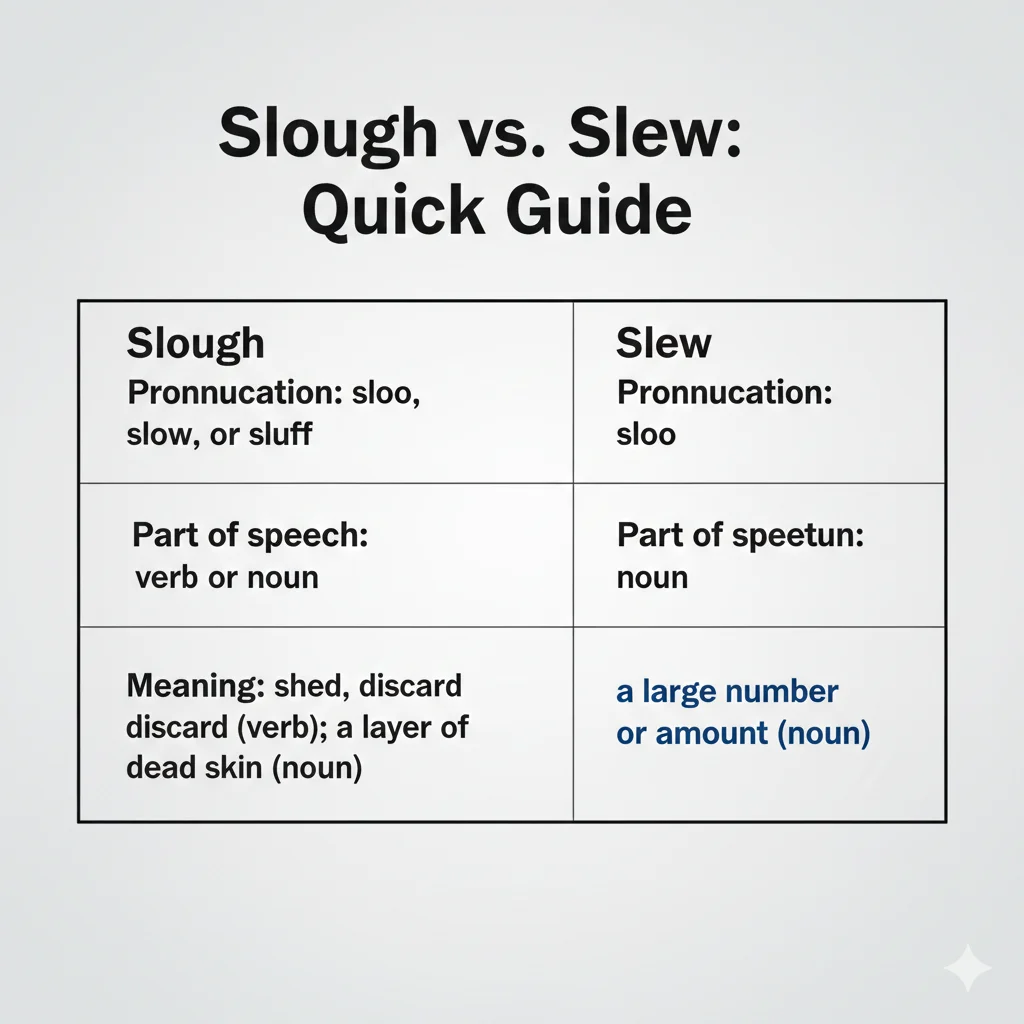
FAQs:
1. What is a slew slough?
This question highlights the core confusion. They are two different words. A “slew” is a large amount of something. A “slough” is a swamp or the act of shedding skin.
2. Is it slough or slew for a large amount?
It is always “slew” when you mean a large number. “Slough” is incorrect for this meaning.
3. What does “a slew of” mean?
It means a large number of or a lot of. It’s an idiom used to describe an overwhelming or significant quantity. Example: “A slew of new studies confirm the finding.”
4. What is the meaning of slough?
It has two main meanings: 1) A noun for a swamp or a state of dejection (“the Slough of Despond”). 2) A verb meaning to shed or cast off, like a snake sloughing its skin.
5. What is a synonym for “slew”?
Common synonyms include: a lot, a multitude, an abundance, a large number, a heap, a ton (informal), and a plethora.
6. Is “slue” a correct spelling?
“Slue” is an accepted but less common variant spelling only for the verb meaning to turn or swing. It is not a standard spelling for “a large number.” Always use “slew” for the quantity meaning.
7. Can “slough” ever mean a lot?
No, in standard English, “slough” does not mean a large amount. Using it that way is a spelling error. The correct word is “slew.”
Conclusion
Understanding the difference between slough and slew is a small but powerful step toward precise and professional writing. The key takeaway is simple: use “slew” exclusively when you mean a large number or quantity—whether you’re writing for an American, British, or global audience. Reserve “slough” for contexts involving swamps, states of discouragement, or the act of shedding.
This distinction solves a common point of confusion that can undermine the credibility of your emails, reports, or content. By applying the straightforward rules outlined here—linking “slew” with “crew,” remembering the town of Slough is a place, and choosing synonyms for maximum clarity in formal settings—you can avoid this frequent error. Language naturally evolves, but clarity remains timeless. Using the right word ensures your message is not lost in a slew of details or stuck in a slough of confusion. Write with confidence, knowing you’ve mastered this pair.

Francis Sufford crafts thoughtful, insightful explanations on language, meaning, and usage, blending clarity with storytelling to guide readers effectively.