Soil is usually heterogeneous because it contains different materials mixed together — like sand, clay, rocks, organic matter, roots, and tiny organisms.
However, in rare cases (like lab-prepared soil), it can be homogeneous.
Have you ever wondered whether soil is homogeneous or heterogeneous — and why this question even matters? Many students, teachers, and even adults get confused because soil looks simple from the outside… but inside, it has a whole world of different materials.
In this friendly guide, you’ll learn the meaning, difference, and correct usage of the terms homogeneous and heterogeneous when describing soil. We explain everything in clear, everyday language that even a 4th-grade student can understand.
By the end, you’ll know how to identify soil types, use the terms correctly in science class, and avoid common mistakes — with examples, comparisons, a table, memory tricks, and a fun quiz.
What Do “Homogeneous” and “Heterogeneous” Mean?
1. Homogeneous – Meaning
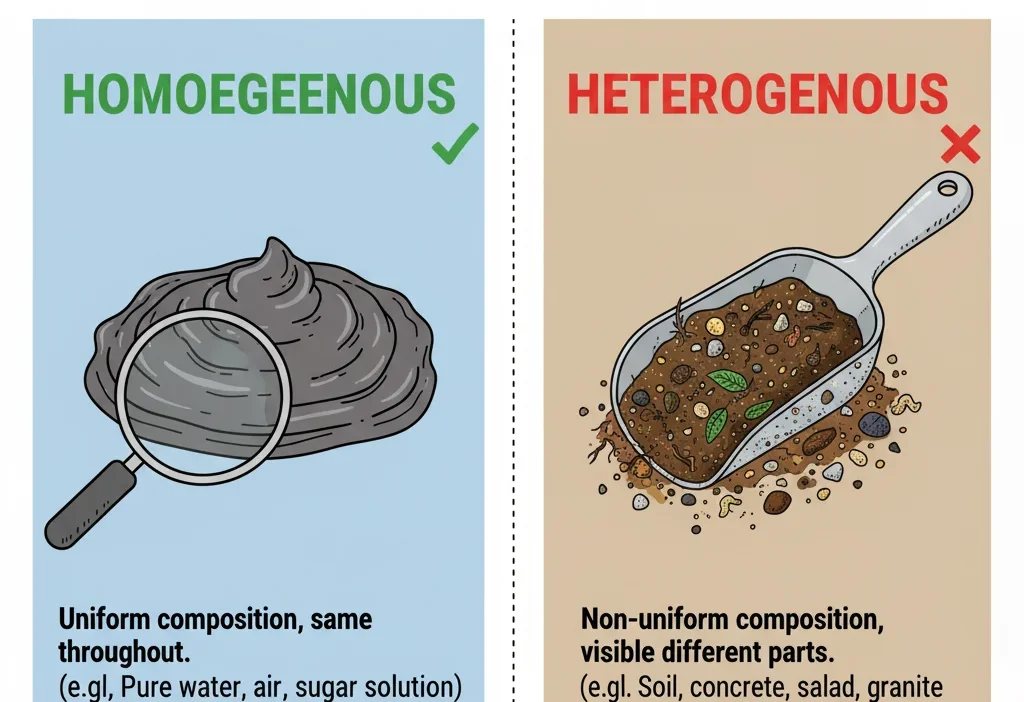
A homogeneous material is the same everywhere.
It looks and feels uniform, with no visible differences.
🔹 Part of speech: adjective
🔹 Simple meaning: Looks the same in all parts.
Easy Examples:
- Sugar water is homogeneous — it looks the same everywhere.
- Clean air is homogeneous.
- Salt mixed completely in water is homogeneous.
2. Heterogeneous – Meaning
A heterogeneous material has different parts you can see or feel.
It is not the same everywhere.
🔹 Part of speech: adjective
🔹 Simple meaning: Made of different materials you can spot.
Easy Examples:
- Fruit salad is heterogeneous.
- A handful of sand mixed with stones is heterogeneous.
- A bowl of cereal with milk is heterogeneous.
The Key Difference: Soil Homogeneous or Heterogeneous?
Most real-world soil is heterogeneous because it contains:
✔ Sand
✔ Clay
✔ Silt
✔ Little stones
✔ Dead plants
✔ Worms, insects, bacteria
✔ Water
A perfectly uniform soil almost never exists naturally.
Comparison Table: Homogeneous Soil vs Heterogeneous Soil
| Feature | Homogeneous Soil | Heterogeneous Soil |
|---|---|---|
| Meaning | Same throughout | Different materials mixed |
| Appearance | Smooth, uniform | Uneven, visible pieces |
| Nature | Rare in nature | Very common |
| Example | Lab-prepared soil sample | Garden soil, forest soil |
| Sentence Example | “The scientist used homogeneous soil for testing chemicals.” | “The farmer noticed the soil was heterogeneous with stones and roots.” |
Quick Tip to Remember
👉 Homogeneous = “Home for Similar”
(Everything looks the same.)
👉 Heterogeneous = “Hetero = Different”
(Mixed, uneven, not the same.)
Common Mistakes and How to Avoid Them
❌ Mistake 1:
“All soil is homogeneous.”
✔ Soil is usually heterogeneous, not uniform.
❌ Mistake 2:
“If two soils look similar, they are homogeneous.”
✔ They may look similar, but still differ inside.
❌ Mistake 3:
“Homogeneous means clean soil.”
✔ It means uniform, not clean.
When to Use “Homogeneous Soil”
Use this term when soil is:
✔ Mixed evenly
✔ Prepared in a lab
✔ Filtered or processed
✔ Free from visible particles or lumps
Examples:
- The scientist tested seeds in homogeneous soil.
- The lab heated the soil until it became fully homogeneous.
- A homogeneous soil sample helps in controlled experiments.
- Homogeneous soil helps get more accurate scientific results.
When to Use “Heterogeneous Soil”
Use this when the soil has:
✔ Different textures
✔ Stones, sticks, organic matter
✔ Layers and patches
✔ Natural variations
Examples:
- Forest soil is heterogeneous because of leaves and roots.
- The farmer removed stones from the heterogeneous soil.
- Garden soil becomes heterogeneous after rain.
- Clay and sand mixed unevenly form a heterogeneous mixture.
- Desert soil is also heterogeneous due to rocks and dry patches.
Memory Hack:
Heterogeneous = “Here and There Differences.”
(Things are mixed here and there.)
Quick Recap: Homogeneous vs Heterogeneous Soil
- Homogeneous Soil:
– Uniform
– Rare
– Mostly lab-made - Heterogeneous Soil:
– Mixed
– Natural
– Common everywhere - Soil in nature = Almost always heterogeneous
Advanced Tips (Optional for Students)
🔹 In exams: Always mention that natural soil is heterogeneous.
🔹 In lab reports: A homogeneous sample is used for fair testing.
🔹 History note:
Homogeneous comes from Greek homo = same.
Heterogeneous comes from Greek hetero = different.
Mini Quiz (Test Yourself!)
Fill in the blanks:
- Garden soil is usually ___________.
- A mixture that looks the same everywhere is ___________.
- Soil with stones and leaves is ___________.
- Lab-prepared soil samples are often ___________.
- “Hetero” means ___________.
(Answers: 1. heterogeneous, 2. homogeneous, 3. heterogeneous, 4. homogeneous, 5. different)
Conclusion
Now you know exactly when soil is homogeneous and when it is heterogeneous. Most natural soil is uneven and mixed, so it is almost always heterogeneous. Homogeneous soil appears only in specially prepared or processed samples.
Keep practicing these words, and soon you’ll be able to use them correctly in science class, assignments, and everyday conversations. Learning small differences like this can improve your understanding of the world around you — one step at a time.
FAQs
1. Is soil homogeneous or heterogeneous?
Most soil is heterogeneous because it contains different materials.
2. Can soil ever be homogeneous?
Yes, but only when it is mixed evenly, usually in a lab.
3. Why is real soil heterogeneous?
Because it has different components like sand, clay, rocks, and organic matter.
4. Is clay soil homogeneous?
No. Even clay soil usually contains water, minerals, and organic materials.
5. Why do we study this difference?
To understand soil behavior, water flow, farming, and scientific experiments.

Polly Clark creates clear, insightful guides on language and usage, helping readers understand meanings, differences, and nuances with clarity and confidence.