Confused about whether spouse or child gets the legal right, priority, or benefit in different situations? You’re not alone. These two words seem simple, but when it comes to legal rights, family matters, inheritance, and documents, the difference becomes extremely important. This clear, beginner-friendly guide will help you understand the meanings, correct usage, differences, and real-life examples—so you never make a mistake again.
People often get confused about the terms spouse and child, especially when filling forms, reading legal documents, talking about rights, or understanding family responsibilities. Even though these words are common, their meanings and uses become very important when dealing with insurance, inheritance, emergency contacts, or family rights.
In this simple and friendly guide, you’ll learn the exact meaning, difference, and correct usage of spouse or child. You’ll also see examples, comparison charts, memory tricks, and real-life situations. Everything is explained in plain English so even a class 4 student can understand it easily.
Let’s make the confusion disappear—step by step.
What Does Each Word Mean?
Meaning of “Spouse”
A spouse is a person you are legally married to.
It can be your husband or wife.
Part of Speech:
✔️ Noun
Simple meaning:
Your life partner after marriage.
Easy Examples:
- My spouse is listed as my emergency contact.
- She added her spouse to her health insurance.
- After marriage, your spouse becomes part of your immediate family.
Meaning of “Child”
A child is your son or daughter.
A child can be biological or adopted.
Part of Speech:
✔️ Noun
Simple meaning:
Your kid or someone below adult age.
Easy Examples:
- Their child is in grade 3.
- Every child deserves care and love.
- The form asked how many children she has.
Mini-Story to Make It Memorable
Imagine a family of three: Ali, his wife, and their daughter.
- Ali’s spouse = his wife
- Ali’s child = his daughter
Easy, right?
The Key Difference Between Spouse and Child (Rights)
The biggest difference is:
👉 Spouse = The person you choose through marriage
👉 Child = The person connected to you by birth or adoption
When talking about rights, the priority may change depending on laws, documents, or family matters.
Comparison Table: Spouse vs Child (Rights & Usage)
| Point of Comparison | Spouse | Child |
|---|---|---|
| Meaning | Husband or wife | Son or daughter |
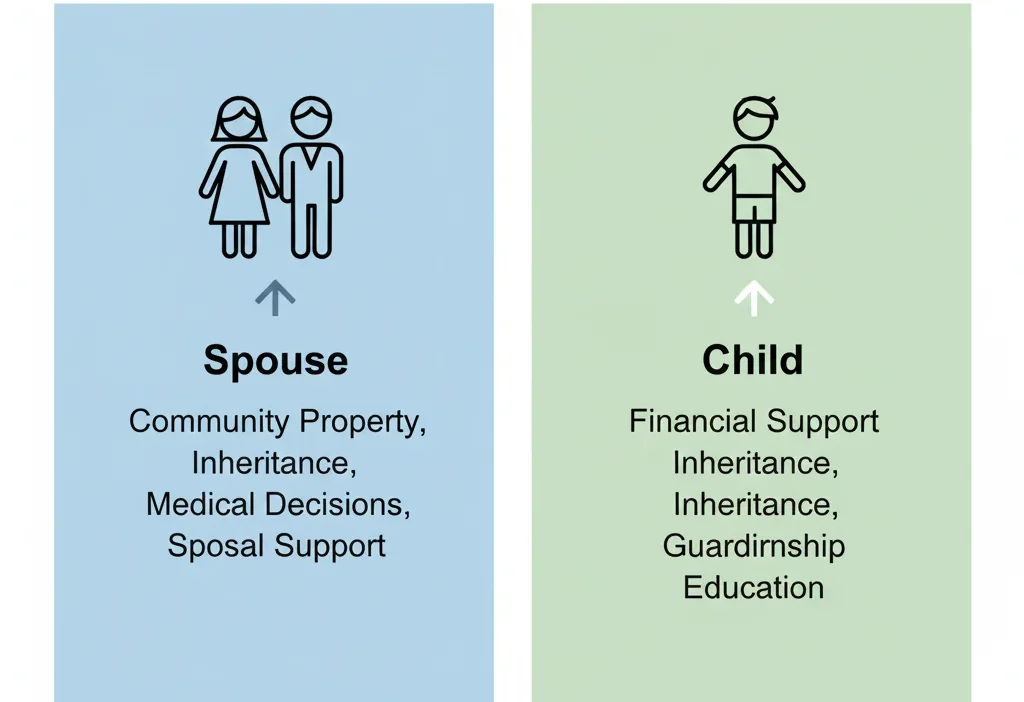
| Priority in Legal Rights (varies by country) | Often gets first rights in inheritance, medical decisions, and insurance | Gets rights after spouse in many cases |
| Usage in Sentences | Talking about marriage relationships | Talking about parental relationships |
| Example | “My spouse will receive my medical updates.” | “My child will inherit my books.” |
| Grammar | Singular noun | Singular or plural (child/children) |
Quick Memory Tip:
Spouse = Marriage
Child = Family by birth
Common Mistakes and How to Avoid Them
❌ Mistake 1: Using ‘child’ instead of ‘spouse’ in documents
Incorrect: Add your child as your marriage partner.
Correct: Add your spouse as your marriage partner.
Why it happens: The person thinks “family member” and chooses the wrong one.
Fix: Remember—marriage = spouse.
❌ Mistake 2: Thinking children always have more rights
Incorrect: Children always get everything first.
Correct: In many cases, the spouse gets first legal rights.
Fix: Always check the rules—but spouse usually comes first.
❌ Mistake 3: Using spouse to refer to kids
Incorrect: I am taking my spouse (meaning child) to the park.
Correct: I am taking my child to the park.
Fix: Spouse is never a child.
When to Use “Spouse”
Use spouse when talking about:
✔️ Marriage
“My spouse and I celebrated our anniversary.”
✔️ Legal documents
“The spouse is usually the first beneficiary.”
✔️ Insurance
“You can add your spouse to your health plan.”
✔️ Emergency contact
“List your spouse as the first contact.”
✔️ Rights & decisions
“The spouse may make medical decisions.”
More Example Sentences:
- The hospital asked for the name of my spouse.
- Her spouse is traveling with her.
- Married people can file taxes with their spouse.
- My spouse is allowed to sign documents for me.
- The law allows a spouse to inherit property.
When to Use “Child”
Use child when talking about:
✔️ Kids or minors
“My child is in school.”
✔️ Parental information
“Parents must support their child.”
✔️ Rights of minors
“Every child has the right to education.”
✔️ Family benefits
“Benefits may cover one child or more.”
✔️ Legal care
“The mother has custody of the child.”
More Example Sentences:
- My child loves drawing.
- Every child needs protection.
- Benefits increase with each child.
- Their child was awarded a scholarship.
- A child cannot sign legal documents.
Memory Hack:
Think of child = kid. If you can replace the word with “kid,” then the word should be child.
Quick Recap: Spouse vs Child (Rights)
- Spouse = husband or wife
- Child = son or daughter
- A spouse often gets first rights in legal matters
- A child gets rights after the spouse in many cases
- Spouse relates to marriage, child relates to family lineage
- Never use spouse when talking about kids
- Never use child when talking about marriage partners
Advanced Tips (For Deep Understanding)
1. Word Origin
- Spouse comes from Latin “sponsus,” meaning “promised.”
- Child is an old English word meaning “young person.”
2. Formal Writing Usage
In legal or academic writing, “spouse” is always preferred over “husband/wife” because it is gender-neutral.
3. Common Online Mistakes
People often Google “who gets rights first spouse or child,” showing this confusion is global.
4. Inheritance or Legal Rights
In many countries:
Spouse → Child → Parents
This order changes based on country and religion
Mini-Quiz (Test Yourself!)
Fill in the blanks:
- Her ________ will receive the life insurance first.
- A ________ must be under the care of adults.
- You can add your ________ to your health benefits.
- The school asked how many ________ she has.
- A ________ can legally make decisions for you if married.
Answers: spouse, child, spouse, children, spouse.
5 FAQs
1. Who has more rights—spouse or child?
In many legal systems, the spouse gets priority over the child, especially in inheritance and medical decisions.
2. Is a spouse considered family?
Yes. A spouse becomes your immediate family after marriage.
3. Can a child have more rights than a spouse?
In some situations (like guardianship or parental assets), a child may receive rights, but usually after the spouse.
4. What is the simple meaning of spouse?
A spouse is your husband or wife.
5. Can the word “child” include adopted children?
Yes. A child can be biological or adopted.
Conclusion
Understanding the difference between spouse or child (rights) is important not only for grammar but also for family, legal, and daily life situations. Now you know exactly when to use each word, what they mean, and how rights may differ between them. With simple examples and clear rules, you can confidently use both terms correctly. Keep practicing, and your English will improve every single day.

Francis Sufford crafts thoughtful, insightful explanations on language, meaning, and usage, blending clarity with storytelling to guide readers effectively.