Many English learners get confused between stop or go. Both are simple words, but using them in the wrong situation can change your meaning completely. Imagine telling someone to stop when you mean go! Small mistakes like this happen often, even to native speakers.
In this guide, you will learn the difference between stop and go, their meanings, correct usage, and easy tips to remember which one to use. We will provide clear examples for daily situations, school, writing, and casual conversations. By the end, you will confidently know when to use stop and when to use go — no more second-guessing.
This article is beginner-friendly, uses simple English, and even a class 4 student can understand it.
What Does Each Word Mean?
Stop
Meaning: To pause, halt, or cease movement or action.
Part of Speech: Verb (can also be a noun in some cases).
Examples:
- Please stop talking during the class.
- The car stopped at the red light.
- I stop eating when I feel full.
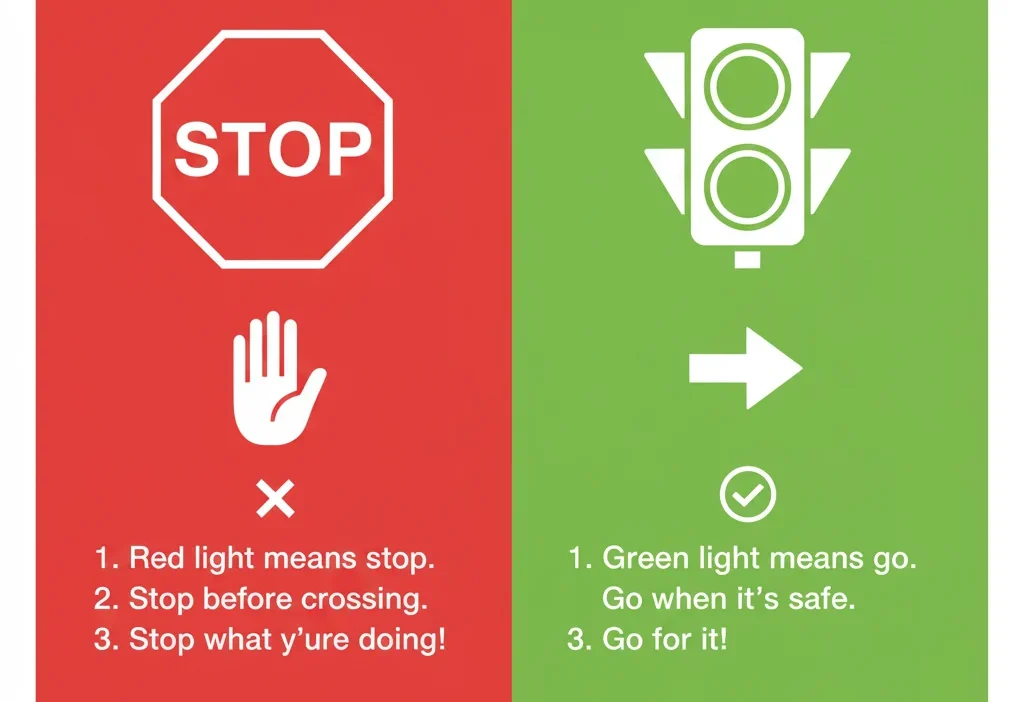
Story Tip: Think of a red traffic light — red always means stop.
Go
Meaning: To move forward, continue, or start an action.
Part of Speech: Verb
Examples:
- You can go now; the road is clear.
- She wants to go to the park after school.
- Press the button to go to the next slide.
Story Tip: Think of a green traffic light — green always means go.
The Key Difference Between Stop and Go
| Feature | Stop | Go |
|---|---|---|
| Meaning | Pause or halt | Move forward or start |
| Part of Speech | Verb | Verb |
| Example 1 | Stop talking! | Go to the playground. |
| Example 2 | I stopped eating. | He went to school. |
| Example 3 | Stop the car! | Let’s go now. |
Quick Tip: Red = Stop, Green = Go. Visual memory tricks make it easy to remember!
Common Mistakes and How to Avoid Them
- Incorrect: Go quiet during the lecture.
Correct: Stop talking during the lecture. - Incorrect: Stop to the park after school.
Correct: Go to the park after school. - Incorrect: The car goes at the red light.
Correct: The car stops at the red light.
Why Mistakes Happen: Learners sometimes confuse the “movement” idea (go) with “pausing” (stop). Always visualize a traffic signal!
When to Use Stop
Use stop when you want to:
- Pause an action
- End a movement
- Prevent something from happening
Examples:
- Please stop shouting.
- The dog stopped running.
- He stopped his homework to eat lunch.
- Stop the music; it’s too loud.
- The teacher told us to stop playing outside.
Memory Trick: Red = Stop. Think of brakes.
When to Use Go
Use go when you want to:
- Start an action
- Move forward or leave a place
- Continue something
Examples:
- You can go now.
- Let’s go shopping tomorrow.
- She goes to school by bus.
- Press start to go.
- Go and ask for help if needed.
Memory Trick: Green = Go. Think of traffic lights and movement.
Quick Recap: Stop vs Go
- Stop = pause, halt, or prevent movement.
- Go = move forward, start, or continue.
- Visual Tip: Red = Stop, Green = Go.
- Use examples from daily life to remember usage.
Advanced Tips
- Origin: “Stop” comes from Old English stoppian (to block). “Go” comes from Old English gān (to move).
- Formal Writing: Always ensure correct usage in essays, exams, or professional writing.
- Texting / Online Writing: Misusing these can confuse your reader. Example: “Stop now” vs “Go now” conveys opposite actions.
Mini Quiz
Fill in the blanks:
- Please ___ talking during the lesson.
- The traffic light is green; it’s time to ___.
- Don’t ___! Wait for me.
- We will ___ to the park tomorrow.
- She ___ running when she saw her friend.
Answers: 1. stop, 2. go, 3. stop, 4. go, 5. stopped
FAQs
1. Can stop and go be used as nouns?
Yes, but rarely. Example: “At the last stop, we got off the bus.”
2. Is stop always a verb?
Mostly, yes. It describes pausing or halting an action.
3. Can go mean leave a place?
Yes, it often means moving from one place to another.
4. How to remember stop vs go easily?
Think of traffic lights: red = stop, green = go.
5. Are stop and go confusing for beginners?
Yes, but with examples and practice, it becomes easy.
Conclusion
Now you clearly know the difference between stop and go. Stop means to pause or halt, and go means to move forward or start. Using the right word can make your sentences accurate and easy to understand.
Remember the traffic light trick: red = stop, green = go. Practice with real-life examples like school, traffic, or daily routines. Check your writing and conversations for common mistakes.
Every small step you take to use English correctly adds up. Keep practicing, and soon using stop and go will become automatic.

Gwendoline Riley delivers clear, compelling insights into language and usage, helping readers understand meanings, nuances, and differences with confidence.