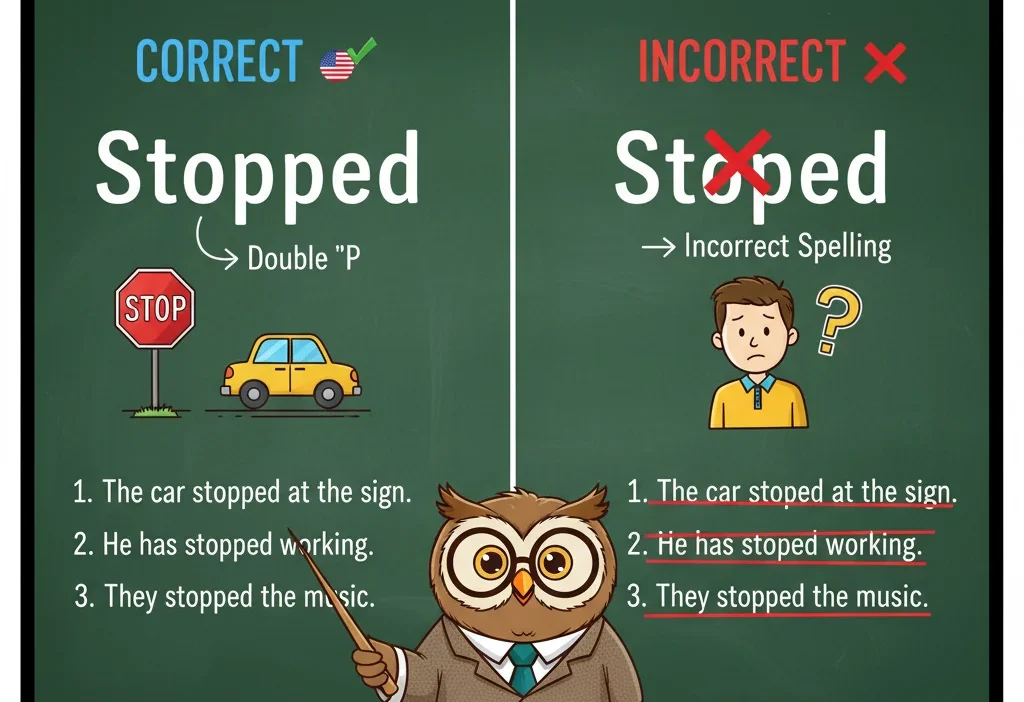
“‘Stopped’ is the correct spelling of the past tense of ‘stop’; ‘stoped’ is a common mistake.”
Confused about whether to write “stoped” or “stopped”? You’re not alone. The correct past tense of “stop” is “stopped” with a double “p”, because one-syllable verbs ending in a single vowel + consonant double the consonant before adding -ed.
On the other hand, “stoped” is a frequent spelling error and should be avoided in formal and informal writing alike. Using “stopped” correctly ensures your writing is clear, professional, and grammatically accurate.
Whether you’re writing essays, emails, social media posts, or school assignments, this article will guide you through why “stopped” is correct, common mistakes with “stoped,” and simple memory tips to remember the correct spelling in the future.
🧠 What Does Each Word Mean?
Let’s start with the basics — what do these two words mean, and are they both real words?
✅ Stopped – The Correct Word
Stopped is the past tense and past participle of the verb stop.
It means to bring something to an end or to make something no longer move or happen.
Part of speech: Verb (past tense)
Examples:
- She stopped the car at the red light.
- It stopped raining after an hour.
- I stopped talking when the teacher entered.
In all these examples, “stopped” clearly shows that the action is finished.
❌ Stoped – The Incorrect or Rare Word
Stoped looks like it could be a word, but in normal English, it’s incorrect.
It’s a common spelling mistake for “stopped.”
However, in geology, “stoped” has a rare, technical meaning. It comes from the word “stope,” which means a step-like excavation in a mine.
So “stoped” (with one “p”) can mean “excavated using stopes.”
But in everyday English, that’s not what most people mean — they simply spell “stopped” wrong!
Examples (Geology only):
- The miners stoped the ore body carefully.
So unless you’re talking about mining, always write “stopped.”
⚖️ The Key Difference Between “Stopped” and “Stoped”
Here’s a quick comparison to make it crystal clear 👇
| Feature | Stopped | Stoped |
|---|---|---|
| Correctness | ✅ Correct spelling | ❌ Incorrect (except in geology) |
| Meaning | Past tense of “stop” | Technical term (geology) |
| Common Usage | Everyday English | Rare, scientific use |
| Example | She stopped crying. | The miners stoped the tunnel. |
🪄 Quick Tip:
If you mean “ended,” “paused,” or “halted,” always spell it with two P’s — STOPPED.
Think of it like this: You “stop” once, but you “stopped” with extra effort — so add an extra “P”!
🚫 Common Mistakes and How to Avoid Them
Here are some real mistakes people make — and how to fix them:
| ❌ Wrong | ✅ Correct | 💡 Why |
|---|---|---|
| She stoped working. | She stopped working. | The past tense of “stop” doubles the “p.” |
| He stoped talking to me. | He stopped talking to me. | Verbs ending in consonant-vowel-consonant double the final consonant before -ed. |
| It stoped suddenly. | It stopped suddenly. | Always use two “p”s before “-ed.” |
🧩 Grammar Rule:
When a one-syllable verb ends with a consonant-vowel-consonant (like “stop”), we double the last consonant before adding -ed or -ing.
stop → stopped / stopping
plan → planned / planning
hop → hopped / hopping
📍 When to Use “Stopped”
Use “stopped” when you’re talking about something that ended, paused, or ceased in the past.
Examples:
- The baby stopped crying.
- They stopped the movie halfway.
- I stopped running because I was tired.
- The rain stopped after a few minutes.
- We stopped by the shop to buy snacks.
🧠 Memory Hack:
👉 “Stopped” has two “p’s” because the action was so strong, it needed extra power to stop! 💪
📍 When to Use “Stoped”
You’ll almost never use “stoped” — unless you’re writing a geology report!
Examples (scientific use only):
- The miners stoped the northern tunnel.
- The ore was stoped from the upper levels of the mine.
For all everyday English — writing, texting, speaking, or essays — use “stopped.”
🧾 Quick Recap: Stopped vs Stoped
Let’s wrap it up neatly:
- ✅ Stopped = Correct spelling (past tense of stop)
- ❌ Stoped = Common misspelling (except in geology)
- 🧠 Rule: Double the last consonant (p) before adding -ed
- 💬 Example: She stopped the car. (Not “stoped”)
- 📚 Remember: One “p” is wrong unless you’re mining! ⛏️
💡 Advanced Tips: History and Formal Use
- The word “stop” comes from Old English stoppian, meaning to close or block.
- “Stopped” has been used for centuries as the proper past tense.
- In formal writing, “stopped” is always correct — never “stoped.”
- In texting or social media, people sometimes skip letters, but it’s still considered a spelling error.
So if you want your writing to look smart and professional — always choose stopped.
🧩 Mini Quiz: Test Yourself!
Fill in the blanks with the correct form — stopped or stoped 👇
- I ______ playing when it got dark.
- The teacher ______ the class to make an announcement.
- It ______ raining last night.
- The miners ______ the ore body in the tunnel. (Hint: geology term!)
- She ______ the video to take a call.
✅ Answers: 1. stopped 2. stopped 3. stopped 4. stoped 5. stopped
❓ FAQs About “Stopped” vs “Stoped”
- Is “stoped” a real word?
Yes, but only in geology. In everyday English, “stoped” is a spelling mistake. - What is the correct past tense of “stop”?
The correct past tense is stopped (with double “p”). - Why does “stopped” have two P’s?
Because “stop” ends in a consonant-vowel-consonant (CVC) pattern, and English grammar rules require doubling the final consonant before adding *-ed* or -ing. - What is the difference between “stop” and “stopped”?
“Stop” is the base form (present tense), used for general actions or commands. “Stopped” is the past tense and past participle, used for actions that have already ended.- Example (Present): Please stop the music.
- Example (Past): Yesterday, she stopped the car.
- Is “stoped” ever correct? (e.g., “stoped o stopped”, “stoped ou stopped”)
No, not in standard English. Searches like “stoped o stopped” or “stoped ou stopped” often come from speakers of languages like Spanish, Portuguese, or French where spelling rules differ. In English, the only correct spelling for the past tense is stopped. - What about similar words like “stopping” and “stoping”?
The same rule applies. The correct -ing form is stopping with a double ‘p’. “Stoping” (with one ‘p’) is incorrect, except as the very rare technical present tense of the geology term “stope”. - How can I remember the difference?
Think of it like this: You need extra power to stop — so add an extra P! - Can I use “stoped” in writing or exams?
No. Always use stopped in academic, formal, and casual writing. - I see “stopped czy stoped” or “stoped или stopped” online. Which is right?
These searches show the common confusion across languages (e.g., Polish, Russian). The correct English spelling is always stopped. The other versions are either misspellings or non-English words. - Is “stopped” correct in all English dialects (like American and British English)?
Yes. Unlike words like traveled/travelled, the double ‘p’ in stopped is consistent in all major dialects of English (American, British, Australian, etc.).
🏁 Conclusion
Now you know the difference between stopped and stoped — and you’ll never confuse them again! 🎉
Remember:
✅ “Stopped” = correct past tense of “stop.”
❌ “Stoped” = spelling mistake (except in mining).
Keep practicing, read carefully, and your English will get better every day.

Gwendoline Riley delivers clear, compelling insights into language and usage, helping readers understand meanings, nuances, and differences with confidence.