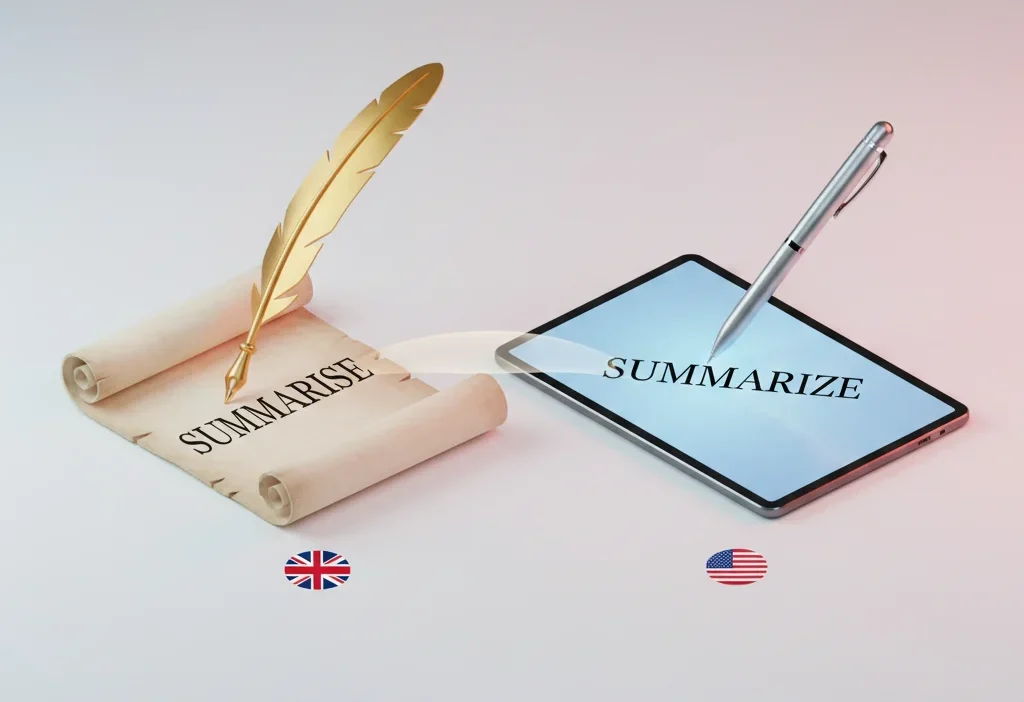
Both “summarise” and “summarize” are correct spellings, but their usage depends on British or American English.
Many English learners get confused because the difference is only in spelling, not in meaning. Summarise is used in British English, while summarize is standard in American English.
Both words mean to give a brief and clear version of something by highlighting the main points. Using the wrong form for your audience can make writing look inconsistent, especially in exams, academic work, professional documents, blogs, and online content.
For example:
- British English: “Please summarise the chapter in your own words.”
- American English: “Please summarize the chapter in your own words.”
In this article, you will learn which spelling to use in different contexts, why the difference exists, common mistakes to avoid, and how to write confidently using the correct form, ensuring your English is always polished, clear, and professional.
Summarise / Summarize
Both “summarise” and “summarize” are correct. The difference is regional.
- Use summarize in American English. Example: “The AI tool can summarize the long article quickly.”
- Use summarise in British English, Australian English, and most other Commonwealth varieties. Example: “Please summarise the key points from the meeting.”
The core meaning is identical: to give a brief statement of the main points of something. The spelling only changes based on your audience’s location or the language standard you are following. This is a primary example of how English spelling adapts.
The Origin of Summarise / Summarize
The word “summarise/summarize” didn’t appear out of thin air. Its journey explains the spelling split. It originates from the Latin word “summarius,” meaning “of or pertaining to a summary.” This evolved into the Medieval Latin verb “summarizare.” The word entered English in the late 15th century, adapting to the existing grammar rules of the time.
The critical turning point was the work of 19th-century American lexicographer Noah Webster. In his famous 1828 dictionary, Webster championed spelling reforms to make American English more distinct, systematic, and phonetic than British English. One of his key changes was promoting the “-ize” suffix over the British “-ise.” He argued that “-ize” more accurately reflected the Greek root “-izo,” common in many verbs. While British English often uses “-ise,” it’s worth noting that the Oxford English Dictionary actually prefers the “-ize” ending as etymologically more correct, though “-ise” remains the dominant popular usage in the UK. This natural linguistic evolution is why two standard forms exist today.
British English vs American English Spelling
The “-ise” vs. “-ize” difference is a classic and consistent spelling rule between British and American English. It applies to a whole family of verbs. Understanding this pattern helps you spell dozens of words correctly based on your chosen dialect.
American English Spelling Rule: Consistently use -ize. This is seen as more aligned with the etymology (word origin) and is the standard for US publishing, education, and formal writing.
Example: organize, realize, authorize, recognize, summarize.
British English Spelling Rule: Predominantly uses -ise. This is the most common everyday and commercial spelling in the UK, although some academic and formal publications may use “-ize.”
Example: organise, realise, authorise, recognise, summarise.
Important Note: Not all “-ise” ending verbs follow this rule. Verbs that are not derived from Greek roots and where “-ise” is part of the core word must always be spelled with “-ise” in all dialects. Examples include: advise, surprise, comprise, revise.
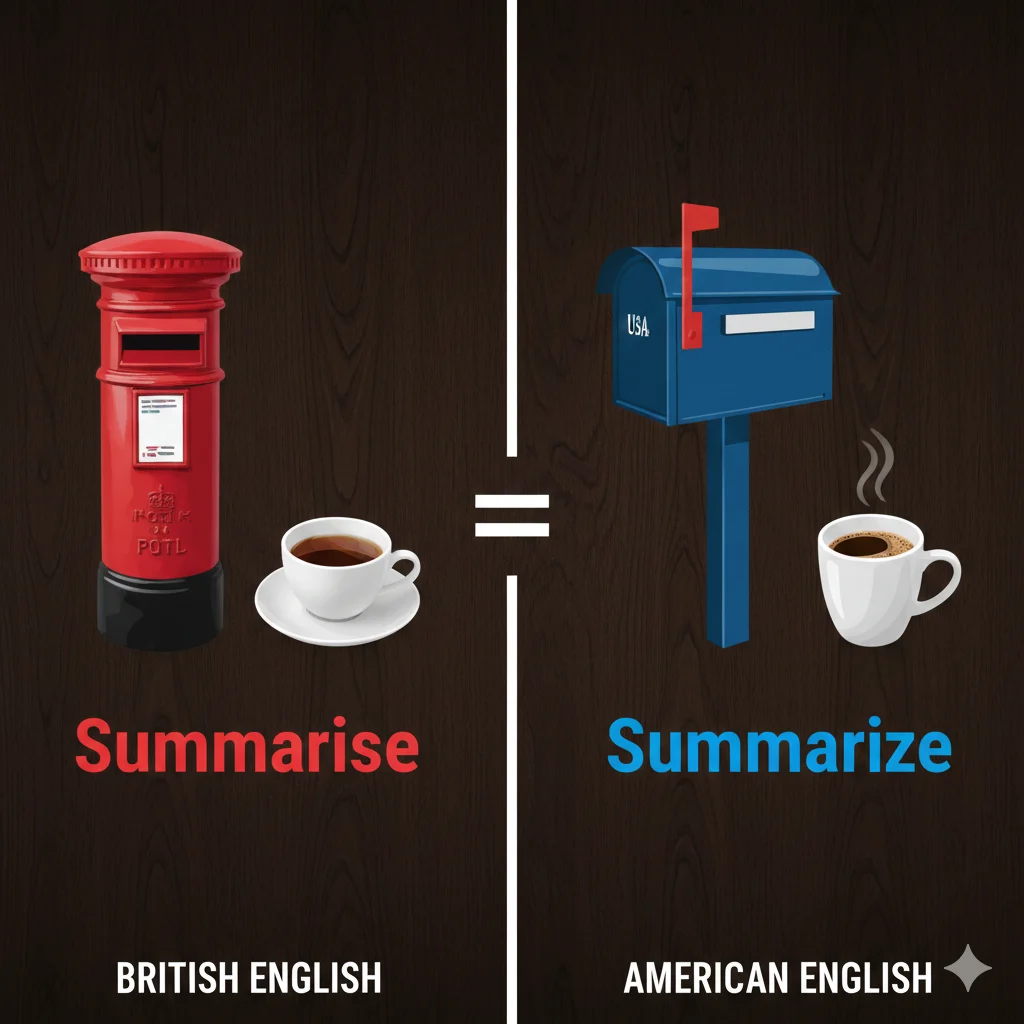
Here is a simple comparison table to visualize the differences:
| Verb Meaning | American English Spelling (-ize) | British English Spelling (-ise) |
|---|---|---|
| To make short | Summarize | Summarise |
| To make real | Realize | Realise |
| To give structure | Organize | Organise |
| To give permission | Authorize | Authorise |
| To identify | Recognize | Recognise |
| To make stable | Stabilize | Stabilise |
Which Spelling Should You Use?
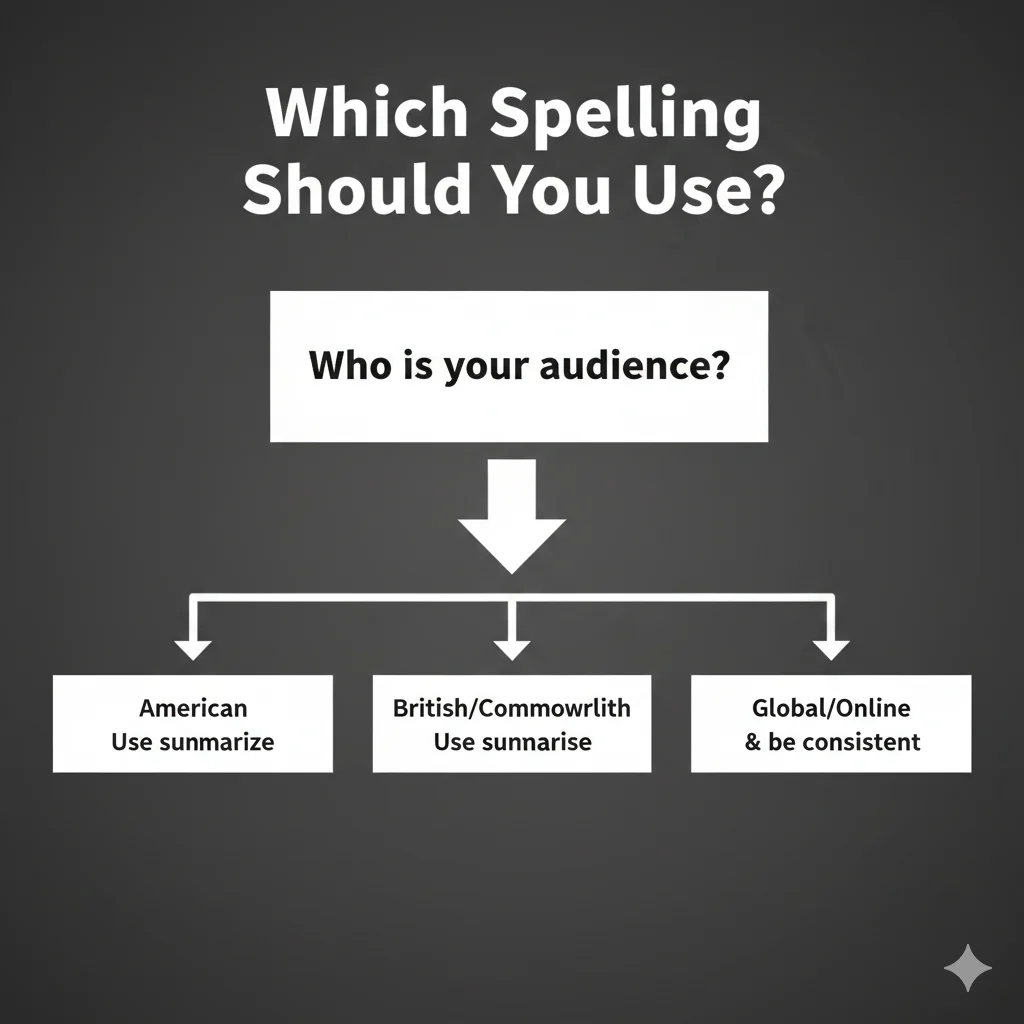
Your choice isn’t about right or wrong; it’s about audience and consistency. This is a core principle for clear, professional, and user-focused communication, a factor search engines like Google increasingly reward with good rankings.
- If Your Audience is Primarily American: Use summarize. This includes writing for US businesses, websites with a .com domain targeting US users, or publications following the Associated Press (AP) style. Sticking to “summarize,” “organized,” and “realized” shows respect for their linguistic norms.
- If Your Audience is in the UK, Australia, Canada (outside Quebec), or other Commonwealth nations: Use summarise. This is the expected form in schools, most media, and daily life. Using “summarise” makes your content feel local and trustworthy.
- If You Are Writing for a Global or Online Audience: Choose one standard and be ruthlessly consistent. For global tech companies or international scientific journals, American English (“summarize”) is often the default. The key is to pick one variant (e.g., US English) and apply it to every instance of every “-ize/-ise” word throughout your document, website, or app. Consistency builds authority and improves the user experience, which is great for both human readers and the Google algorithm assessing your content’s quality.
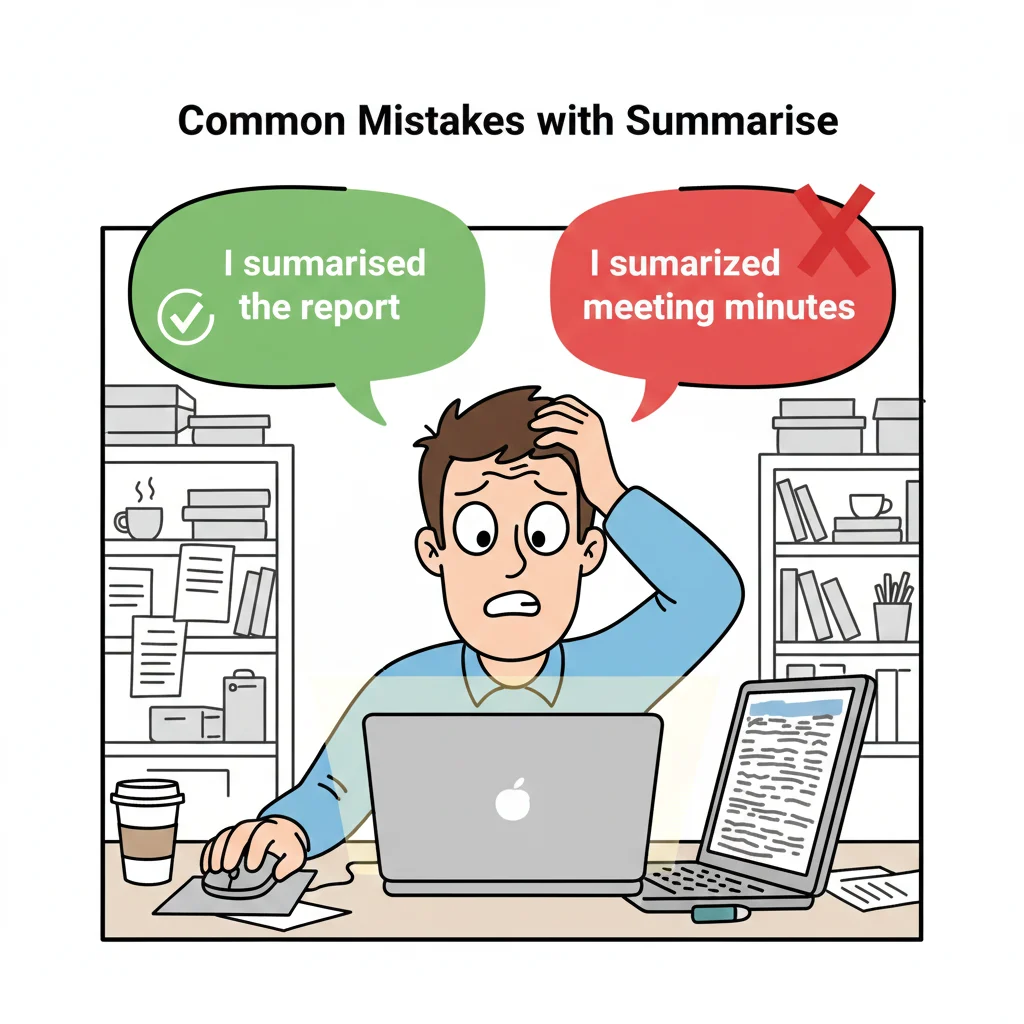
Common Mistakes with Summarise / Summarize
The most frequent errors stem from mixing dialects or misunderstanding the spelling rules.
- Mixing Dialects in a Single Document: This is the top mistake. It confuses readers and looks sloppy.
- Incorrect: “The report will summarise the findings, and we used a tool to summarize the data.”
- Correct (UK): “The report will summarise the findings, and we used a tool to summarise the data.”
- Correct (US): “The report will summarize the findings, and we used a tool to summarize the data.”
- Incorrect Past Tense and Participle Forms: The spelling rule extends to other forms of the verb.
- Incorrect (US context): “He summarised the video yesterday.”
- Correct (US): “He summarized the video yesterday.” (Past tense)
- Correct (US): “She has summarized the book.” (Past participle)
- Applying the Rule to the Wrong Words: Remember, words like “advise” or “surprise” are always spelled with “-ise.”
- Incorrect: “I need you to advize on this summary.”
- Correct: “I need you to advise on this summary.”
Summarise / Summarize in Everyday Examples
Seeing the word in context helps cement the correct usage.
- Email (UK): “Hi team, please summarise the client feedback in a brief document before EOD.”
- News Headline (US): “President to Summarize Foreign Policy Goals in Tonight’s Address.”
- Social Media (Global Brand using US English): “Thread: Can’t watch the full keynote? Here’s a thread to summarize the top 5 announcements. #TechEvent”
- Formal Academic Writing (UK): “This chapter will summarise the methodological approach taken in the prior study.”
- App Store Description: “Summarize Tech with AI: This app can summarize any YouTube video lecture or long article in seconds.”
Summarise / Summarize – Google Trends & Usage Data
Analysing search data provides a clear, real-world picture of the spelling divide. A consistent pattern emerges when comparing the two terms globally. Searches for “summarize” (the American spelling) show highest popularity in the United States, Canada, and the Philippines. In contrast, “summarise” peaks in search volume in the United Kingdom, Australia, Ireland, and New Zealand. This map perfectly mirrors the historical linguistic boundaries.
Furthermore, related search trends reveal user intent. High-volume queries include “summarize meaning,” “summarize video,” and “summarize online free,” indicating a strong user desire for quick comprehension tools. The rise of terms like “Summarize Tech” and “summarise summarize app” highlights the growing niche for AI-powered summarization software. These natural language patterns are exactly what search engines like Google analyze to understand and match user queries with helpful content, making it crucial for creators to use the spelling variants their specific audience is searching for.
(FAQs)
Which one is correct, summarise or summarize?
Both are correct. “Summarize” is American English. “Summarise” is British English. Your choice depends on your audience.
How do you spell summarised in the UK?
In the UK, the past tense and past participle are spelled summarised. Example: “She summarised the report for the committee.”
What is the past tense of summarize?
The past tense is “summarized” in US English and “summarised” in UK English. Both are pronounced the same way.
What is the British version of summarize?
The British version is summarise. This “-ise” spelling convention applies to many similar verbs like “organise” and “realise.”
Is there a free tool to summarise text online?
Yes, many free AI-powered tools and websites can summarize text online. They often cater to both spellings in their search functions. It’s a popular solution for students and professionals.
Can you summarize a video automatically?
Yes, several apps and Summarize Tech tools use artificial intelligence to summarize video content, providing a text overview of key points from lectures, meetings, or tutorials.
Should I use “summarise” in my resume/CV?
Yes, but match the spelling to the country of the employer. Use summarize for US companies and summarise for UK/Australian companies. It shows attention to detail.
Conclusion
The journey through “summarise vs. summarize” is more than a spelling lesson; it’s a masterclass in effective communication. The key takeaway is that neither spelling is inherently wrong. The “correct” choice is a strategic one, based entirely on your reader’s location and expectations. For American audiences, summarize is the default. For British and Commonwealth readers, summarise is the norm. In our interconnected digital world, consistency is your greatest ally. Choose one English variant and stick to its rules throughout your entire piece of content, whether it’s a social media post, a research paper, or a website.

Eley Williams writes clear, engaging guides on confusing words and phrases, helping readers understand meanings, differences, and correct usage with ease.