🛒 Have you ever seen a supermarket sign that says “10 Items or Less” and wondered if that’s actually correct?
You’re not alone! This small phrase has caused big debates among grammar lovers.
Many people use “Ten items or less”, while others say it should be “Ten items or fewer.”
So, which one is right? And why does it even matter?
In this easy English guide, you’ll learn:
- What each phrase really means
- The difference between “less” and “fewer”
- How to use them correctly (with simple examples)
- Common mistakes to avoid
- And a few fun grammar tips to remember forever!
By the end, even a 4th grader will clearly understand when to say less and when to say fewer. 🌟
🧠 What Does Each Word Mean?
Let’s start with simple meanings before we dive into grammar rules.
Meaning of “Less”
- Part of speech: Adjective or adverb
- Used for: Things you cannot count (uncountable nouns)
💡 Simple meaning: “A smaller amount of something.”
Examples:
- I want less water in my glass.
- She spends less time on her phone now.
- We have less sugar left in the jar.
👉 You use “less” when talking about amounts, not numbers. You can’t count “water,” “time,” or “sugar” — so “less” fits perfectly.
Meaning of “Fewer”
- Part of speech: Adjective
- Used for: Things you can count (countable nouns)
💡 Simple meaning: “A smaller number of things.”
Examples:
- There are fewer apples in the basket.
- He made fewer mistakes on the test.
- We have fewer chairs than we need.
👉 You use “fewer” when you can count the items — apples, mistakes, chairs, etc.
⚖️ The Key Difference Between “Less” and “Fewer”
Here’s a quick way to remember it:
| Aspect | Less | Fewer |
|---|---|---|
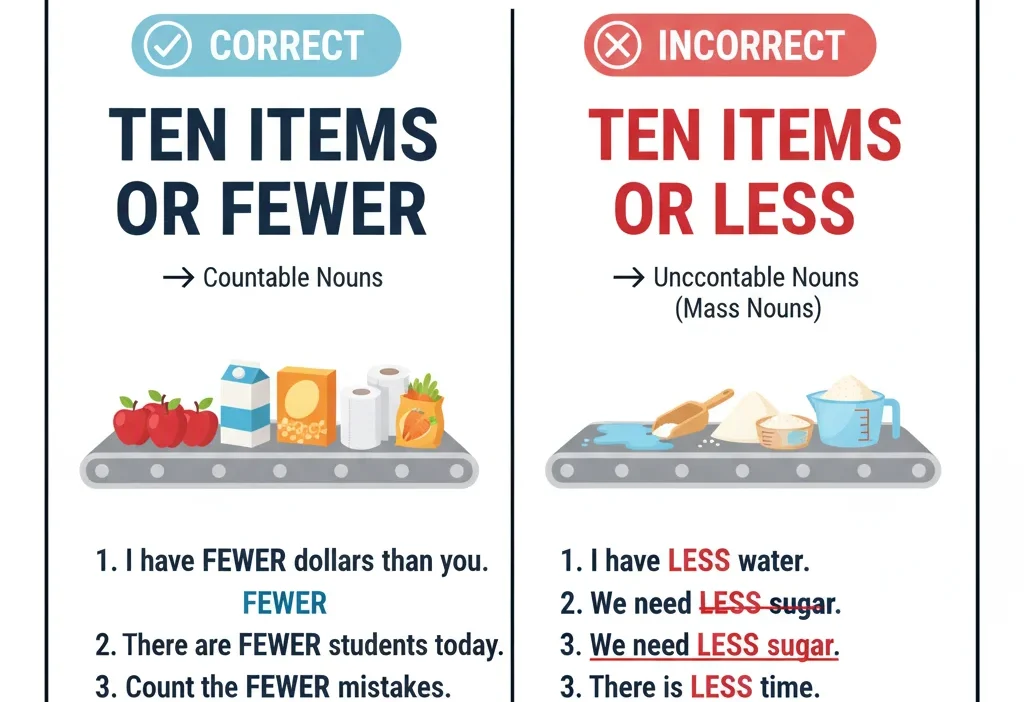
| Used for | Uncountable nouns (mass nouns) | Countable nouns |
| Meaning | A smaller amount | A smaller number |
| Examples | Less milk, less money, less time | Fewer bottles, fewer people, fewer minutes |
| Quick Tip | If you can’t count it, use less | If you can count it, use fewer |
✅ Memory Trick:
If you can add an -s at the end of a word (like apples, books, chairs), use fewer.
If you can’t, use less.
🚫 Common Mistakes and How to Avoid Them
Even native English speakers get confused with “less” and “fewer.” Let’s fix that with easy examples.
❌ Common Mistake #1:
“There are less people in the class today.”
✅ Correct:
“There are fewer people in the class today.”
Why?
People are countable — you can count 1, 2, 3 people — so use fewer.
❌ Common Mistake #2:
“I have fewer money than you.”
✅ Correct:
“I have less money than you.”
Why?
Money is uncountable (you count rupees, not money), so use less.
❌ Common Mistake #3:
“We need less chairs for the event.”
✅ Correct:
“We need fewer chairs for the event.”
Why?
Chairs are countable, so “fewer” is the right choice.
🛍️ When to Use “Ten Items or Fewer”
“Ten items or fewer” is the grammatically correct phrase.
Why? Because “items” are countable — you can count 1, 2, 3 items.
Examples:
- Please use this lane if you have ten items or fewer.
- You can only buy fewer than ten items in this section.
- I had fewer items than the limit, so I used the express lane.
- He packed fewer clothes this time.
- There were fewer boxes on the shelf.
💡 Grammar Tip:
Whenever you can count the things, always choose fewer, not less.
🧺 When to Use “Ten Items or Less”
Even though “Ten items or fewer” is grammatically correct, you’ll still see “Ten items or less” on many supermarket signs.
So, is it wrong?
Technically, yes — but it’s widely accepted in casual or informal English.
Language changes with usage, and most people understand “ten items or less” instantly.
Examples:
- This lane is for customers with ten items or less.
- I bought less than ten things from the shop.
- He spent less money at the store.
📝 Real-Life Grammar Note:
In spoken English, “less” often sounds more natural and smoother, so stores keep using it.
However, in formal writing or exams, always use “fewer.”
💡 Quick Recap: “Less” vs “Fewer”
Let’s summarize everything in simple points:
- ✅ Use fewer for countable things.
→ Fewer apples, fewer mistakes, fewer chairs. - ✅ Use less for uncountable things.
→ Less water, less time, less money. - 🛍️ “Ten items or fewer” is grammatically correct.
- 🗣️ “Ten items or less” is acceptable in everyday speech, but not in formal English.
- 💭 Memory Trick:
👉 If you can count it → fewer
👉 If you can’t count it → less
📚 Advanced Grammar Tips
1. Origin of the Confusion
The rule comes from Old English grammar.
Originally, “less” was used for both countable and uncountable nouns.
Over time, grammarians decided to separate them:
- “Less” → for amounts
- “Fewer” → for numbers
But the old habit of saying “less” for everything never completely disappeared.
2. Exceptions to the Rule
Sometimes “less” is correct even with numbers. For example:
- “Less than 5 kilometers”
- “Less than 10 dollars”
- “Less than 20%”
Why? Because these measure quantities, not individual items.
So, “less” works for time, money, distance, weight, and percentages.
3. In Formal Writing
Always use “fewer” when writing essays, reports, or official content.
It shows your grammar is accurate and polished.
Example:
4. In Casual Speaking
In daily speech, people often say:
✅ That’s perfectly fine — because “minutes” and “dollars” represent quantities here.
5. Grammar in the Digital Age
Even major brands and stores sometimes use “Ten items or less.”
In fact, it’s so common that it feels “normal” to most people.
So, while grammar lovers prefer “fewer,” both forms are widely understood today.
🧩 Mini Quiz: Test Your Understanding!
Fill in the blanks with less or fewer.
- There are ______ people at the park today.
- I spent ______ money than yesterday.
- Please take ______ cookies if you’re not hungry.
- The project took ______ time than expected.
- We made ______ mistakes this time.
- He drinks ______ coffee now.
- This box has ______ books than that one.
✅ Answers: 1. fewer | 2. less | 3. fewer | 4. less | 5. fewer | 6. less | 7. fewer
🏁 Conclusion
You did it! 🎉
Now you know the difference between “less” and “fewer.”
👉 Use “fewer” for things you can count.
👉 Use “less” for things you can’t count.
So next time you’re at a store and see a “Ten items or less” sign, you’ll know the rule — and the reason behind it!
Keep practicing, notice these words in everyday life, and you’ll soon use them naturally. 🌟
❓ Top 5 FAQs About “Ten Items or Less” vs “Ten Items or Fewer”
1. Which is grammatically correct — “Ten items or less” or “Ten items or fewer”?
✅ “Ten items or fewer” is grammatically correct because “items” are countable.
2. Why do stores say “Ten items or less” if it’s wrong?
Because it sounds more natural in speech and has become accepted in casual English.
3. Can I use “less” with numbers?
Yes — when talking about measurements like time, money, or distance.
Example: “Less than 5 minutes.”
4. What’s the quick rule to remember?
If you can count it → use fewer.
If you can’t count it → use less.
5. Is “Ten items or fewer” too formal for everyday English?
Not really. It’s correct, polite, and perfect for both speaking and writing.

Polly Clark creates clear, insightful guides on language and usage, helping readers understand meanings, differences, and nuances with clarity and confidence.