Have you ever written something and wondered whether you should use “to” or “too”? You’re not alone! These two tiny words confuse millions of English learners because they sound the same but have different meanings.
In this simple guide, you’ll learn the difference between “to” and “too,” how to use each one correctly, and how to avoid common mistakes. By the end, you’ll be confident using both words like a pro—whether you’re writing an essay, a text, or an email. Let’s make it easy and fun!
What Does Each Word Mean?
Before we dive into the differences, let’s understand what each word really means.
1. “To” — A Preposition or Part of a Verb
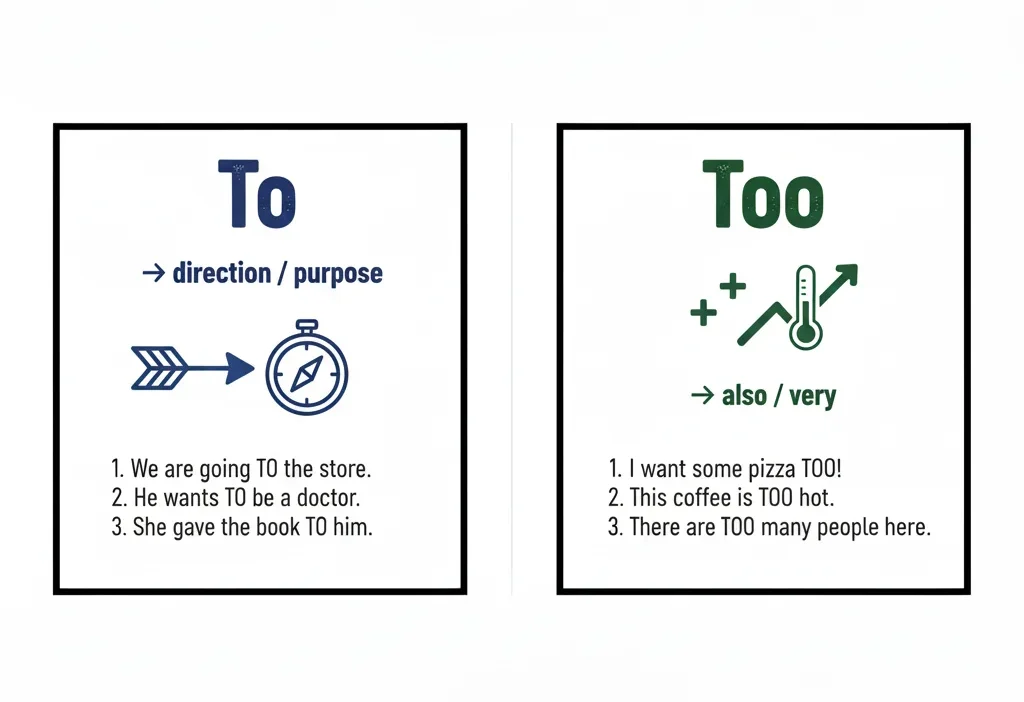
The word “to” shows direction, movement, or purpose. It’s one of the most common words in English. You also use “to” before a verb (called the infinitive form).
Examples:
- I am going to school. (Direction)
- She wants to dance. (Before a verb)
- Give this to your teacher. (Purpose)
Think of “to” as an arrow (→). It points toward something — a place, a goal, or an action.
2. “Too” — Means “Also” or “Very”
The word “too” is an adverb, and it usually means “also” or “more than enough.”
Examples:
- I want to go, too. (Also)
- This soup is too hot. (More than enough)
- He’s too tired to play. (Excessive amount)
So, when you use “too,” it’s like saying extra or also.
The Key Difference Between “To” and “Too”
Here’s an easy way to see how they differ:
| Word | Part of Speech | Meaning | Example Sentence |
|---|---|---|---|
| To | Preposition or part of verb | Shows direction, purpose, or relationship | I’m going to the store. |
| Too | Adverb | Means “also” or “more than enough” | It’s too cold today. |
✅ Quick Tip to Remember:
If you can replace the word with “also” or “very,” use “too.”
If not, it’s probably “to.”
Common Mistakes and How to Avoid Them
Let’s fix some everyday mix-ups people make:
❌ Incorrect: I want too go home.
✅ Correct: I want to go home.
(You’re showing purpose, not “also.”)
❌ Incorrect: This cake is to sweet.
✅ Correct: This cake is too sweet.
(You mean “very sweet.”)
❌ Incorrect: I’m going too the park.
✅ Correct: I’m going to the park.
(You’re showing direction.)
👉 Tip: If your sentence talks about where, when, or what action, use “to.”
If it adds extra meaning or emotion, use “too.”
When to Use “To”
You’ll use “to” in many different situations. Let’s look at the main ones:
1. Showing Direction
- She went to the market.
- Let’s drive to the beach.
2. Showing Purpose
- I came here to learn.
- He studies hard to pass the exam.
3. Before a Verb (Infinitive Form)
- I like to read.
- They want to play.
4. Showing Relationship
- This key belongs to me.
- Be kind to others.
🧠 Memory Trick:
Think of “to” as a small arrow → showing movement toward something or someone.
When to Use “Too”
Now let’s see how to use “too” correctly.
1. Meaning “Also” or “As Well”
- I want ice cream, too.
- She’s coming too!
2. Meaning “Very” or “Excessively”
- The box is too heavy.
- It’s too late to call.
- He’s too excited to sleep.
3. At the End of a Sentence
When “too” means “also,” it often comes at the end of a sentence.
- I love music, too.
- Can I come, too?
🧩 Memory Hack:
If something feels extra or you could replace it with also, use “too.”
Quick Recap: To vs Too
Here’s a short and simple summary:
- To = direction, purpose, or before a verb.
👉 Example: “I’m going to sleep.” - Too = also, very, or more than enough.
👉 Example: “I’m too tired to talk.”
Easy Trick to Remember:
“Too” has two o’s, which means “extra” or “more.”
So, when you mean “extra,” use the word with extra o!
Advanced Tips: Going Beyond the Basics
If you want to sound more natural in English, here are a few expert grammar tips:
1. Formal Writing
In essays or formal letters, use “to” for purpose clearly:
- I am writing to express my opinion.
Avoid slang forms like “wanna” (want to) in formal writing.
2. Texting and Informal Writing
People sometimes forget one “o” when typing fast (e.g., me to instead of me too).
That can change the meaning completely!
✅ Write clearly, even in texts, to avoid confusion.
3. Common Expressions
- To: “Nice to meet you,” “Go to bed,” “Talk to you soon.”
- Too: “Me too,” “Too much,” “Too late.”
4. Origin
Both words come from Old English — “to” (tō) meant direction, and “too” (tōo) meant “in addition.” They’ve stayed close in sound ever since!
Mini Quiz: Test Yourself!
Fill in the blanks with to or too.
- I’m going ___ the party.
- It’s ___ cold outside!
- She wants ___ learn Spanish.
- May I come ___?
- You’re working ___ hard today.
- We need ___ finish our homework.
- That bag is ___ heavy for me.
✅ Answers: 1) to, 2) too, 3) to, 4) too, 5) too, 6) to, 7) too
FAQs: To vs Too
1. What’s the difference between “to” and “too”?
“To” shows direction or purpose. “Too” means also or very.
2. Can “too” come before a verb?
Yes, when it means “very.” Example: “It’s too hot to move.”
3. Why do people confuse “to” and “too”?
They sound the same, but have different meanings and spellings.
4. Can “too” start a sentence?
Sometimes, yes! Example: “Too much noise makes it hard to study.”
5. What’s an easy way to remember the difference?
Think: “Too” has two o’s → means extra or also.
Conclusion
Now you know the difference between “to” and “too”!
Remember — “to” shows direction or purpose, while “too” means also or very. Practice using them in your writing, messages, and everyday speech.
Keep it simple, and you’ll never mix them up again.
Every small grammar improvement makes your English stronger and clearer — one word at a time! 🌟

Polly Clark creates clear, insightful guides on language and usage, helping readers understand meanings, differences, and nuances with clarity and confidence.