Have you ever written “totalled” or “totalling” and wondered if it should have one “L” or two? You’re not alone! Many English learners (and even native speakers) get confused between “totaled” vs “totalled” and “totaling” vs “totalling.”
In this guide, we’ll break it all down in plain English — what each word means, when to use them, and the key spelling difference between American and British English.
By the end, you’ll know exactly which spelling to use in your writing, emails, or essays — easily and confidently! 🌟
🧩 What Does Each Word Mean?
Let’s start simple. All these words — totaled, totalled, totaling, and totalling — come from the verb “total,” which means to add up numbers or to amount to something.
So when you say:
- “The bill totalled $100.”
👉 You mean the bill added up to $100.
But the spelling changes depending on where you live or which version of English you use.
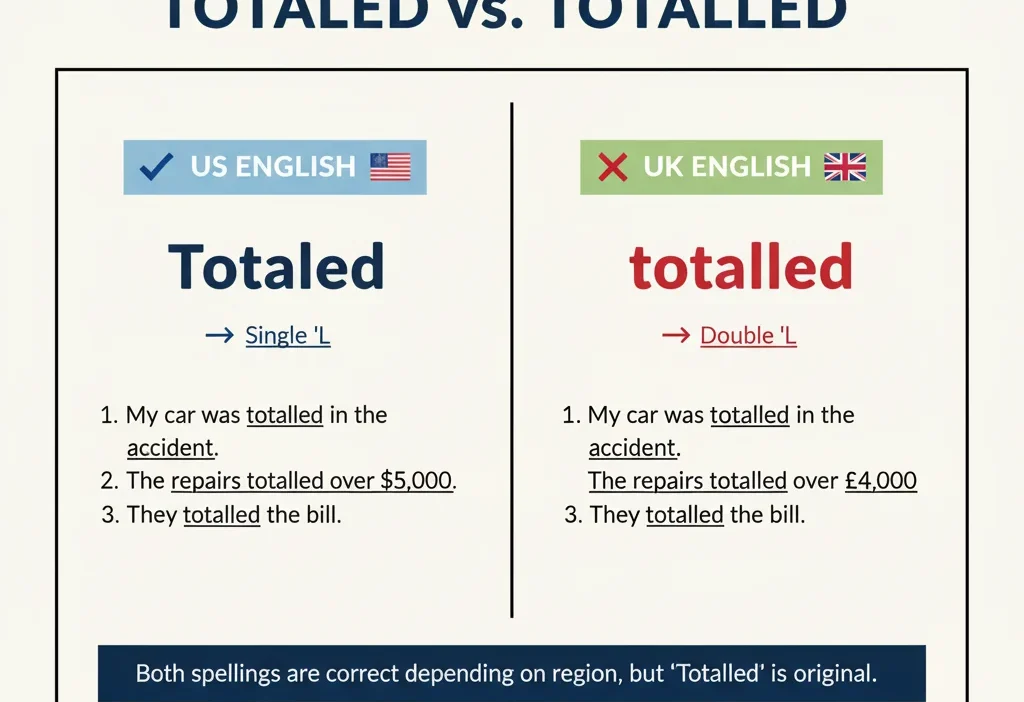
🇺🇸 American English:
- ✅ Totaled
- ✅ Totaling
🇬🇧 British English:
- ✅ Totalled
- ✅ Totalling
That’s the main difference — one L (US) vs two Ls (UK).
Simple Meanings:
| Word | Meaning | Example |
|---|---|---|
| Totaled (US) | Added up to a total; destroyed completely (in informal use). | The damage totaled $500. |
| Totalled (UK) | Same meaning as “totaled,” but British spelling. | The cost totalled £200. |
| Totaling (US) | Present participle (happening now) in American English. | She is totaling the receipts. |
| Totalling (UK) | Present participle in British English. | He is totalling the votes. |
⚖️ The Key Difference Between “Totalled” and “Totalling”
Here’s a quick comparison to make it crystal clear 👇
| Feature | American English | British English |
|---|---|---|
| Past tense | Totaled | Totalled |
| Continuous form | Totaling | Totalling |
| Example (past tense) | “The storm totaled the car.” | “The storm totalled the car.” |
| Example (present tense) | “She is totaling the sales.” | “She is totalling the sales.” |
| Common in | USA, Canada | UK, Australia, New Zealand |
🪄 Quick Tip to Remember:
🇺🇸 One L for American English.
🇬🇧 Two Ls for British English.
If you’re writing for an American audience — stick to totaled/totaling.
If your readers are in the UK or use British spelling — use totalled/totalling.
❌ Common Mistakes and How to Avoid Them
Mistake 1: Mixing Both Styles
❌ The car was totalled in New York City.
✅ The car was totaled in New York City. (Use American spelling in US context.)
Mistake 2: Switching Styles Mid-Sentence
❌ She is totalling the receipts, and the final number totaled $2000.
✅ She is totaling the receipts, and the final number totaled $2000. (Keep one consistent style.)
Mistake 3: Using the Wrong Form
❌ He total the expenses yesterday.
✅ He totaled the expenses yesterday.
💡 Grammar Tip: Always match the -ed or -ing ending with the correct tense and region.
🏫 When to Use “Totaled” and “Totaling” (American English)
Use totaled and totaling if you’re following American English rules.
Examples:
- The company totaled their sales for the quarter.
- The car was totaled after the crash.
- She is totaling the points from each game.
- Their monthly bills totaled $500.
- The accountant is totaling the expenses right now.
🧠 Memory Trick:
America likes things short and simple — so only one L in “totaled” and “totaling.”
🎓 When to Use “Totalled” and “Totalling” (British English)
Use totalled and totalling if you follow British English — used in the UK, Australia, and other Commonwealth countries.
Examples:
- The invoices totalled £450.
- He is totalling the marks for the exam.
- The accident totalled two cars.
- Their donations totalled £1,000.
- She’s totalling her grocery receipts.
🧠 Memory Trick:
British words often double the final consonant when adding -ed or -ing.
So: “travel → travelled,” “cancel → cancelled,” and “total → totalled.”
🔁 Quick Recap: “Totalled” vs “Totaling” vs “Totalling”
- Totaled / Totaling → 🇺🇸 American English (one L)
- Totalled / Totalling → 🇬🇧 British English (two Ls)
- Both mean to add up numbers or to reach a total amount.
- Be consistent in your spelling throughout your writing!
✅ Example Recap Table
| Situation | American | British |
|---|---|---|
| Adding up money | totaling | totalling |
| Talking about the past | totaled | totalled |
| In writing for US readers | ✅ | ❌ |
| In writing for UK readers | ❌ | ✅ |
📘 Advanced Tips & Fun Facts
✨ The root word “total” comes from Latin “totalis,” meaning “entire” or “whole.”
✨ “To total” something can also mean “to destroy it completely” — like “The car was totaled in the crash.”
✨ Always check your document’s language setting (US or UK) in Word or Google Docs — it will auto-correct based on region.
✨ In formal writing (like essays or reports), consistency is more important than which version you use.
🧠 Mini Quiz — Test Your Understanding!
Fill in the blanks with the correct form:
- The damage ________ $2,000.
- She is ________ the total marks.
- The car was completely ________ after the storm.
- He is ________ the expenses for the event.
- Their donations ________ £3,500 last year.
Answer Key:
- totaled / totalled
- totaling / totalling
- totaled / totalled
- totaling / totalling
- totaled / totalled
(Choose spelling based on your region]!
❓FAQs About “Totalled / Totalling / Totaling”
Q1. Is “totalled” a real word?
Yes! “Totalled” is the British English spelling of “totaled.” Both are correct depending on your region.
Q2. Which is correct: totalled or totaled?
Both are correct. Use “totaled” in American English and “totalled” in British English.
Q3. Why do British words have double Ls?
British English doubles the consonant when adding -ed or -ing to some words ending with a single vowel + consonant.
Q4. Can “totaled” mean destroyed?
Yes. Informally, “to total a car” means the car is completely wrecked or beyond repair.
Q5. What’s the difference between totaling and adding?
“Adding” focuses on the act of putting numbers together; “totaling” focuses on finding the final sum or result.
🏁 Conclusion
So, the next time you write totalled, totalling, totaled, or totaling, remember — it’s not about right or wrong, it’s about where you are and who you’re writing for!
Stay consistent with your spelling, and you’ll sound natural whether you write in American or British English.
Keep learning, keep practicing, and soon English spelling differences won’t confuse you at all. 🌍✨

Jenn Ashworth offers clear, engaging explanations of language and usage, helping readers grasp meanings, nuances, and differences with accuracy and ease.