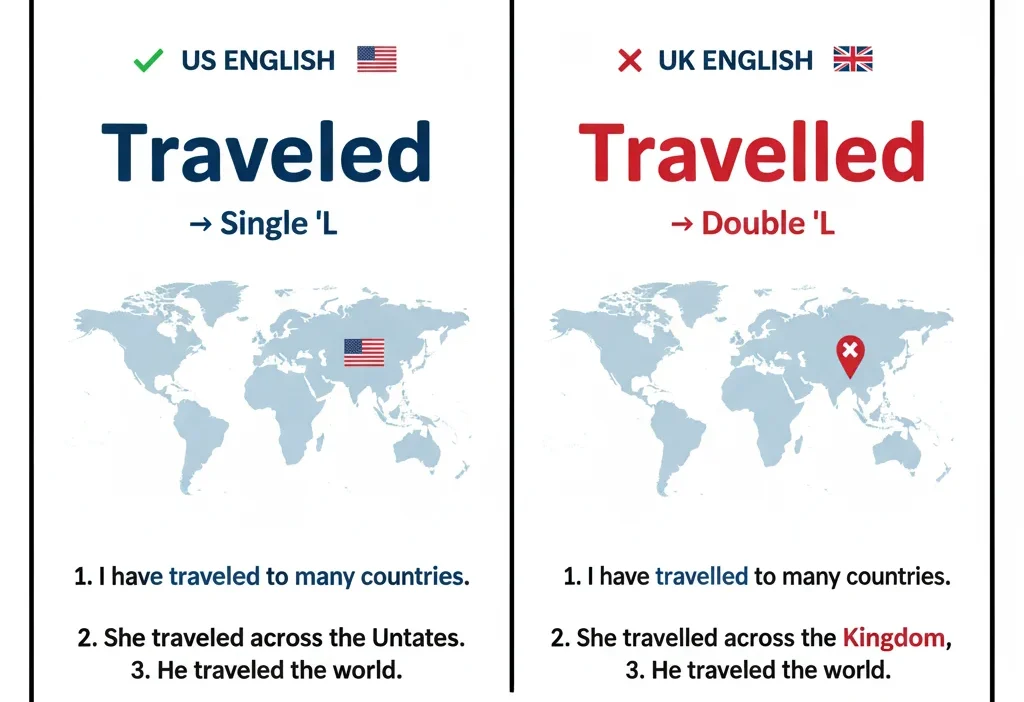
“‘Traveled’ is American English, while ‘Travelled’ is British English; both are correct spellings of the past tense of ‘travel’.”
Confused about whether to write “traveled” or “travelled”? You’re not alone. Both spellings are correct, but their usage depends on the variety of English you are using. “Traveled” is the standard in American English, whereas “Travelled” is preferred in British, Australian, and Canadian English.
Using the wrong form can subtly affect the professionalism and clarity of your writing. Whether you’re writing essays, emails, reports, blog posts, or content for international audiences, knowing which spelling to use ensures your writing is polished and appropriate.
In this article, you’ll find clear examples of traveled vs travelled, easy tips to remember the correct form, and guidance for writing in different English variants, making it simple to choose the right spelling every time.
What Does Each Word Mean?
Both “traveled” and “travelled” are past tense forms of the verb “travel.”
The word “travel” means to go from one place to another, usually for fun, work, or adventure.
Let’s break them down:
✈️ “Traveled” — (American English)
- Part of speech: Verb (past tense of travel)
- Used in: American English (U.S.)
- Meaning: Went on a journey or moved from one place to another.
Examples:
- We traveled to New York last summer.
- She traveled across the country by train.
- My parents traveled a lot when they were young.
🌍 “Travelled” — (British English)
- Part of speech: Verb (past tense of travel)
- Used in: British, Canadian, and Australian English
- Meaning: Exactly the same as “traveled” — just spelled differently!
Examples:
- They travelled to Paris for their honeymoon.
- I travelled through India during my gap year.
- The teacher travelled abroad to attend a conference.
🧠 Quick Memory Tip:
Think “one L” for the U.S. (shorter word, American spelling) and “two Ls” for the UK (longer word, British spelling).
The Key Difference Between “Traveled” and “Travelled”
The only difference is spelling — not pronunciation or meaning.
Here’s a simple comparison table to help you remember:
| Feature | Traveled | Travelled |
|---|---|---|
| Region | American English 🇺🇸 | British / Canadian / Australian English 🇬🇧🇨🇦🇦🇺 |
| Spelling | One “L” | Two “L”s |
| Meaning | Went from one place to another | Same meaning |
| Example | I traveled to Los Angeles. | I travelled to London. |
✅ Quick Tip:
If you’re writing for an American audience, use “traveled.”
If your readers are from the UK, Canada, or Australia, use “travelled.”
Common Mistakes and How to Avoid Them
Let’s look at a few common errors:
❌ Wrong: I travelled to California last month.
✅ Correct (American English): I traveled to California last month.
❌ Wrong: We traveled around Europe for two months.
✅ Correct (British English): We travelled around Europe for two months.
Why it happens:
English spelling rules differ between regions. Americans simplify double letters (like travelled → traveled), while British spelling keeps them double.
How to fix it:
👉 Always check your audience location before writing.
👉 Set your word processor (MS Word or Google Docs) to U.S. or U.K. English for automatic spell checking.
When to Use “Traveled” (U.S. English)
Use “traveled” when writing for:
- American schools
- U.S. websites or businesses
- American English exams (like TOEFL)
Examples:
- We traveled across the United States by car.
- He traveled from Texas to California in one week.
- My cousin traveled to Washington for a job interview.
- They have traveled a lot since retiring.
- She traveled to Hawaii for her birthday.
Memory Hack:
🇺🇸 America likes to keep things simple — one “L” is enough!
When to Use “Travelled” (British English)
Use “travelled” when writing for:
- British or European audiences
- UK-based schools or exams (like IELTS)
- Formal writing in Commonwealth countries
Examples:
- We travelled to Scotland by train.
- She travelled to France during her holidays.
- He has travelled extensively in Asia.
- The author travelled for inspiration.
- They travelled together every summer.
Memory Hack:
🇬🇧 Britain likes things traditional — double “L” for extra style!
Quick Recap: Traveled vs Travelled
Here’s a short summary to help you remember fast:
- ✅ Traveled = American English (one “L”)
- ✅ Travelled = British English (two “L”s)
- 🚫 Never mix them in the same piece of writing.
- ✈️ Meaning: Same for both — past tense of travel
- 💡 Tip: Match your spelling to your audience or country.
Advanced Tips: The History Behind the Two Spellings
The difference between “traveled” and “travelled” comes from Noah Webster, the American dictionary creator.
In the early 1800s, Webster simplified many English spellings — removing extra letters like colour → color, favourite → favorite, and travelled → traveled.
British English, however, kept the original double-L form.
So today, both are correct, just regionally different.
📚 In writing exams or essays:
- Use “traveled” if you’re writing in American English.
- Use “travelled” if you’re writing in British English.
- Don’t switch styles halfway!
Mini Quiz: Test Your Understanding 🎯
Choose the correct spelling for each sentence:
- We __________ to Japan last year.
a) traveled b) travelled - She has __________ through Europe many times.
a) traveled b) travelled - My uncle __________ from New York to Florida.
a) traveled b) travelled - They __________ to Canada for Christmas.
a) traveled b) travelled - I __________ abroad when I was 18.
a) traveled b) travelled
(Answers: 1a (U.S.), 2b (U.K.), 3a (U.S.), 4b (U.K.), 5a or b — depends on region!)
5 FAQs About “Traveled” vs “Travelled”
1. Are “traveled” and “travelled” both correct?
Yes! Both are correct, but they belong to different English styles — “traveled” (U.S.) and “travelled” (U.K.).
2. Is “traveled” American or British?
“Traveled” is American English spelling.
3. Is “travelled” still used in modern English?
Yes. It’s widely used in British, Canadian, and Australian English.
4. Can I use both spellings in one essay?
No. Always stay consistent with one form throughout your writing.
5. How do I know which one to use?
Check your audience or platform. If it’s U.S.-based, use “traveled.” If it’s U.K.-based, use “travelled.”
Conclusion
Now you know the clear difference between “traveled” and “travelled.”
They mean the same thing, but where you’re writing decides which one to use.
- ✈️ Use “traveled” in American English.
- 🌍 Use “travelled” in British, Canadian, or Australian English.
Remember: English may look tricky, but once you understand the patterns, it becomes easy and fun to use every day.
Keep practicing, and soon, you’ll travel confidently — in language and in life!

Polly Clark creates clear, insightful guides on language and usage, helping readers understand meanings, differences, and nuances with clarity and confidence.