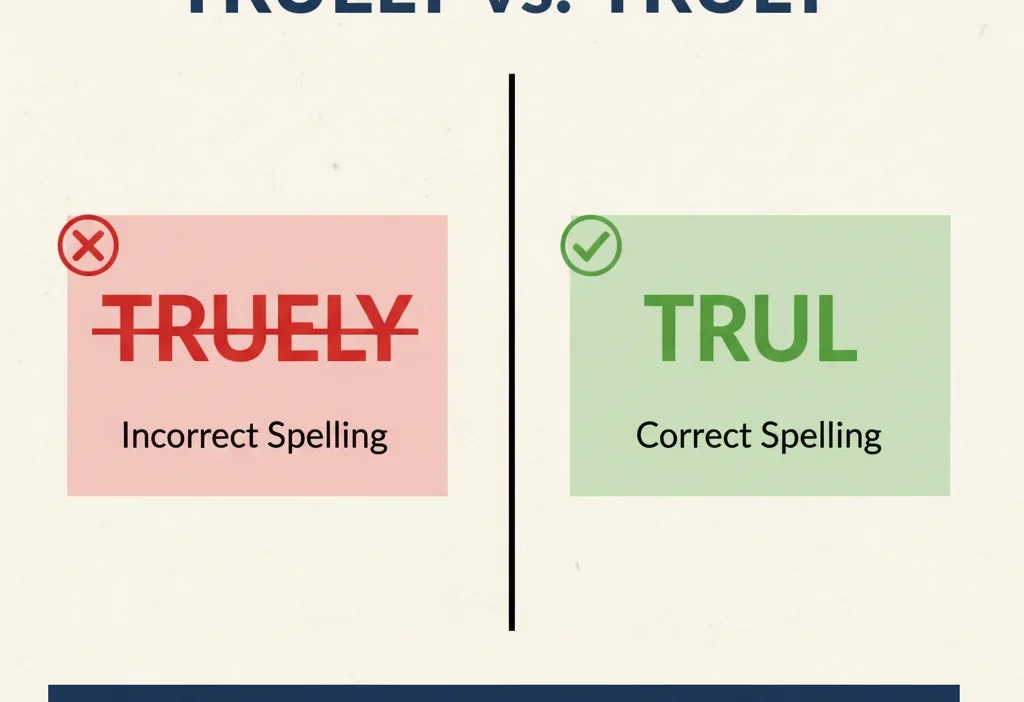
English spelling can be confusing — especially when a word sounds correct in one form but is spelled differently. A perfect example of this confusion is “truely or truly.”
Many people write “truely”, thinking that adding -ly to “true” should keep the e — like blue → bluely or safe → safely.
But in this case, the correct spelling is TRULY, not truely.
In this guide, you’ll learn:
- What each form means
- Which spelling is correct and why
- Easy grammar tips to remember
- Real-life examples
- A comparison table + quiz
This article is written in very simple language — so even a student in 4th grade can understand it.
✅ What Does Each Word Mean?
🚫 1. “Truely” — Incorrect Spelling
❌ “Truely” is not a real English word.
You might see people type it by mistake online, but it is not accepted in dictionaries like:
- Oxford English Dictionary
- Merriam-Webster
- Cambridge Dictionary
Why do people misspell it?
Because the base word true ends with e, and many similar words keep the e when adding -ly.
Example (correct patterns):
| Base Word | + ly | Correct Word |
|---|---|---|
| safe | -ly | safely |
| polite | -ly | politely |
| absolute | -ly | absolutely |
So people think:
“If true → truely… right?”
❌ Wrong.
✅ 2. “Truly” — Correct Spelling
✔️ “Truly” is the correct spelling.
Part of Speech: Adverb
Meaning: In a sincere, real, honest, or accurate way.
Simple Definition:
👉 “Truly” means something is real and honest.
✅ Examples of truly
- I truly appreciate your help.
- She is truly happy today.
- That story is truly inspiring.
Here’s a short mini-story:
Maria studied hard for her test. When she scored first place, she was truly proud of herself.
The word adds feeling, honesty, and truth to a sentence.
⭐ The Key Difference Between Truely and Truly
| Feature | Truely | Truly |
|---|---|---|
| Correct Spelling | ❌ No | ✅ Yes |
| Exists in English? | ❌ Not a word | ✅ Real English word |
| Used in formal writing? | ❌ Never | ✅ Always |
| Part of Speech | — | Adverb |
| Meaning | — | truthfully / sincerely / honestly |
| Example in sentence | — | I truly care about your success. |
👉 Quick Tip to Remember
❗ Drop the “e”: TRUE → TRULY
Just like:
- argue → truly (same pattern: argue → arguing)
- value → valuing
The final “e” disappears.
🔥 Why Does “TRUE” Lose the Letter E?
This is a simple grammar rule.
When a word ending in e changes into an adverb with -ly,
we remove the e.
Example pattern:
| Base Word | Remove “e” + ly | Final Word |
|---|---|---|
| true | tru + ly | truly |
| due | du + ly | duly |
| whole | whol + ly | wholly |
📌 This spelling rule is part of elementary English and helps improve writing accuracy.
⚠️ Common Mistakes and How to Fix Them
| ❌ Incorrect | ✅ Correct |
|---|---|
| I truely believe you. | I truly believe you. |
| This is truely amazing! | This is truly amazing! |
| You are truely my best friend. | You are truly my best friend. |
Why do people make this mistake?
Because they see the word true and assume they simply add -ly.
Fix:
Just remember: Not truely — only truly.
🟢 When to Use “Truly”
Use truly when you want to show:
- honesty
- reality
- strong emotions
- respect or appreciation
✅ Examples in real-life sentences
- Thank you. I truly mean that.
- She is truly an amazing teacher.
- This place is truly beautiful.
- I truly don’t understand the question.
- He was truly sorry for his mistake.
👉 These sentences show honesty and truth.
🚫 When to Use “Truely”
Never.
There is no situation where truely is correct.
✔️ Always choose TRULY.
🧠 Memory Trick (Super Easy!)
Think of this:
“True loses E to be Truly.”
Just like:
blue → bluish (drop the e)
Or say it like a fun chant:
🥁 Not TRUELY, only TRULY!
🔄 Quick Recap — Truely vs Truly
- Truely ❌ = incorrect spelling
- Truly ✅ = correct spelling
- Meaning: honestly, really, sincerely
- Grammar Rule: Drop the e before adding -ly
✍️ Advanced Tip (For Essay, Exams & Professional Writing)
Use truly to sound formal, polite, and respectful:
- I truly appreciate your feedback.
- We are truly grateful for your support.
Many companies use truly at the end of emails:
Sincerely yours,
Truly yours,
This shows honesty and professionalism.
📚 Mini Quiz (Test Yourself!)
Fill in the blanks with TRULY:
- I ___ enjoyed the movie.
- She is ___ talented.
- Thank you. I ___ mean it.
- This is ___ a beautiful view.
- He was ___ sorry.
Answers: truly, truly, truly, truly, truly
(If you wrote truely anywhere — take a deep breath and try again 😄)
❓ 5 Most Helpful FAQs (Featured Snippet Ready)
✅ 1. What is the correct spelling — truely or truly?
Truly is correct. “Truely” is never correct.
✅ 2. Why is “truely” wrong?
Because when adding -ly to true, the final e is dropped → truly.
✅ 3. Is “truely” ever used in British English?
No. Both American and British English use truly.
✅ 4. What does truly mean?
It means honestly, really, genuinely, sincerely.
✅ 5. How can I remember the correct spelling?
Use the memory trick:
Conclusion
“Truely or Truly” is one of the most common spelling mistakes in English.
You now know:
- Truely ❌ is never correct.
- Truly ✅ means honest, real, sincere.
- When adding -ly, TRUE drops the “e.”
Keep practicing with the examples and memory tricks.
Every time you write the word, remind yourself:
⭐ Not TRUELY — always TRULY! ⭐
Your English improves a little more every day — and I truly believe you can master it.

Gwendoline Riley delivers clear, compelling insights into language and usage, helping readers understand meanings, nuances, and differences with confidence.