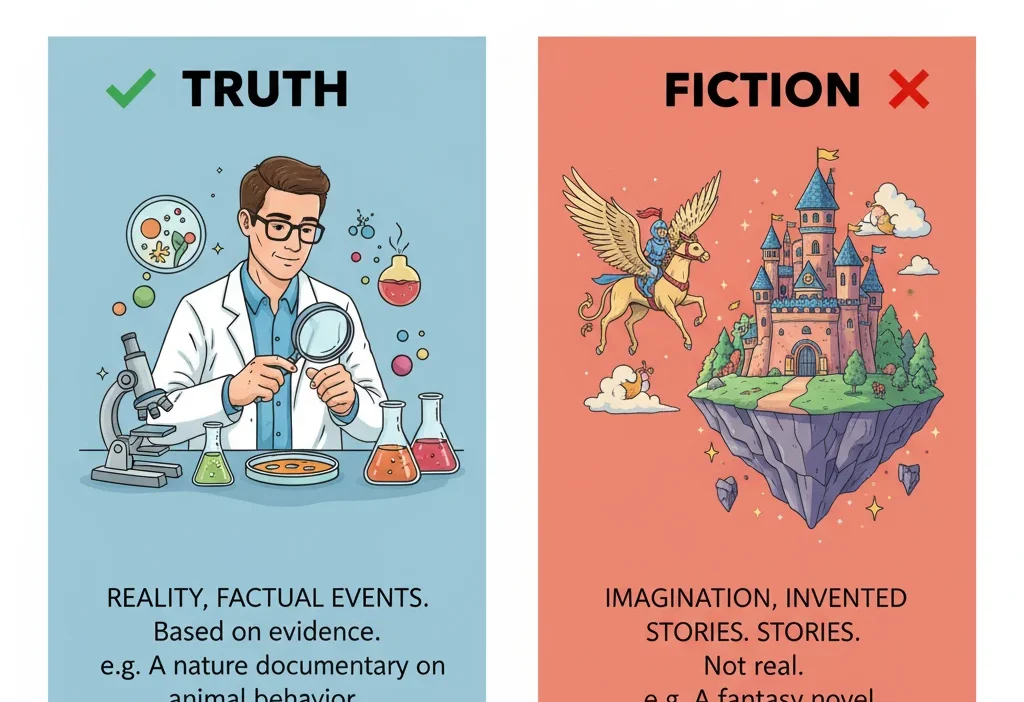
Truth refers to facts or reality, while fiction refers to made-up stories or imagination. Knowing the difference is essential for clear writing, reading, and everyday conversations
Do you ever get confused between truth and fiction? You’re not alone! Many people mix them up because both deal with stories or information, but they are actually opposites. Truth is about reality — things that really happened. Fiction is about imagination — stories that are made up.
In this guide, you’ll learn everything you need to know: the meanings of both words, their differences, correct usage, common mistakes, and practical examples. By the end, you’ll be able to use truth and fiction confidently in your writing and speaking. Even if you’re a beginner, this article will make it easy and fun to understand.
What Does Each Word Mean?
Meaning of Truth
Truth is something real, factual, and proven. It is not imagined or invented.
- Part of speech: Noun
Examples:
- The truth about the missing book was finally revealed.
- Always tell the truth, even if it’s hard.
- Scientists search for the truth in experiments and data.
Think of truth as something you can touch or prove, like facts in school or news reports.
Meaning of Fiction
Fiction is something that is made up, imaginary, or invented. It’s not real.
- Part of speech: Noun
Examples:
- Harry Potter is a famous piece of fiction.
- She enjoys reading fiction stories before bed.
- That movie is pure fiction; it never actually happened.
Imagine fiction as a fun story or movie that exists only in your imagination.
The Key Difference Between Truth and Fiction
| Feature | Truth | Fiction |
|---|---|---|
| Meaning | Real, factual, proven | Imaginary, made-up, not real |
| Usage | Facts, reality, honesty | Stories, novels, movies |
| Example Sentence | He told the truth about the accident. | That tale about dragons is pure fiction. |
| Quick Tip | If it can be proven, it’s truth. | If it’s a story from imagination, it’s fiction. |
Common Mistakes and How to Avoid Them
Mistake 1: “I can’t believe this fiction!” (when referring to a fact)
✅ Corrected: “I can’t believe this truth!”
Mistake 2: “This movie is full of truth.” (referring to made-up story)
✅ Corrected: “This movie is full of fiction.”
Why these mistakes happen: People often associate both words with “stories,” so they confuse real events with imagined ones. Always ask: “Is it real or made-up?”
When to Use Truth
Use truth when talking about facts, honesty, or reality.
Examples:
- Always speak the truth to your friends.
- The truth about climate change is supported by research.
- I want to know the truth behind the rumor.
- It’s hard to accept the truth, but it’s necessary.
- Teachers value students who tell the truth.
When to Use Fiction
Use fiction when talking about stories, imagination, or creative writing.
Examples:
- She writes amazing fiction novels.
- The movie is pure fiction, not based on real events.
- Fairy tales are classic examples of fiction.
- He enjoys science fiction books in his free time.
- Imagine a world full of talking animals — that’s fiction!
Memory Hack: Think: “Truth = Real, Fiction = Fantasy.”
Quick Recap: Truth vs Fiction
- Truth = real facts, reality, honesty.
- Fiction = imaginary stories, invented ideas.
- Quick check: Can it be proven? → Truth. Is it from imagination? → Fiction.
- Avoid common mistakes by asking: “Is it real or made-up?”
- Use truth in school, news, or daily conversations.
- Use fiction in stories, novels, and creative writing.
Advanced Tips
- Origin: “Truth” comes from Old English trēowth, meaning faithfulness or reality. “Fiction” comes from Latin fictio, meaning something invented.
- Formal Writing: Use truth in essays, research, and reporting. Use fiction in literature, storytelling, or creative writing.
- Online Writing: Misusing these words in texting or social media can confuse readers. For example, calling a story “truth” may mislead someone into believing fiction.
Mini Quiz
Fill in the blanks:
- The detective finally discovered the ______ behind the mystery. (truth/fiction)
- “The Hobbit” is a famous ______ story. (truth/fiction)
- Always tell the ______, even if it’s difficult. (truth/fiction)
- That movie is just pure ______. (truth/fiction)
- Scientists search for ______ through experiments. (truth/fiction)
- Cinderella is a work of ______. (truth/fiction)
- I want to know the ______ about your trip. (truth/fiction)
Conclusion
Understanding the difference between truth and fiction is simple once you remember: truth is real, fiction is imaginary. By using them correctly, your writing and speaking become clearer and more professional. Keep practicing by reading, writing, and thinking about whether something is real or made-up. Remember, every small step in learning English makes a big difference. Keep exploring and improving every day!
Author Note: Written by an English grammar enthusiast passionate about making language simple for everyone.
FAQs
1. What is the easiest way to remember truth and fiction?
Think: Truth = Real facts, Fiction = Imagination or made-up stories.
2. Can a story contain both truth and fiction?
Yes! Some stories mix real events with imaginary elements, like historical fiction.
3. Is fiction always a lie?
No, fiction is not a lie; it’s just invented for entertainment or learning.
4. Can truth be subjective?
Some truths are personal opinions, but factual truth can be proven.
5. How do I use truth and fiction in everyday conversation?
Use truth for real events or honesty, fiction for stories, imagination, or creative discussions.

Francis Sufford crafts thoughtful, insightful explanations on language, meaning, and usage, blending clarity with storytelling to guide readers effectively.