Many English learners (and even native speakers!) get confused between “tying” and “tieing.”
Both seem like they could be the right spelling — after all, we say “tie,” so shouldn’t adding -ing make it “tieing”?
That’s a common question!
In this easy grammar guide, you’ll learn:
✅ The correct spelling between tying and tieing
✅ What each word means and how to use it
✅ The difference between tying and tieing
✅ Common mistakes and simple tricks to remember the right one
By the end, even a 4th-grader will confidently know when to use tying and why tieing looks correct but usually isn’t!
🧠 What Does Each Word Mean?
Let’s understand both words one by one — clearly and simply.
✳️ Tying — The Correct Word
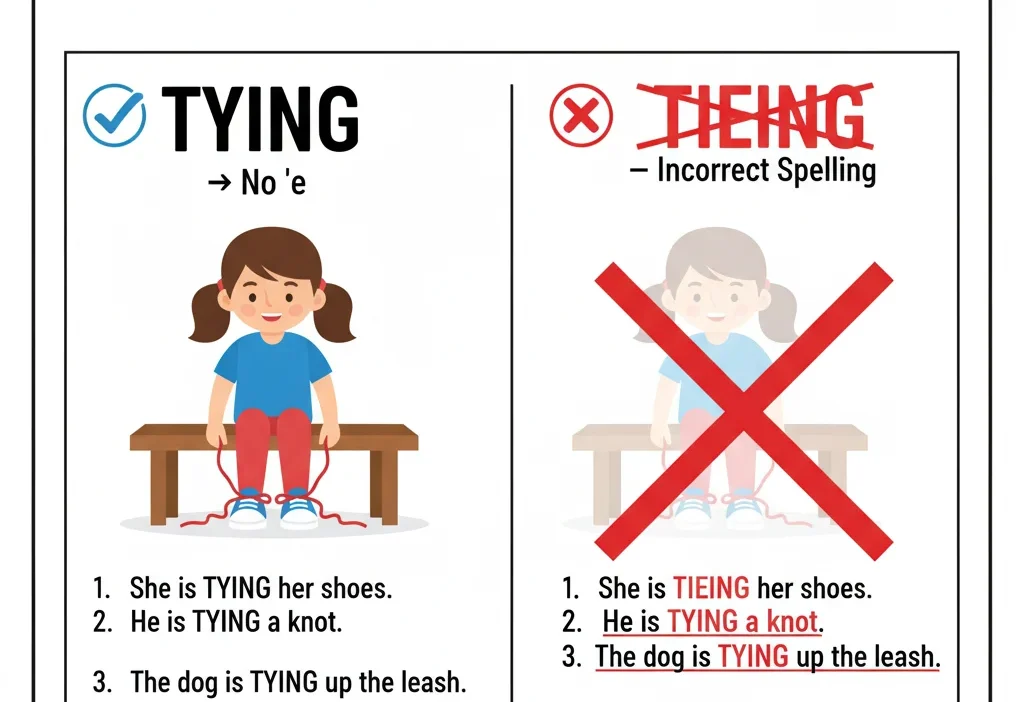
Tying is the present participle (the -ing form) of the verb “tie.”
It means to fasten, connect, or bind something using a string, rope, ribbon, or similar object.
✅ Examples:
- She is tying her shoelaces before running.
- Mom is tying the gift with a red ribbon.
- The fisherman is tying his boat to the dock.
💡 Tip:
When a verb ends in -ie, like tie, we change “ie” to “y” before adding -ing.
That’s why it becomes tying, not tieing.
⚠️ Tieing — The Incorrect (But Rarely Used) Form
Tieing looks like it makes sense — just “tie” + “ing” — but in modern English, it’s almost always incorrect.
However, tieing was used historically or in specific sports terms (like “tieing flies” in fishing), though even there, tying is now preferred.
✅ Example (rare/special use):
- Some old fishing manuals mention “tieing the fly”, but modern ones use “tying.”
So, while tieing isn’t technically nonsense, “tying” is the correct spelling in 99.9% of cases today.
📊 The Key Difference Between Tying and Tieing
| Feature | Tying | Tieing |
|---|---|---|
| Correctness | ✅ Correct (modern English) | ❌ Incorrect (outdated spelling) |
| Meaning | Fastening or connecting | Outdated form of “tying” |
| Usage | Everyday English | Historical or rare (fishing context) |
| Example Sentence | She is tying her hair. | (Old use) He was tieing flies for fishing. |
💡 Quick Tip to Remember:
If it ends in -ie, change ie → y before adding -ing.
Example: die → dying, lie → lying, tie → tying.
❌ Common Mistakes and How to Avoid Them
❗ Mistake 1:
❌ She is tieing her shoes.
✅ Correct: She is tying her shoes.
Why it happens:
Because people think you just add -ing to any word. But when a word ends in -ie, it changes to -y.
❗ Mistake 2:
❌ I am tieing my hair before going out.
✅ Correct: I am tying my hair before going out.
Why:
Same rule — change ie → y before -ing.
🧩 Quick Grammar Rule:
For verbs ending in -ie, replace “ie” with “y” before adding “-ing.”
✅ tie → tying
✅ die → dying
✅ lie → lying
🎯 When to Use Tying
Use tying when someone is fastening, connecting, or binding something.
It’s used in both literal and figurative ways.
✅ Examples:
- He is tying his necktie for the meeting.
- We are tying balloons for the party.
- The teacher is tying the project papers with a string.
- She is tying her hair back with a band.
- They are tying the boat to the dock.
💡 Memory Hack:
Imagine replacing tie with die → “dying.”
If you wouldn’t write dieing, don’t write tieing!
The correct one is tying.
🪶 When to Use Tieing
You’ll almost never need this spelling.
But just for knowledge:
- Tieing can occasionally appear in old books or fishing texts (e.g., tieing flies).
- Even then, modern grammar and dictionaries mark it as archaic.
✅ Examples (rare/historical):
- The old manual showed a man tieing fishing flies.
- In the 1800s, “tieing” sometimes appeared in printed materials.
🧠 Modern Rule: Always use tying — even in fishing or crafts!
🔁 Quick Recap: Tying vs Tieing
Let’s summarize everything clearly 👇
- Tying ✅ = correct form of tie + -ing
- Tieing ❌ = incorrect/outdated form
- Rule: Change -ie → -y before adding -ing
- Examples: tie → tying, die → dying, lie → lying
- Usage: Use tying in all modern writing and speech.
📘 Advanced Tips for Curious Learners
✴️ Origin:
The word “tie” comes from Old English tīgan, meaning to fasten or bind.
Over time, English spelling rules evolved — that’s why tying became the accepted form.
✴️ Formal Writing:
In essays, reports, or exams, always use tying.
Using tieing may be marked as a spelling mistake.
✴️ Texting & Informal Use:
Sometimes people type tieing online because it “looks right.”
But even in casual writing, tying is the only correct and accepted spelling.
🧩 Mini Quiz: Test Your Understanding!
Fill in the blanks with the correct form (tying or tieing):
- She is _______ her shoes.
- The boy is _______ a ribbon on the box.
- They are _______ their boat to the dock.
- The old book mentioned _______ fishing flies.
- I am _______ my hair back before class.
(Answers: 1. tying, 2. tying, 3. tying, 4. tieing (rare), 5. tying)
❓ Frequently Asked Questions (FAQs)
1. Which is correct: tying or tieing?
✅ Tying is the correct modern spelling. Tieing is outdated and rarely used.
2. Why do we write tying, not tieing?
Because verbs ending in -ie change to -y before adding -ing.
3. Is tieing still used anywhere?
Only rarely, in old books or fishing manuals. Modern English uses tying.
4. Can I use tieing in essays or exams?
No. It will be marked as a spelling error. Use tying.
5. What are other examples like tie → tying?
✅ die → dying
✅ lie → lying
✅ untie → untying
✨ Conclusion
Now you know the difference between tying and tieing — and you’ll never get them mixed up again!
Remember:
“If it ends in -ie, change ie → y before adding -ing.”
So next time you’re tying your shoes or hair, you’ll also be tying up loose ends in your English grammar skills!
Keep practicing — every word you learn makes your English stronger and clearer. 🌟

Francis Sufford crafts thoughtful, insightful explanations on language, meaning, and usage, blending clarity with storytelling to guide readers effectively.